
مقدمة
As demand for reliable electricity and renewable energy continues to grow, integrated energy storage systems are becoming an important solution for residential solar installations and selected small commercial applications. By combining battery storage and inverter technology in one unit, an all-in-one energy storage system can simplify system integration and help users manage solar energy more efficiently.
ال EH-63 نظام تخزين الطاقة الشامل بقدرة 12 كيلو وات و16 كيلو وات في الساعة is designed for applications that require high-power AC output, integrated battery storage, and solar charging capability. Featuring a 51.2V LiFePO4 battery system, a 12kW inverter, dual MPPT solar input, and WiFi monitoring with optional 4G connectivity, the EH-63 brings key energy management functions together in one cabinet.
For solar installers, energy storage distributors, importers, and project developers, the EH-63 offers an integrated platform to evaluate for compatible solar storage and backup power projects.
1. What Is the EH-63 All-in-One Energy Storage System?
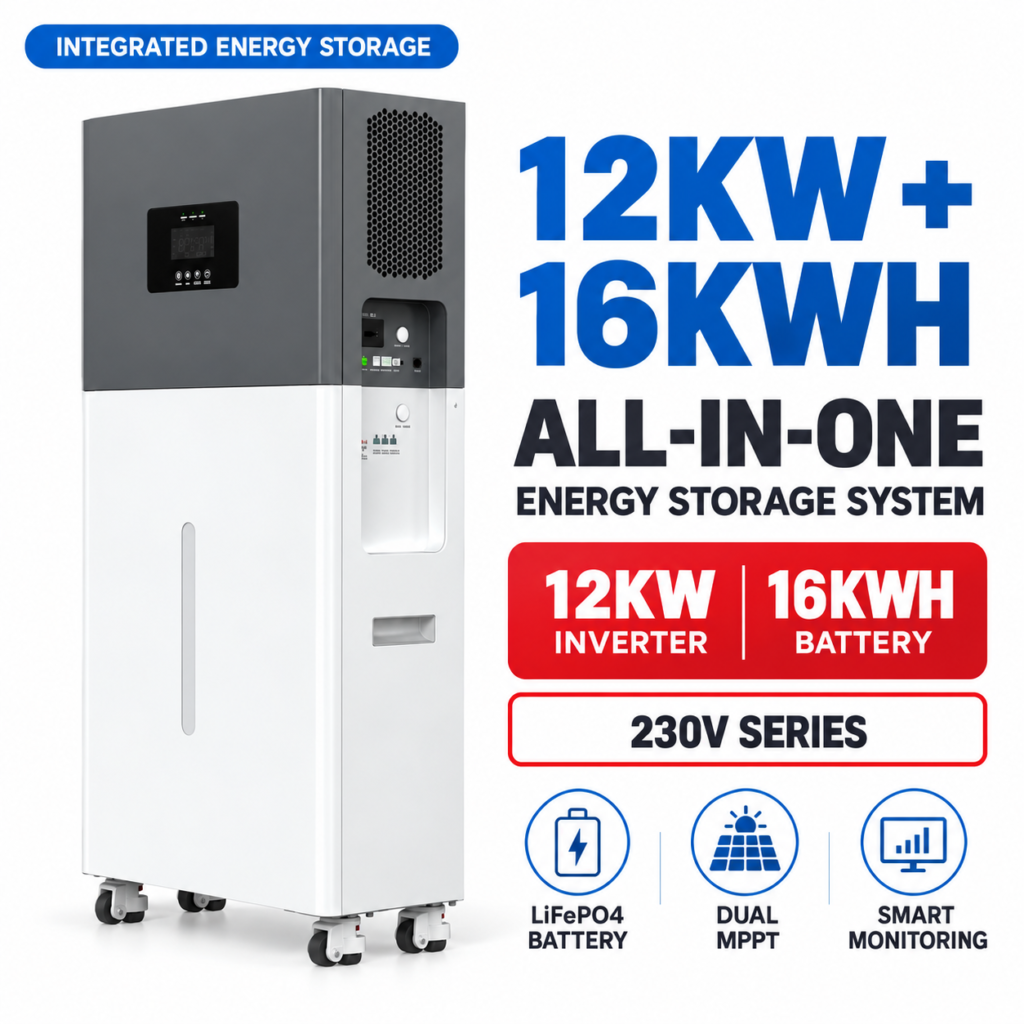
The EH-63 is an integrated energy storage solution that combines a battery, inverter, and battery management system in a single floor-standing cabinet.
Instead of sourcing a separate inverter and battery cabinet, buyers can evaluate an integrated system designed around a coordinated power and storage configuration. This can simplify equipment selection and help reduce the complexity of integrating separate components.
The EH-63 combines a nominal 12kW AC output rating with approximately 16kWh of battery energy storage. Its 230V AC output configuration is intended for compatible single-phase applications, subject to the final product configuration and local electrical requirements.
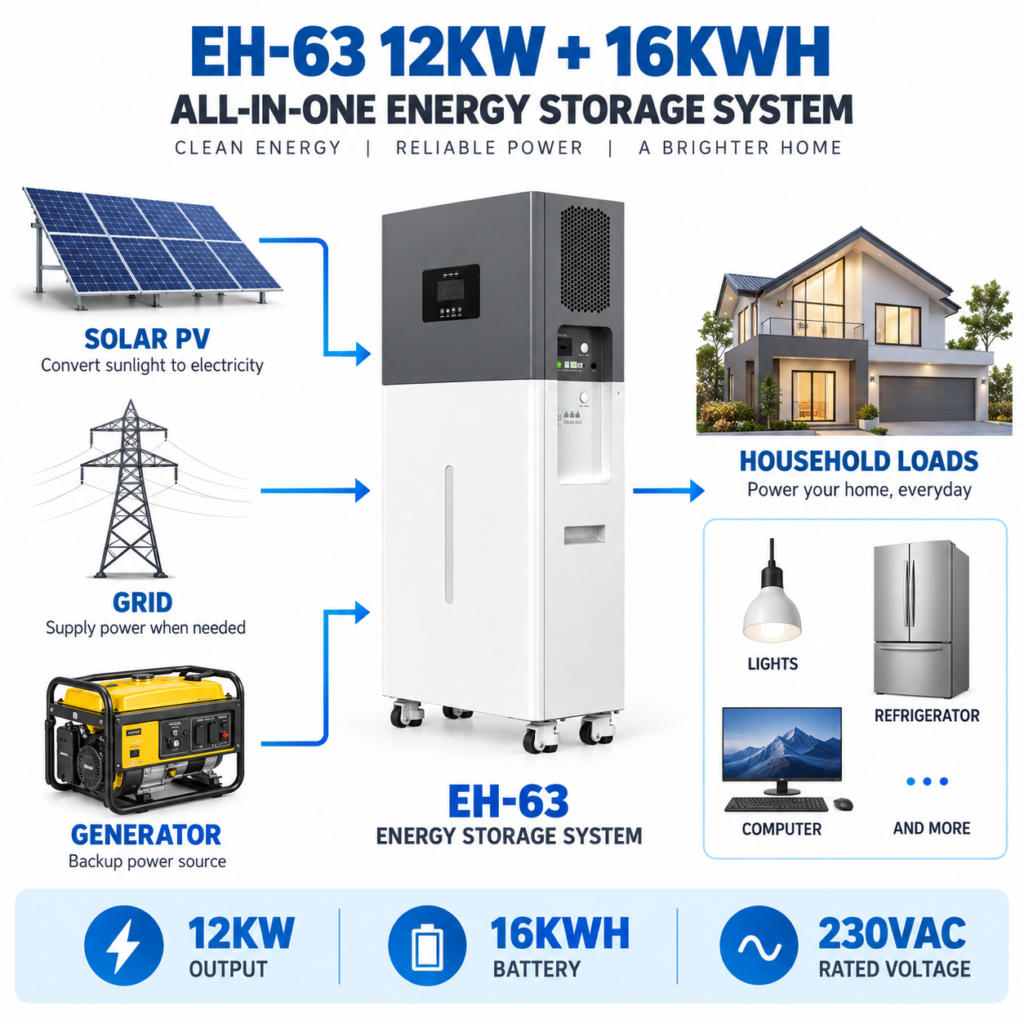
The system is designed to support solar energy charging, battery storage, AC power conversion, and system monitoring. Its dual MPPT design allows the solar input configuration to be planned around the characteristics of the installed photovoltaic array.
Key product features include:
- 12kW rated inverter output
- Approximately 16kWh battery energy storage
- 51.2V LiFePO4 battery configuration
- 230V AC output configuration
- Dual MPPT solar charging
- Maximum PV open-circuit voltage of 500VDC
- MPPT operating voltage range of 90–450VDC
- Pure sine wave AC output
- USB and RS485 communication
- WiFi monitoring with optional 4G connectivity
- IP21 enclosure protection rating
Final PV input power and charging-current ratings should be confirmed against the latest technical datasheet for the ordered configuration.
2. 12kW Output and 16kWh Storage Capacity
One of the main considerations when selecting an energy storage system is the relationship between inverter power and battery capacity.
The inverter’s rated power determines how much power the system can deliver to compatible loads at a given time. Battery capacity determines how much energy can be stored and made available over a period of time.
The EH-63 combines a 12kW inverter with approximately 16kWh of battery energy, providing a high-power integrated configuration for appropriately designed solar storage and backup applications.
على سبيل المثال, a group of compatible loads drawing a combined 3kW may theoretically consume 12kWh over four hours. Actual operating time will depend on usable battery energy, كفاءة التحويل, load fluctuations, ظروف التشغيل, and the system’s permitted battery discharge range.
When planning a project, buyers should consider both continuous power demand and the total energy required during the intended operating period.
The 12kW output rating should not be interpreted as a guarantee that every appliance can operate simultaneously. Motor startup current, surge power, power factor, and the inverter’s overload limits must also be evaluated.
3. Integrated LiFePO4 Battery Technology
The EH-63 uses a 51.2V LiFePO4 battery configuration with a rated energy capacity of approximately 16.076kWh.
Lithium iron phosphate is widely used in stationary energy storage because of its operating characteristics and suitability for repeated charging and discharging when used within the manufacturer’s specified limits.
The battery management system helps monitor and manage battery operation, including relevant electrical and thermal conditions. Actual protective functions and operating limits depend on the final product configuration.
When evaluating a battery storage product, buyers should review more than nominal capacity. Important considerations include:
- Rated and usable energy
- Permitted depth of discharge
- Maximum continuous charge and discharge current
- Battery operating voltage range
- Charging and discharging temperature limits
- Cycle-life test conditions
- Warranty terms
- Communication compatibility with the inverter
These factors influence how a battery performs in a real installation and help buyers compare different energy storage solutions more accurately.
4. Dual MPPT Solar Charging for PV Integration
Solar compatibility is an important consideration when choosing a hybrid energy storage system.
The EH-63 features dual MPPT solar charging. Maximum power point tracking helps the inverter adjust its solar operating point to capture available photovoltaic power under changing sunlight conditions.
The published configuration includes a maximum PV open-circuit voltage of 500VDC and an MPPT operating voltage range of 90–450VDC.
When designing a solar array, installers should check the number of PV strings, module electrical characteristics, expected cold-weather open-circuit voltage, operating current, and the inverter’s maximum permitted PV input power.
The final PV string design must remain within the inverter’s voltage and current limits. The maximum PV input power and current ratings should be verified from the latest EH-63 datasheet before installation or project quotation.
A properly matched solar array can help the system make effective use of available solar generation while maintaining compatibility with the inverter.
5. Pure Sine Wave AC Output for Compatible Loads
The EH-63 is designed to provide pure sine wave AC output for compatible electrical equipment.
A pure sine wave output is commonly used in residential and commercial electrical applications because it resembles the waveform of conventional AC power. لكن, compatibility still depends on the connected equipment’s voltage, frequency, power consumption, startup requirements, and the inverter’s operating limits.
Before selecting the EH-63 for a project, installers should identify the loads that must operate simultaneously and calculate their combined power requirements.
For installations that require backup power, it is also important to confirm the system’s backup operating mode, transfer characteristics, wiring arrangement, and compatibility with local electrical codes.
Proper system planning helps ensure that the inverter and battery configuration matches the actual application rather than relying on the rated power figure alone.
6. Monitoring and Communication
Monitoring can help users and installers understand system status and review operating conditions.
The EH-63 configuration includes an LCD display and USB and RS485 communication interfaces. WiFi monitoring is available, with optional 4G connectivity depending on the ordered configuration.
These features can support system monitoring and communication with compatible devices or software. Buyers who require remote monitoring should confirm the supported application, بروتوكول الاتصال, connectivity hardware, and any additional service requirements before placing an order.
For distributors and installers, clear communication specifications are especially important when integrating the system into projects with defined monitoring or energy management requirements.
7. Applications of the EH-63 Energy Storage System
Residential Solar Energy Storage
For homes with compatible solar installations, the EH-63 can be evaluated as an integrated battery and inverter solution. Solar electricity can be used by compatible loads, while available surplus energy may be stored for later use, depending on system settings and operating conditions.
The appropriate configuration depends on household energy consumption, solar generation, the required backup loads, and local electrical standards.
Home Backup Power
Battery storage can help provide power to selected loads when grid electricity is unavailable, provided that the system supports the required backup operating mode and is installed accordingly.
For backup applications, buyers should identify critical loads such as lighting, refrigeration, communications equipment, and other essential appliances. The required operating time and total load demand should then be used to assess whether the battery capacity is suitable.
Backup functionality, transfer time, and supported wiring arrangements should be confirmed for the exact EH-63 configuration.
Small Commercial Applications
Small businesses and commercial premises may use solar energy storage to improve the utilization of on-site solar generation and manage electricity consumption.
Potential applications include offices, shops, workshops, and other sites whose electrical loads are compatible with the system’s output specifications.
للمشاريع التجارية, an installer should evaluate the load profile, continuous power demand, peak loads, operating hours, local grid requirements, and potential future expansion needs before selecting a system.
Solar Installation and Distribution Projects
The EH-63 can also be evaluated by solar installers, الموزعين, importers, and project developers looking for an integrated storage product.
للمشترين B2B, product evaluation should include the complete technical datasheet, applicable compliance documentation, packaging information, lead time, warranty terms, after-sales support, and the availability of configuration-specific technical assistance.
A clear specification review helps ensure that the selected system matches the project and destination market.
8. Why Consider an All-in-One Energy Storage Design?
Traditional energy storage installations may use separate inverter and battery units. An all-in-one system integrates key components into a coordinated product configuration.
Potential advantages include:
Simplified Equipment Selection
An integrated product reduces the need to source and match a separate inverter and battery as independent purchases.
Coordinated System Design
The inverter and battery are supplied as part of a defined configuration, although the final installation must still follow the manufacturer’s instructions and compatibility requirements.
Space-Conscious Equipment Layout
Combining key components in one cabinet can simplify equipment layout compared with installations using multiple separate cabinets. The actual footprint and installation clearances must be checked against the product dimensions and installation manual.
Streamlined Project Planning
A single product configuration can make it easier for installers and distributors to review core power and battery specifications during initial project planning.
The suitability of an all-in-one system depends on the installation, service requirements, component accessibility, and whether the selected configuration supports future expansion.
9. What Should Buyers Check Before Ordering the EH-63?
Selecting an energy storage system for a real project requires careful technical review. Before ordering the EH-63, buyers should confirm the following details.
Electrical Compatibility
Confirm the required AC voltage, frequency, طاقة الإخراج, phase configuration, and connection requirements for the destination market.
PV Array Design
Check the maximum PV input power, maximum open-circuit voltage, MPPT voltage range, input current, and supported PV string configuration.
Battery Requirements
Review usable energy, permitted discharge depth, charge and discharge current limits, temperature range, and cycle-life test conditions.
Backup Requirements
Confirm whether the intended application requires backup output, automatic transfer, off-grid operation, or specific critical-load circuits.
Installation Environment
The published enclosure rating is IP21. Installation must follow the product manual and account for temperature, humidity, ventilation, dust, water exposure, and applicable electrical requirements.
Monitoring and Communication
Confirm whether standard WiFi monitoring is sufficient or whether optional 4G connectivity or a particular communication interface is required.
Documentation and Support
Request the latest datasheet, installation manual, applicable certification documents, warranty policy, packaging details, and delivery information for the exact configuration being purchased.
A complete technical review helps avoid mismatches between product specifications and project requirements.
10. EH-63 Product Overview
The EH-63 combines a 12kW inverter with approximately 16kWh of battery storage in an i