
Lithium battery technology continues to evolve as industrial equipment manufacturers, battery pack developers and energy system integrators look for reliable power solutions. Among the available battery chemistries, lithium titanate (LTO) stands out for its high-rate charge and discharge capability, low internal impedance and suitability for applications involving frequent cycling.
A 40Ah, 2.3V lithium titanate battery cell is one option for engineers and B2B buyers evaluating high-power battery systems. Understanding its technical characteristics, potential applications and integration requirements can help businesses determine whether this battery chemistry fits their projects.
1. What Is a Lithium Titanate Battery Cell?
A lithium titanate battery is a rechargeable lithium-ion battery that uses lithium titanate as the negative electrode material. Compared with conventional lithium-ion chemistries, LTO technology has distinct electrochemical characteristics that make it attractive for applications requiring high current capability and repeated charge-discharge operation.
The 40Ah lithium titanate cell discussed in this article has a nominal voltage of 2.3V and a cylindrical metal housing. It is designed for integration into an engineered battery system rather than direct connection to general-purpose electrical equipment.
For battery manufacturers and system integrators, the choice of LTO chemistry should be based on current requirements, voltage architecture, température de fonctionnement, cycle profile, system cost and the intended service environment.
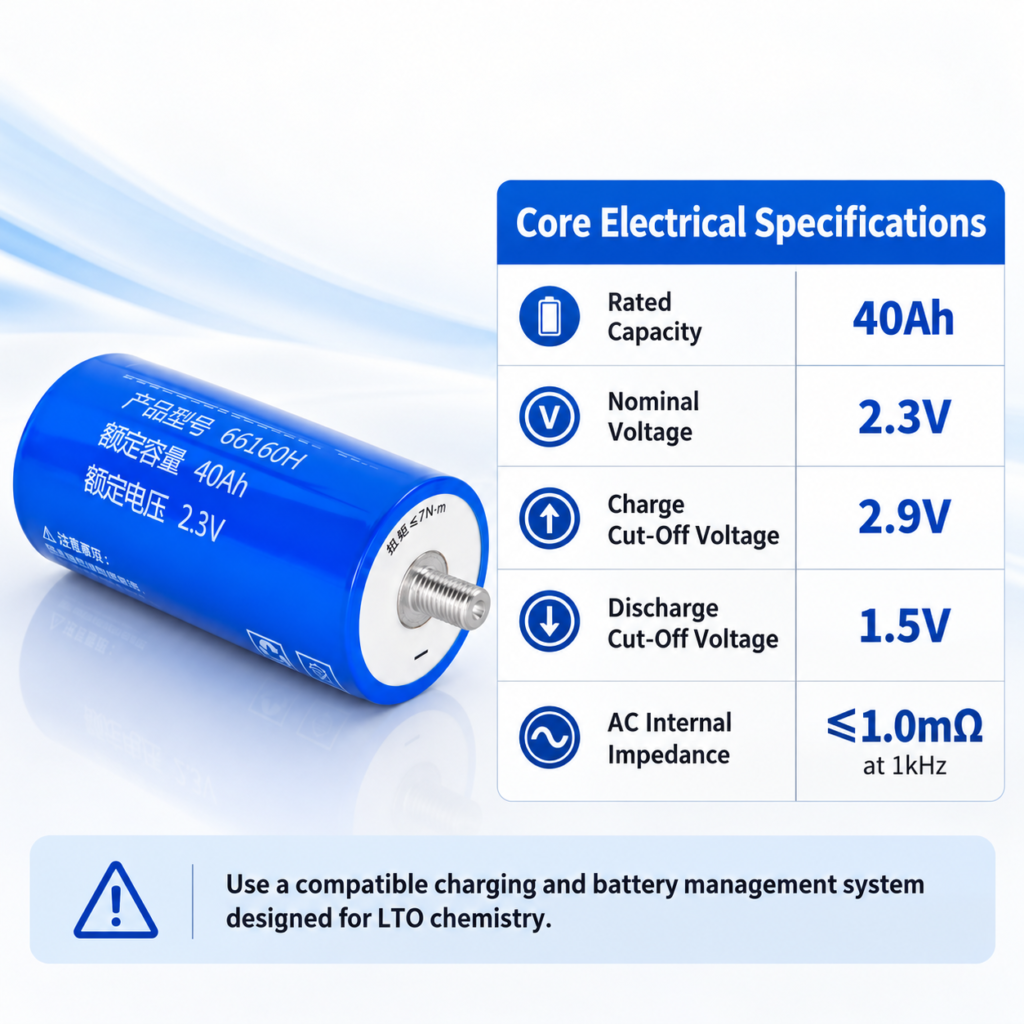
2. Key Specifications of a 40Ah LTO Battery Cell
When evaluating a battery cell for industrial use, buyers should review its electrical ratings, physical dimensions and specified operating conditions.
| Paramètre | Spécification |
|---|---|
| Chimie des batteries | Lithium Titanate (LTO) |
| Capacité nominale | 40Ah |
| Tension nominale | 2.3V |
| Standard Charge Cut-off Voltage | 2.9V |
| Standard Discharge Cut-off Voltage | 1.5V |
| AC Internal Impedance | ≤1.0mΩ at 1kHz under specified conditions |
| Courant de charge continu maximum | 240A at 25°C ±5°C |
| Courant de décharge continu maximum | 240A at 25°C ±5°C |
| Maximum Pulse Current | 400A for 10 seconds at 25°C ±5°C |
| Specified Operating Temperature Range | -40°C to +65°C |
| Diamètre | 66.0 ±1.0mm |
| Hauteur | 161.0 ±1.0mm |
| Poids | 1230 ±10g |
These figures describe the individual cell. The performance of a complete battery pack will also depend on the series-parallel configuration, interconnections, cooling design, battery management system and application-specific operating limits.
3. High-Rate Charging and Discharging Capability
One of the main reasons engineers consider lithium titanate technology is its potential for high-current operation.
The specified 40Ah cell supports continuous charging and discharging currents of up to 240A at 25°C ±5°C. It also specifies a pulse charge or discharge current of 400A for 10 seconds under the same temperature conditions.
High-current capability may be valuable in equipment that experiences changing loads, short periods of elevated power demand or frequent charging and discharging.
Cependant, maximum current ratings should not be treated as universal operating recommendations. Engineers need to evaluate cell temperature, duty cycle, connection resistance, thermal management and the manufacturer’s operating instructions before setting the current limits of a battery pack.
4. Low Internal Impedance and Electrical Performance
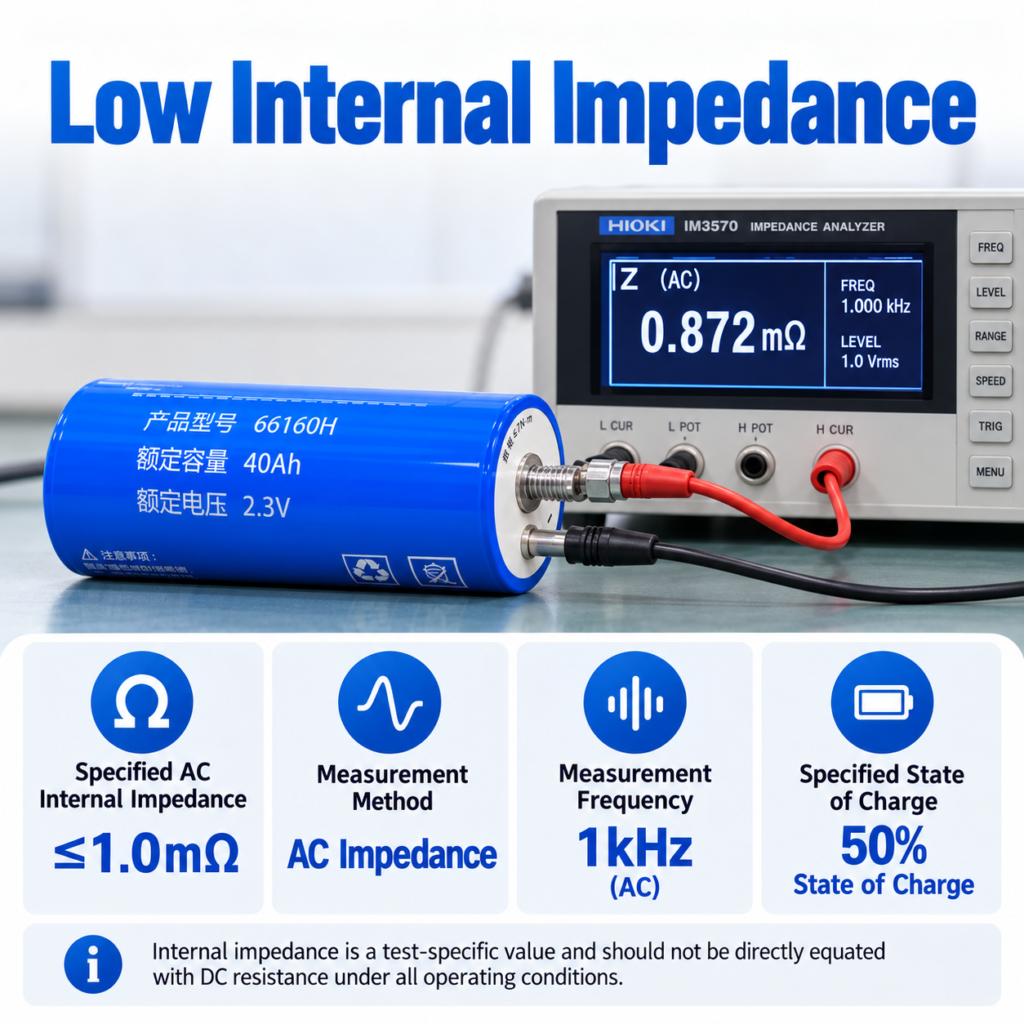
The cell’s specified AC internal impedance is no more than 1.0mΩ, measured at 1kHz under the stated test conditions.
Internal impedance is an important consideration in battery design because resistance contributes to voltage drop and heat generation during current flow. A lower impedance can help reduce resistive losses, although actual system performance also depends on busbars, terminals, wiring, contact resistance and the characteristics of the complete battery pack.
Pour les fabricants de batteries, impedance data can support cell evaluation, connection design and thermal analysis. Cells should be evaluated using consistent measurement conditions when comparing suppliers or production batches.
5. Operating Temperature and Thermal Management
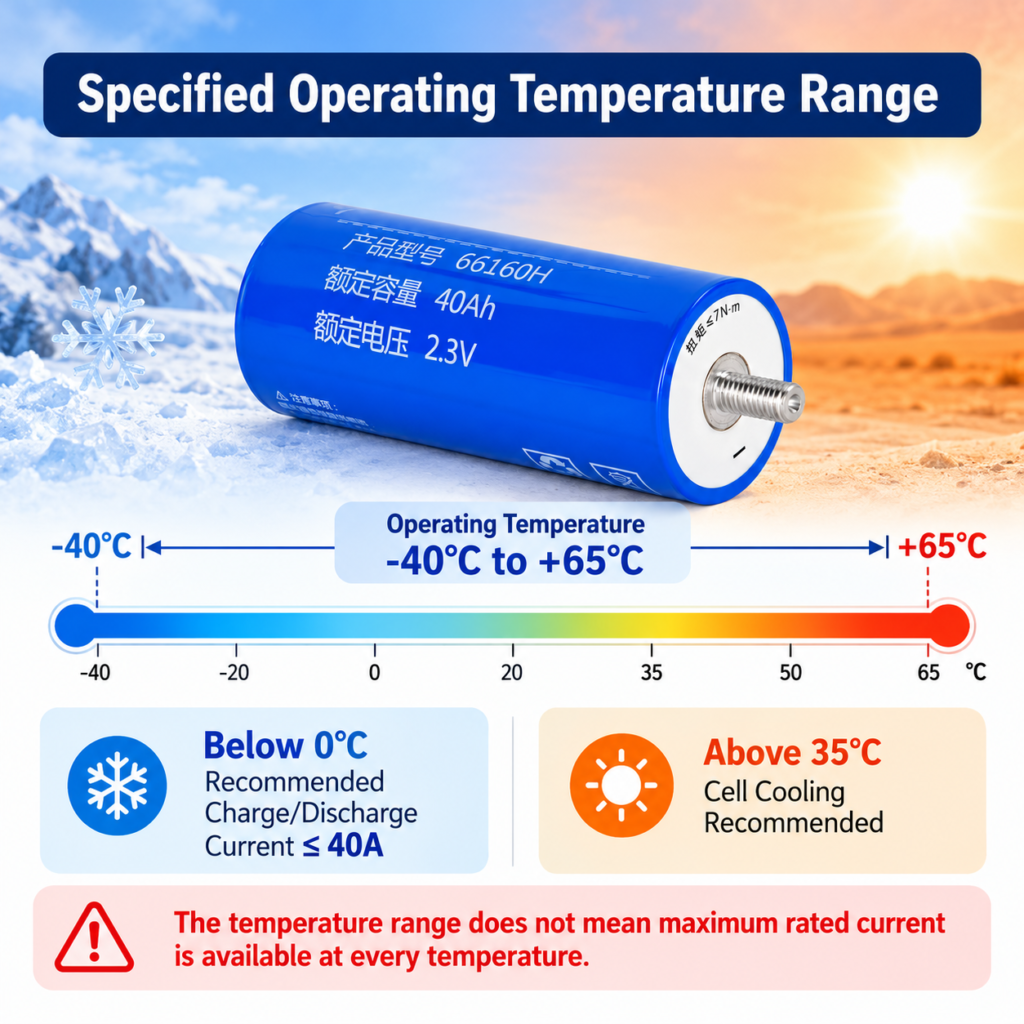
The specified operating temperature range for this LTO cell is -40°C to +65°C. This broad range may make the cell worth evaluating for projects exposed to changing ambient conditions.
Temperature nevertheless affects battery operation. The product specification recommends limiting charging and discharging current to 40A or less when the cell temperature is below 0°C. It also recommends cooling when the cell temperature exceeds 35°C.
These recommendations are important when designing a battery system for industrial use. The specified temperature range does not mean that maximum continuous or pulse current is available throughout the entire range.
A suitable system design should include temperature monitoring, appropriate current limits, thermal management and protection against operation outside the manufacturer’s permitted conditions.
6. Cycle-Life Performance: Understand the Test Conditions
Cycle life is an important purchasing consideration for battery systems used frequently throughout the day.
The product specification lists a 16,000-cycle test criterion, with discharge capacity remaining at or above 80% of the initial capacity after testing under the specified method and conditions.
This figure should be understood as a defined test result criterion, not a guarantee that every battery pack will achieve the same cycle count in real-world operation.
Actual service life depends on factors such as depth of discharge, charge and discharge current, température, storage conditions, system controls and maintenance practices. Buyers should request the applicable test method and conditions when comparing cycle-life claims across different battery chemistries or suppliers.
7. Potential Applications of 40Ah LTO Cells
The high-current characteristics of LTO technology make it a candidate for several types of engineered battery systems.
Industrial Power Systems
Industrial equipment with fluctuating loads may require battery systems capable of delivering substantial current for defined periods. LTO cells can be evaluated for these applications after electrical and thermal requirements are verified.
Battery Pack Manufacturing
Battery pack manufacturers can assess the cell’s voltage, capacité, current ratings, physical dimensions and terminal configuration when developing custom battery assemblies. Pack-level protection, mechanical design and thermal management must be engineered for the intended application.
Equipment Requiring Frequent Cycling
Systems that undergo repeated charge-discharge cycles may benefit from evaluating LTO technology. Suitability depends on the actual duty cycle, test conditions, required service life and overall project economics.
Engineering Development and Specialized Power Projects
Research teams, equipment developers and system integrators may consider LTO cells when evaluating high-rate power architectures. Prototype testing and application-specific validation are necessary before commercial deployment.
These are potential application areas rather than blanket compatibility claims. Each project should be reviewed against the cell manufacturer’s specifications and the relevant system safety requirements.
8. What Should B2B Buyers Check Before Purchasing?
Avant de passer une commande groupée, battery distributors, pack manufacturers and industrial buyers should review several technical and commercial factors.
- Electrical requirements: Confirm the required voltage, capacité, continuous current, pulse current and cut-off voltages.
- System configuration: Calculate the required series and parallel cell arrangement based on the application.
- Thermal design: Verify current limits at the expected operating temperatures and provide suitable cooling where necessary.
- Battery management and protection: Confirm the appropriate monitoring, protection and charging strategy for the selected LTO chemistry.
- Mechanical integration: Check cell dimensions, terminal design, mounting method and electrical connections.
- Testing and documentation: Request the relevant technical specification and available test documentation for the intended application.
- Commercial requirements: Confirm order quantity, delivery arrangements, sample availability and any customization requirements directly with the supplier.
A structured technical review can help reduce integration risks and ensure that the selected cell matches the intended use.
9. Why Work with YIFANG for Battery Sourcing?
Shenzhen Yi Fang Technology Co., Ltée. is a battery and energy storage solutions provider based in Shenzhen, Guangdong, Chine, with 18 years of industry experience.
Our product portfolio includes rechargeable lithium battery cells, LiFePO4 batteries, lithium battery products and energy storage systems for international B2B customers.
We welcome inquiries from battery importers, distributeurs, battery pack manufacturers, industrial equipment developers and system integrators. By understanding the target application, electrical specifications, estimated order quantity and project stage, we can discuss product suitability and sourcing requirements more effectively.
For specialized battery projects, technical compatibility and application-specific validation remain essential. Buyers should confirm the relevant specifications and commercial terms before finalizing a purchase.
10. Foire aux questions
What is the nominal voltage of a 40Ah LTO battery cell?
The nominal voltage is 2.3V per cell. A higher-voltage battery pack requires an appropriate series configuration.
What is the maximum continuous current?
The specified maximum continuous charge and discharge current is 240A at 25°C ±5°C. Actual operating limits should follow the manufacturer’s instructions and the battery system’s thermal design.
Can the cell deliver 400A?
The specification lists a maximum pulse charge/discharge current of 400A for 10 seconds at 25°C ±5°C. This is a defined pulse rating, not a continuous current rating.
What is the operating temperature range?
The specified range is -40°C to +65°C. Current derating and cooling guidance must also be considered.
Is the cell suitable for custom battery packs?
It can be evaluated for battery pack integration. The final design must verify voltage, actuel, performances thermiques, protection, mechanical compatibility and application-specific safety requirements.
Conclusion
A 40Ah, 2.3V lithium titanate battery cell offers a combination of high specified current capability, low AC internal impedance and a broad specified operating temperature range. These characteristics make it worth evaluating for industrial power systems, battery pack integration and other applications involving demanding electrical loads.
Pour les acheteurs B2B, the most important step is to compare the cell’s verified specifications with the actual operating profile of the target system. Reviewing current limits, conditions thermiques, cycle-life test criteria and integration requirements helps establish a more reliable basis for supplier selection.
Looking for a 40Ah lithium titanate battery cell for your project? Contact YIFANG with your application, target specifications and estimated quantity to discuss technical suitability and sourcing requirements.