
High-power equipment places different demands on a lithium-ion battery than ordinary portable electronics. When a device draws a large amount of current, the battery must deliver energy quickly while operating within its electrical and thermal limits. This is particularly important in cordless power tools, high-power portable equipment, and other applications where current demand can change significantly during operation.
Pour les concepteurs de batteries, choosing a suitable cell involves more than comparing capacity ratings. Capacité de décharge, résistance interne, génération de chaleur, and battery pack configuration all influence how a lithium-ion battery responds to demanding loads.
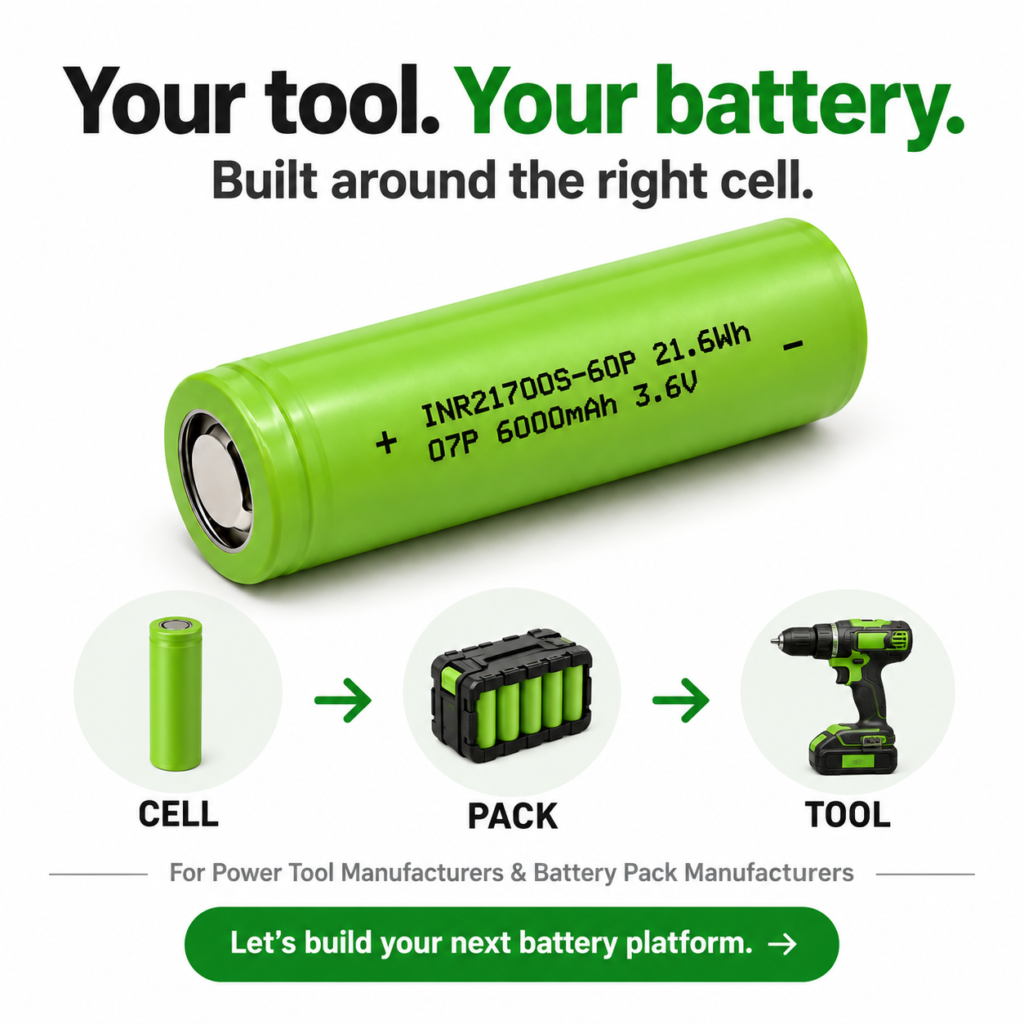
UN 21700 high drain battery is designed for applications that require substantial current output. Yifang 21700 lithium-ion cell, with a nominal voltage of 3.6V and a capacity of 6000mAh, offers a combination of high capacity and high discharge capability for battery system development.
1. Why Do High Current Loads Matter?
Current represents the rate at which electrical charge flows through a circuit. When a power tool starts, encounters resistance, or performs a demanding task, its motor may require a significant amount of current.
The battery must supply this current to maintain the equipment’s operation. Cependant, higher current also places greater electrical and thermal demands on the cell.
Several factors become particularly important:
- Voltage drop: The terminal voltage may decrease as current increases, partly due to the cell’s internal resistance.
- Génération de chaleur: Electrical resistance inside the cell produces heat during discharge.
- Power delivery: The cell must provide sufficient current for the equipment’s operating requirements.
- Operating limits: Discharge current and temperature must remain within the manufacturer’s specified limits.
These factors explain why a battery with a large capacity rating is not automatically suitable for every high-power application.

2. How Does High Current Affect Battery Temperature?
Heat generation is one of the main considerations when evaluating lithium-ion cells for high-current applications.
As current passes through the internal resistance of a battery, electrical energy is converted into heat. Under simplified conditions, resistive heat generation can be expressed as:
P = I²R
In this equation, P represents heat generation, I represents current, and R represents internal resistance.
The relationship is important because heat generation increases with the square of the current when resistance remains constant. Par exemple, doubling the current can result in four times the resistive heat generation under the same resistance conditions.
Actual cell temperature also depends on factors such as discharge duration, cooling conditions, construction de cellules, and the surrounding battery pack.
Pour les fabricants de batteries, thermal management should therefore be considered during the design stage. Espacement des cellules, structure de l'enceinte, heat dissipation, and operating conditions can all influence the thermal behavior of the finished battery system.
3. Why Should Continuous and Pulse Discharge Ratings Be Evaluated Separately?
Not all high-current demands last for the same amount of time. Some equipment requires relatively consistent current during operation, while other devices experience short periods of significantly higher demand.
This is why continuous discharge and pulse discharge ratings serve different purposes.
Continuous discharge current
A continuous discharge rating indicates the current a cell is specified to deliver over a sustained period under defined conditions. It is relevant when evaluating equipment that draws substantial current throughout its operation.
Pulse discharge current
Pulse discharge refers to a higher current delivered for a limited period. This can be relevant to equipment that experiences short bursts of power demand, such as during motor startup or temporary increases in mechanical load.
Yifang 21700 high-drain cell features a 60A discharge rating and a 110A pulse discharge rating for 10 secondes.
These figures should not be interpreted as interchangeable. The 60A rating and the 110A/10s pulse rating describe different discharge conditions. Battery designers should also confirm the manufacturer’s testing conditions, limites de température, and recovery requirements before using these values in a battery system.
4. Does Higher Capacity Automatically Mean Higher Power Output?
Capacity and discharge capability measure different aspects of battery performance.
Capacité, expressed in ampere-hours (Ah) or milliampere-hours (mAh), indicates how much electrical charge a battery can store. Discharge capability describes how much current the cell can deliver under specified operating conditions.
A 6000mAh lithium-ion cell provides a nominal capacity of 6Ah. Cependant, its suitability for a high-power application also depends on its discharge rating and other electrical characteristics.
Par exemple, a battery designed for long operating time may not necessarily meet the current requirements of a demanding power tool. Conversely, a high-drain cell must also provide sufficient capacity for the intended runtime. When evaluating a 6000mAh 21700 batterie, engineers should consider both requirements rather than treating capacity as the only selection criterion.

5. What Should Engineers Consider When Building High-Current Battery Packs?
Selecting an appropriate cell is only one part of battery pack development. The final system must also handle the electrical and thermal demands of the application.
Several design considerations deserve attention:
Cell configuration
Series connections increase the overall nominal voltage, while parallel connections increase the available capacity and current capability of the cell group. The final configuration should match the equipment’s voltage and load requirements.
Résistance interne
The resistance of individual cells and electrical connections affects voltage drop and heat generation. Cell matching and connection design are important when developing high-current battery packs.
Gestion thermique
The battery enclosure and cooling arrangement should account for heat generated during operation. Thermal conditions need to be evaluated under the intended discharge profile.
Protection and monitoring
Battery management systems can monitor relevant operating conditions and provide protection against specified electrical and thermal limits. Their configuration should be compatible with the selected cells and application requirements.
These considerations are especially relevant when designing battery packs for cordless power tools and other equipment with demanding current requirements.
6. Where Are High-Drain 21700 Lithium-Ion Cells Used?
High-drain cylindrical cells are considered for applications where both energy capacity and current delivery are important.
Typical application areas include:
- Outils électriques sans fil: Equipment that requires substantial current during motor operation and demanding work cycles.
- Équipement électrique portatif: Systems that need a rechargeable energy source with a balance of capacity and discharge capability.
- Robotique: Battery-powered platforms with changing electrical loads during movement and operation.
- E-mobility battery packs: Battery systems that require careful evaluation of current demand, configuration, et conditions thermiques.
- Customized battery solutions: OEM battery packs developed around specific voltage, capacité, and discharge requirements.
The final suitability of a cell depends on the equipment’s actual load profile, conditions environnementales, et conception du système de batterie.
7. Yifang 21700 High-Drain Lithium-Ion Battery Cell
For manufacturers developing high-current battery systems, Yifang offers a 21700 lithium-ion cell designed around both capacity and discharge capability.
Its main specifications include:
- Cell format: 21700 cylindrical
- Tension nominale: 3.6V
- Rated capacity: 6000mAh
- Discharge rating: 60UN
- Pulse discharge rating: 110Un pour 10 secondes
This specification combination provides battery designers with a cell option to evaluate for high-drain applications. Before integration, manufacturers should conduct sample testing under their intended load profiles and verify voltage behavior, augmentation de la température, and discharge performance.
Yifang supports the development of lithium-ion battery solutions for different application requirements, with cell selection and battery pack configuration evaluated according to the intended equipment.
Conclusion
When a lithium-ion battery faces high current loads, voltage drop, internal heat generation, and operating limits become increasingly important. Capacity alone cannot determine whether a cell is suitable for demanding equipment. Continuous discharge capability, pulse discharge ratings, gestion thermique, and battery pack configuration all need to be considered together.
For battery manufacturers and equipment developers, understanding these factors helps create more appropriate battery system designs. Yifang 21700 high-drain lithium-ion cell, featuring 6000mAh capacity, 60A discharge capability, and 110A pulse discharge for 10 secondes, offers a specification set worth evaluating for high-current battery applications.