


3.2V 100Ah LiFePO₄ Battery Cell for Energy Storage Applications
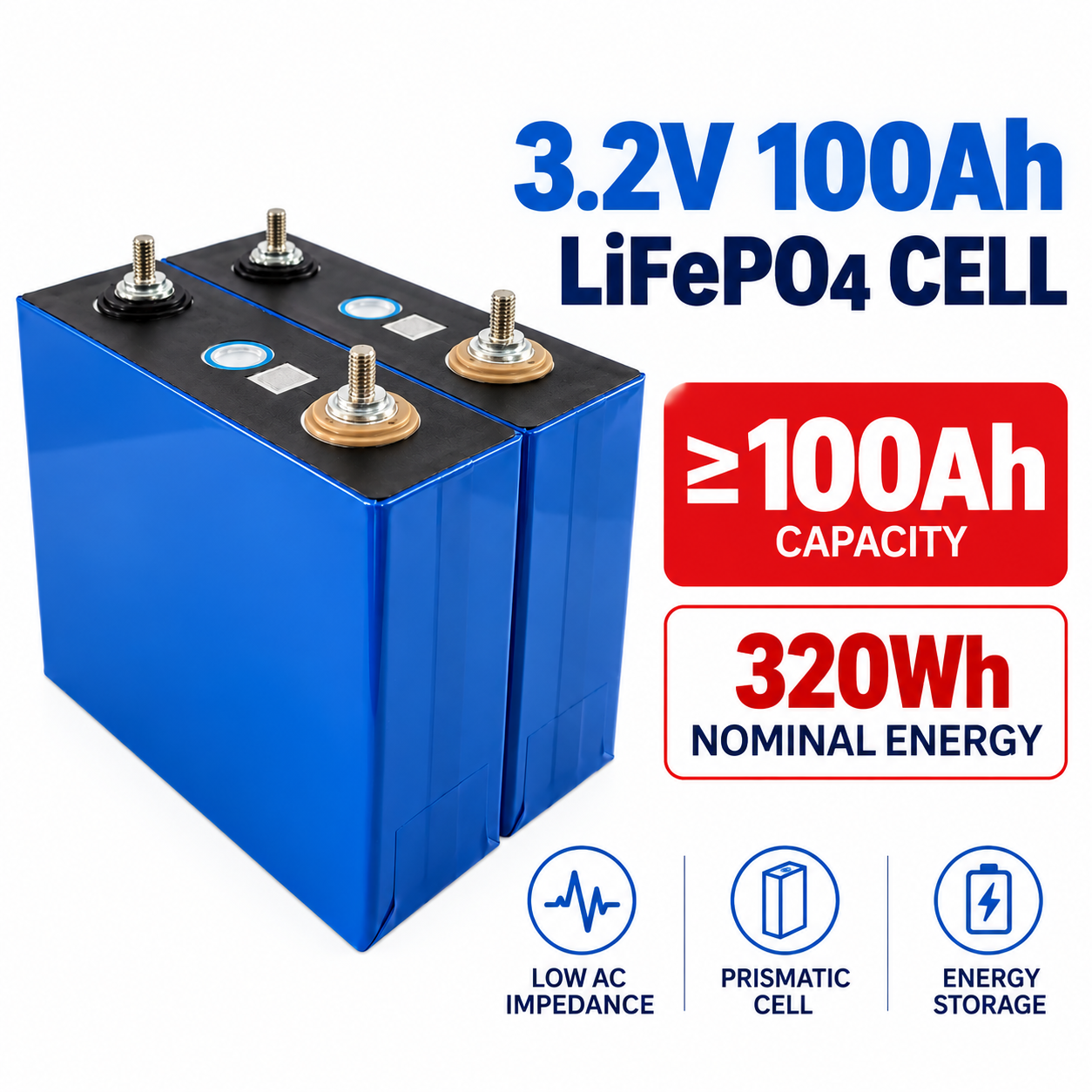
This 3.2V 100Ah lithium iron phosphate (LiFePO₄) battery cell is designed for evaluation in compatible energy storage systems, industrial battery projects and custom battery pack development. With a nominal capacity of at least 100Ah and nominal energy of at least 320Wh, it provides a defined electrical specification for engineers and B2B buyers planning lithium battery modules.
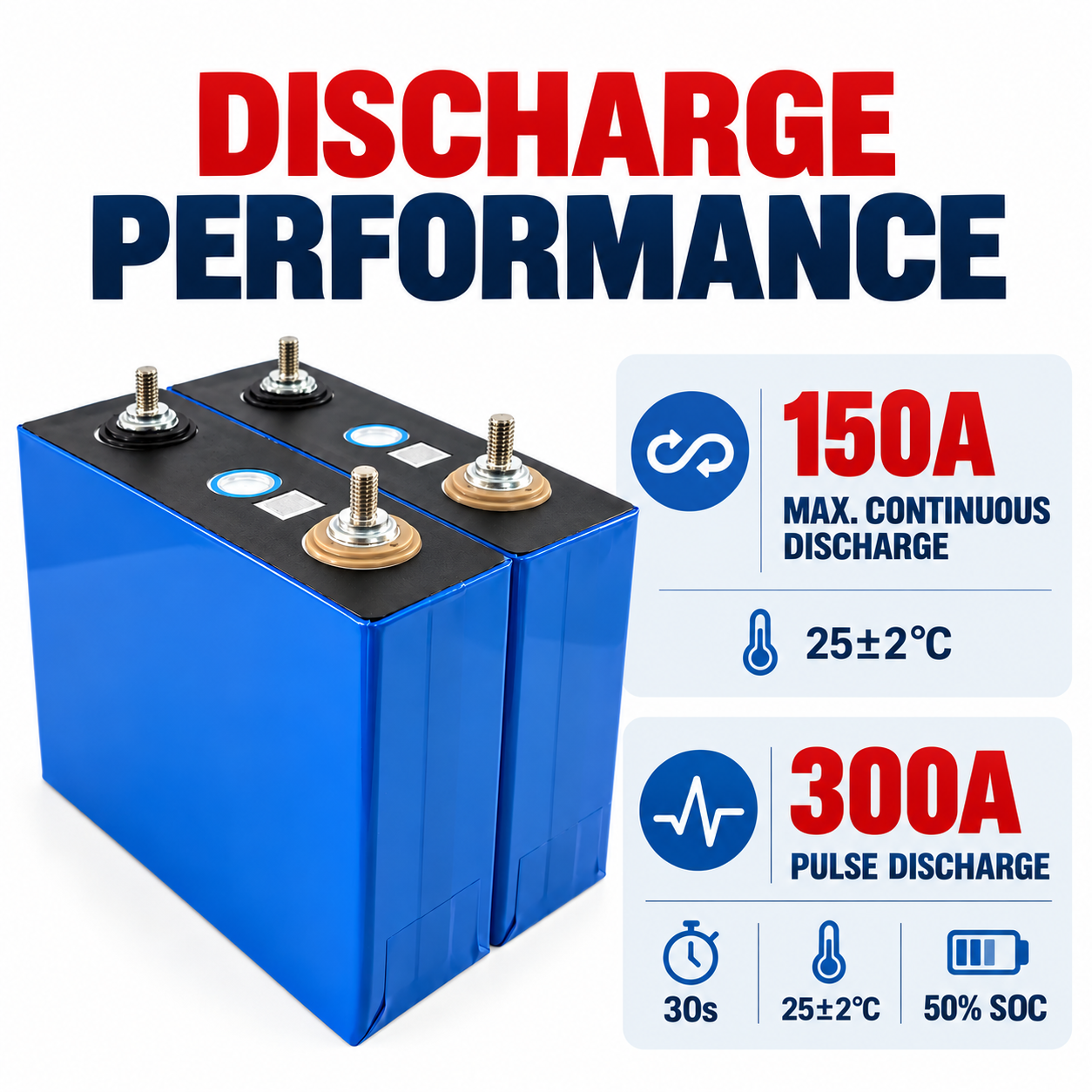
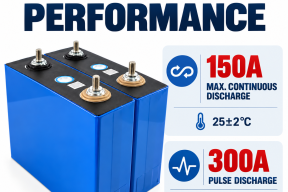
The cell specification lists AC impedance of no more than 0.40mΩ at 1kHz under the stated fresh-cell test condition. Maximum continuous discharge current is specified at 150A at 25±2°C, while a 300A pulse discharge is listed for 30 seconds under the specified temperature and state-of-charge conditions. These ratings provide useful reference points for system sizing, but final current limits must account for temperature, interconnections, BMS settings, cooling and the complete battery design.
Designed for Battery Pack Development
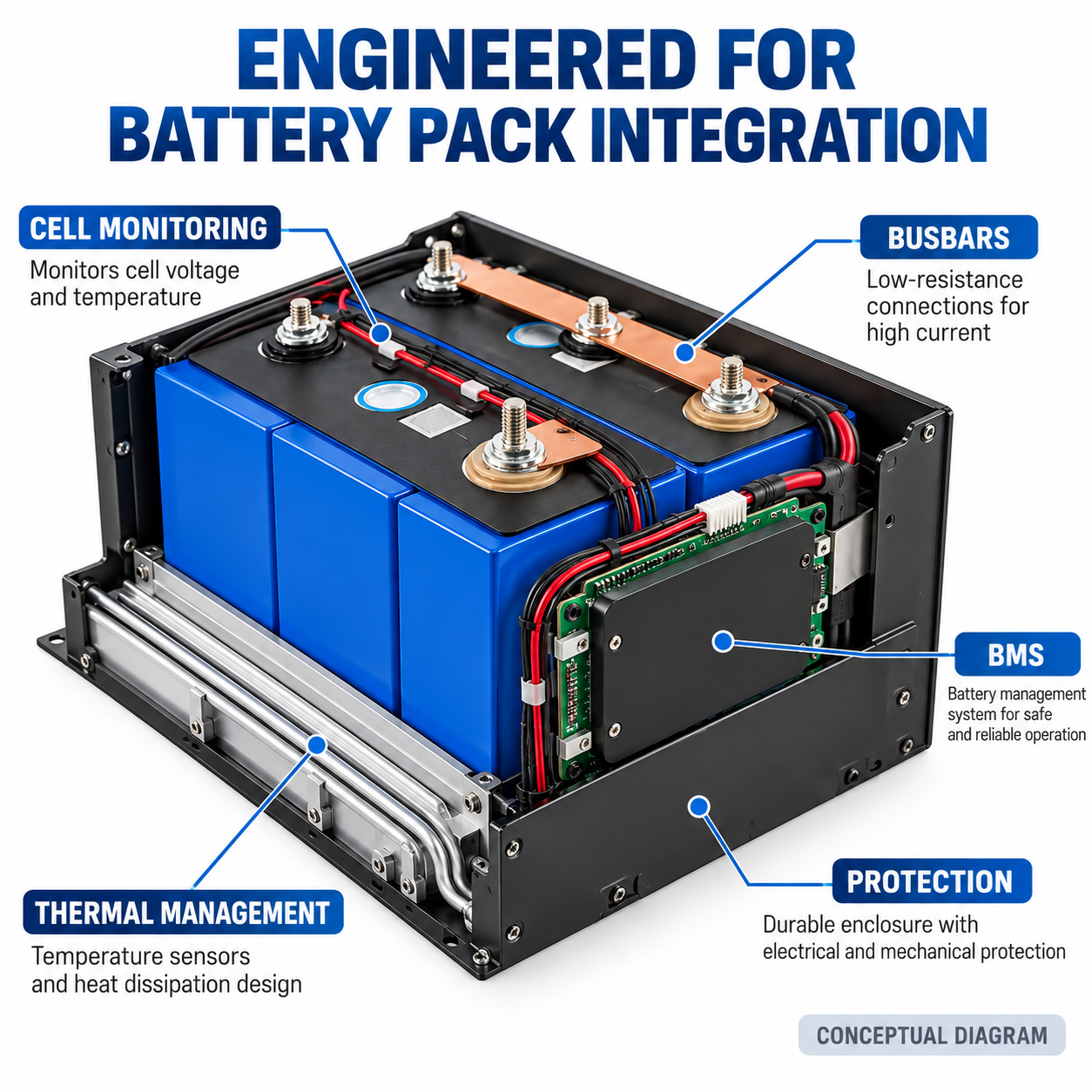
The prismatic aluminum-cased format can be evaluated for battery module integration. Before assembly, engineering teams should verify the official mechanical drawing, terminal arrangement, mounting and compression requirements, cell monitoring, busbar design and thermal management.
Documented Cycle-Life Test Conditions
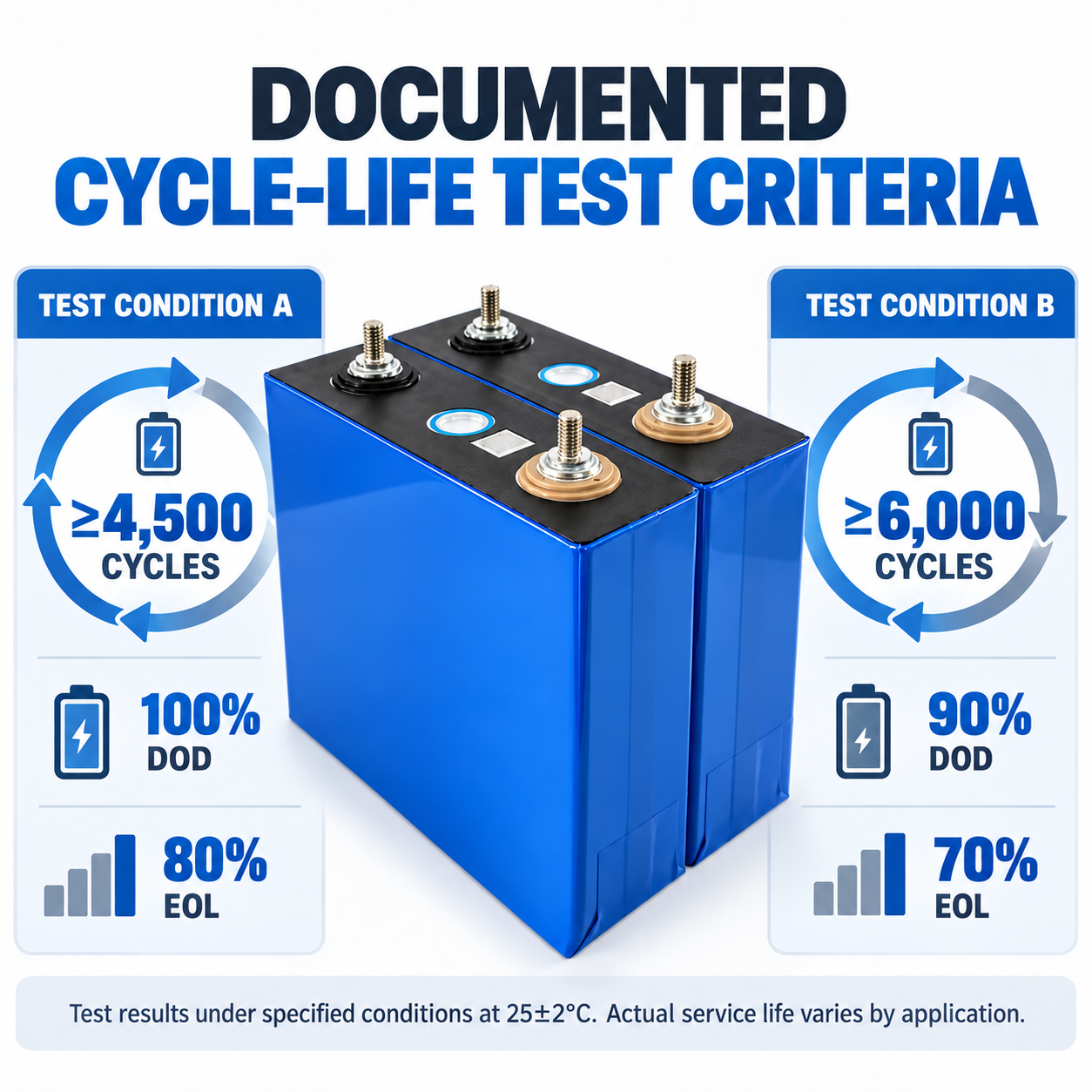
The specification lists at least 4,500 cycles at 100% depth of discharge (DOD) to an 80% end-of-life (EOL) capacity criterion, and at least 6,000 cycles at 90% DOD to a 70% EOL capacity criterion. These figures apply to the stated test procedures and conditions; they are not a guarantee of the cycle life of every finished battery pack.
Temperature and Operating Considerations
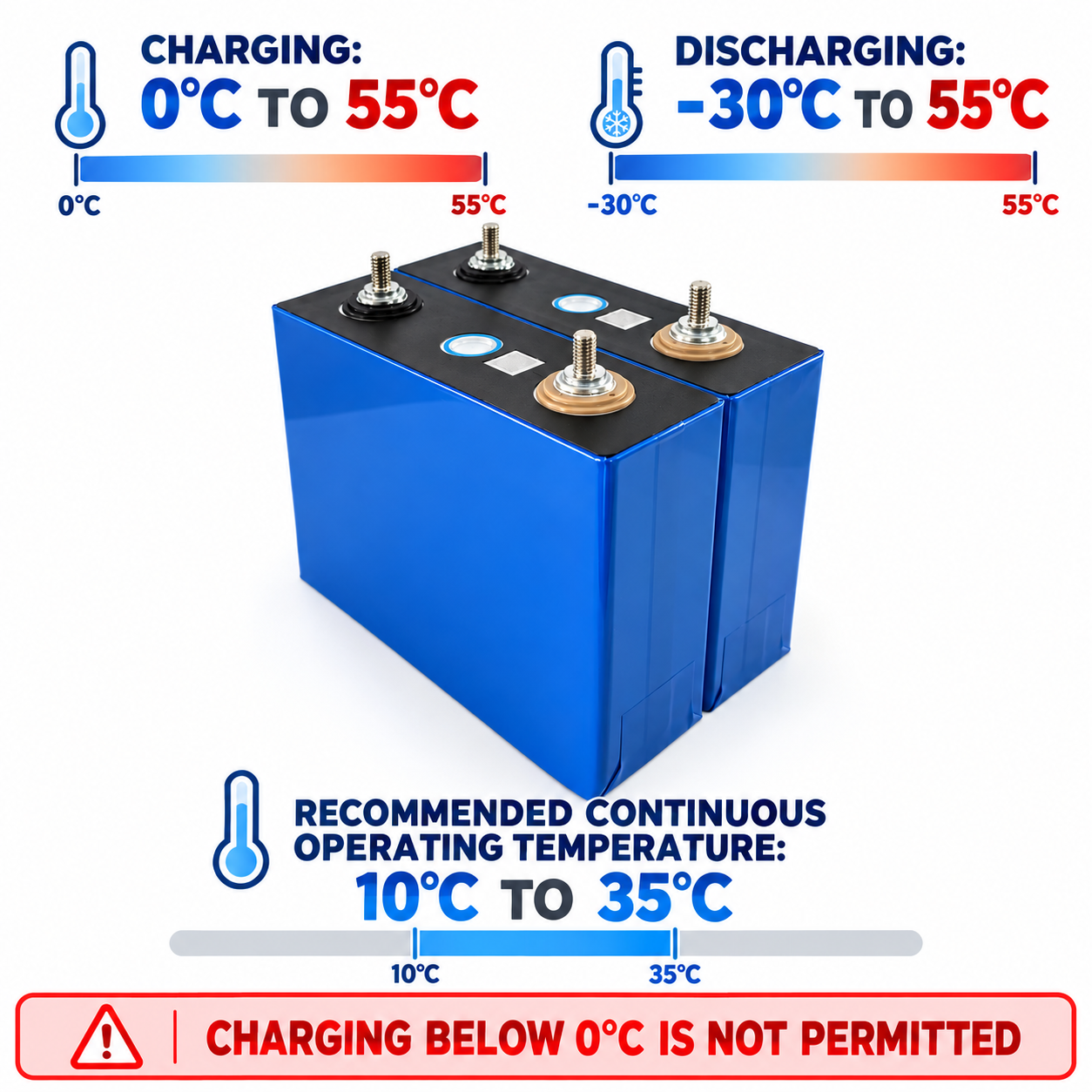
The specified charging temperature range is 0°C to 55°C, while the discharge range is -30°C to 55°C. The recommended continuous operating temperature range is 10°C to 35°C. Charging below 0°C is not permitted by the specification. Battery pack designers should implement appropriate temperature monitoring and charging controls for the intended environment.
For project evaluation, buyers should provide their application, required quantity, target battery voltage, current profile, project stage and destination market. This information helps determine whether the cell’s documented characteristics are suitable for the proposed system.
Technical Specifications
| Parameter | Specification |
|---|---|
| Product Type | LiFePO₄ Energy Storage Battery Cell |
| Cell Format | Prismatic aluminum-cased cell |
| Nominal Voltage | 3.2V |
| Nominal Capacity | ≥100Ah |
| Nominal Energy | ≥320Wh |
| Operating Voltage, T > 0°C | 2.5–3.65V |
| Operating Voltage, T ≤ 0°C | 2.0–3.65V, subject to specified operating conditions |
| AC Impedance | ≤0.40mΩ at 1kHz |
| Impedance Test Condition | Fresh cell, 20% SOC |
| Maximum Continuous Charging Current | Temperature-dependent; see charging limits below |
| Maximum Continuous Discharge Current | 150A at 25±2°C |
| Maximum Pulse Discharge Current | 300A for 30 seconds at 25±2°C, 50% SOC |
| Charging Temperature | 0–55°C |
| Discharging Temperature | -30–55°C |
| Recommended Continuous Operating Temperature | 10–35°C |
| Storage Temperature | -30–60°C |
| Recommended Storage Temperature | 10–35°C |
| Cell Weight | 2.0±0.1kg |
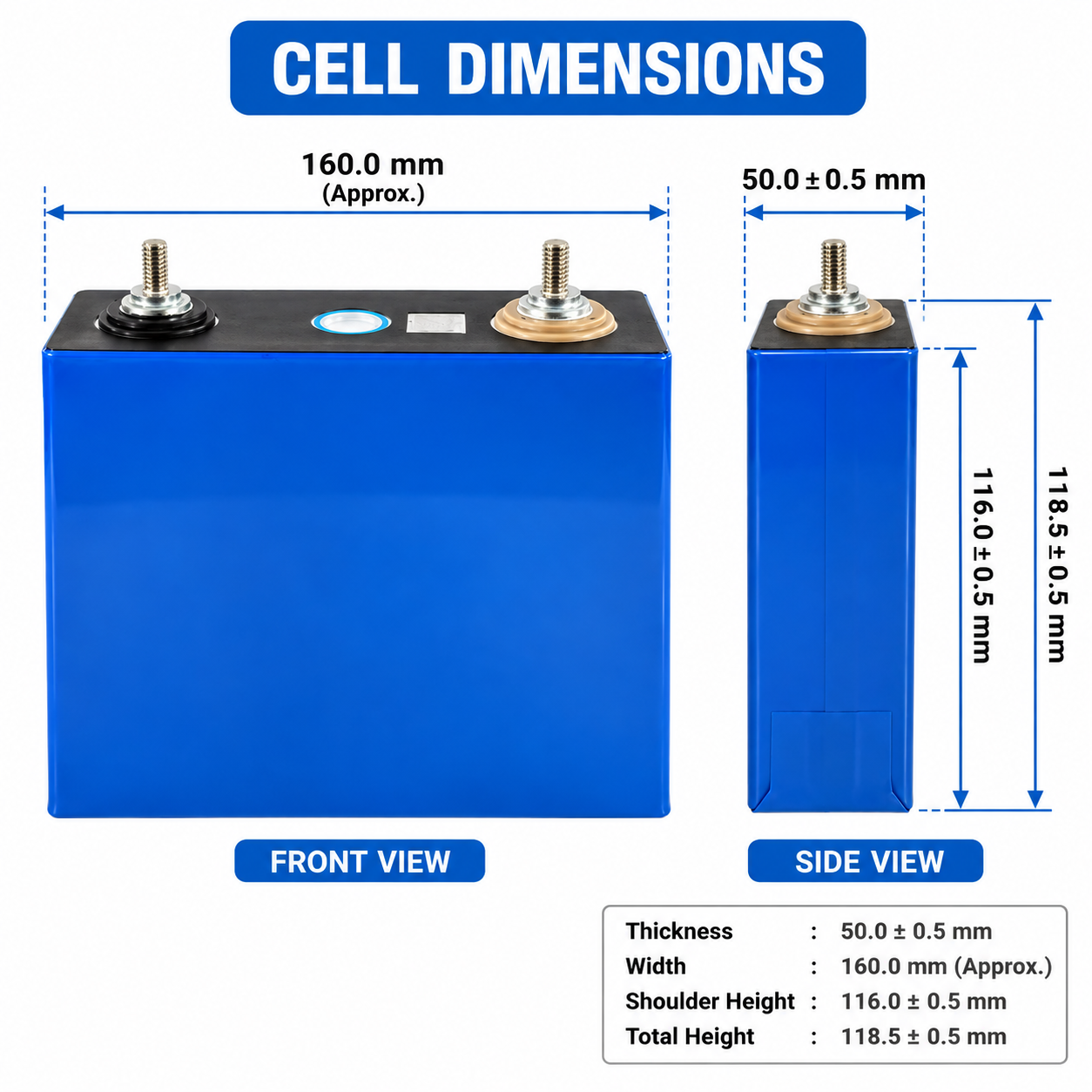
| Thickness | 50.0±0.5mm |
| Width | Approximately 160.0mm; see official drawing for measurement definition |
| Shoulder Height | 116.0±0.5mm |
| Total Height | 118.5±0.5mm |
| Cycle Life, 100% DOD | ≥4,500 cycles, 80% EOL capacity criterion |
| Cycle Life, 90% DOD | ≥6,000 cycles, 70% EOL capacity criterion |
| Cycle-Life Test Temperature | 25±2°C |
| Maximum Specified Application Altitude | ≤2,000m |
Temperature-Dependent Charging Current
| Cell Temperature | Maximum Continuous Charging Current |
|---|---|
| Below 0°C | Charging not permitted |
| 0°C to below 10°C | ≤15A (0.15C) |
| 10°C to below 20°C | ≤50A (0.5C) |
| 20°C to below 45°C | ≤100A (1.0C) |
| 45°C to 55°C | ≤50A (0.5C) |
| Above 55°C | Charging not permitted |
Important technical note: The specification defines charging current according to cell temperature. Always follow the official specification, the battery management system limits and the requirements of the completed pack. The dimensional values above should also be checked against the official drawing before mechanical integration.
Related Products
Related Blogs


This 3.2V 100Ah lithium iron phosphate (LiFePO₄) battery cell is designed for evaluation in compatible energy storage systems, industrial battery projects and custom battery pack development. With a nominal capacity of at least 100Ah and nominal energy of at least 320Wh, it provides a defined electrical specification for engineers and B2B buyers planning lithium battery modules.
The cell specification lists AC impedance of no more than 0.40mΩ at 1kHz under the stated fresh-cell test condition. Maximum continuous discharge current is specified at 150A at 25±2°C, while a 300A pulse discharge is listed for 30 seconds under the specified temperature and state-of-charge conditions. These ratings provide useful reference points for system sizing, but final current limits must account for temperature, interconnections, BMS settings, cooling and the complete battery design.
Designed for Battery Pack Development
The prismatic aluminum-cased format can be evaluated for battery module integration. Before assembly, engineering teams should verify the official mechanical drawing, terminal arrangement, mounting and compression requirements, cell monitoring, busbar design and thermal management.Documented Cycle-Life Test Conditions
The specification lists at least 4,500 cycles at 100% depth of discharge (DOD) to an 80% end-of-life (EOL) capacity criterion, and at least 6,000 cycles at 90% DOD to a 70% EOL capacity criterion. These figures apply to the stated test procedures and conditions; they are not a guarantee of the cycle life of every finished battery pack.Temperature and Operating Considerations
The specified charging temperature range is 0°C to 55°C, while the discharge range is -30°C to 55°C. The recommended continuous operating temperature range is 10°C to 35°C. Charging below 0°C is not permitted by the specification. Battery pack designers should implement appropriate temperature monitoring and charging controls for the intended environment. For project evaluation, buyers should provide their application, required quantity, target battery voltage, current profile, project stage and destination market. This information helps determine whether the cell’s documented characteristics are suitable for the proposed system.1. 100Ah Nominal Capacity
Provides a nominal capacity of at least 100Ah under the specified test procedure, supporting engineering evaluation for compatible battery pack designs.
2. 320Wh Nominal Energy
The nominal energy rating helps engineers estimate cell-level energy when planning a battery module or energy storage system.
3. Low Specified AC Impedance
AC impedance is specified at ≤0.40mΩ at 1kHz for a fresh cell at 20% SOC. Actual system losses depend on the complete electrical design and operating conditions.
4. Defined Continuous Discharge Rating
The specified maximum continuous discharge current is 150A at 25±2°C. The actual permissible current in a finished pack must be determined through system-level validation.
5. Defined Pulse Discharge Capability
The specification lists a 300A discharge pulse for 30 seconds at 25±2°C and 50% SOC. This rating should be used only within the stated test conditions and is not a continuous current rating.
6. Documented Cycle-Life Criteria
The specification includes separate cycle-life criteria for 100% DOD and 90% DOD testing, allowing buyers to review the associated end-of-life conditions instead of relying on an unqualified cycle-life claim.
7. Prismatic Cell Format
The prismatic aluminum-cased design can be assessed for compatible battery module layouts, subject to verification of the mechanical drawing and installation requirements.
8. Defined Temperature Limits
Specified charging and discharging ranges help system designers plan temperature monitoring, protection and thermal management.
9. Suitable for B2B Technical Evaluation
The available electrical and mechanical specifications provide a starting point for battery pack manufacturers, energy storage integrators and industrial equipment developers.
10. Application-Led Procurement
Sharing the project application, quantity, voltage configuration and current requirements helps buyers assess suitability before sample testing and bulk procurement.
Related Products
What products does YiFang offer?
YiFang specializes in batteries, chargers, battery packs, and power solutions, including Li-ion, LiMn (IMR), Ni-MH, and LiFePO₄ batteries.
Does YiFang provide OEM/ODM services?
Yes, we offer flexible OEM and ODM customization, including product design, specifications, and packaging to meet your exact requirements.
What industries use YiFang products?
Our products are widely used in e-cigarettes, UAVs, balance scooters, electric bikes, electronic equipment, toys, flashlights, and other commercial and industrial applications.
What is YiFang’s production capacity?
YiFang operates its own factory with automated production lines, producing up to 100,000 units daily, ensuring consistent quality and timely delivery.
How can I contact YiFang for orders or inquiries?
You can contact us via our website inquiry form, email, or phone. Our team is ready to provide professional guidance and customized solutions.
What industries use YiFang products?
Our products are widely used in e-cigarettes, UAVs, balance scooters, electric bikes, electronic equipment, toys, flashlights, and other commercial and industrial applications.
What industries use YiFang products?
Our products are widely used in e-cigarettes, UAVs, balance scooters, electric bikes, electronic equipment, toys, flashlights, and other commercial and industrial applications.
What warranty and after-sales support does YiFang offer?
We provide 6–12 months warranty, responsive customer support, and global insurance coverage for long-term reliability and customer peace of mind.

