
Введение
As demand for reliable energy storage continues to grow, lithium iron phosphate (LiFePO4 or LFP) battery technology has become an important choice for residential energy storage, commercial energy storage, и промышленные аккумуляторные системы.
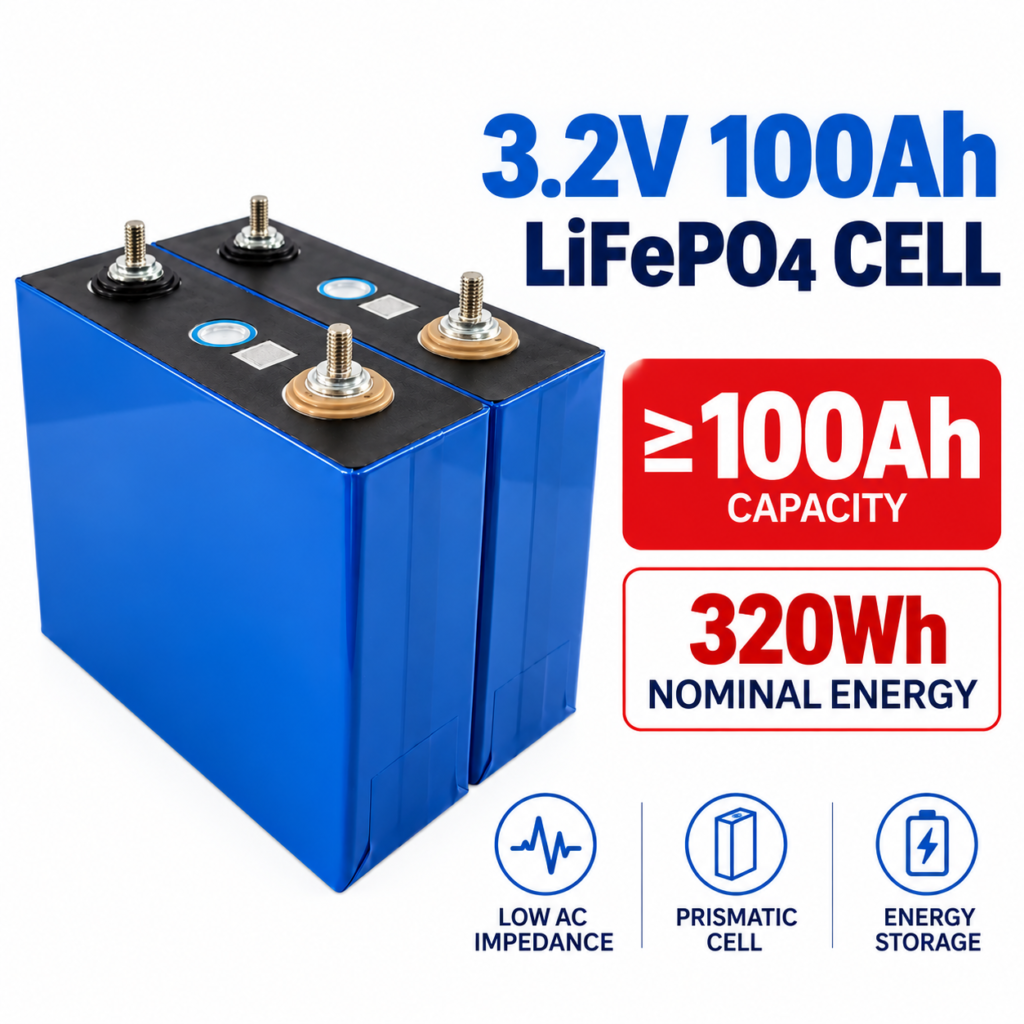
The 3.2V 100Ah LiFePO4 battery cell is designed for battery pack manufacturers, energy storage system integrators, and other B2B customers looking for a high-capacity rechargeable cell. With a nominal capacity of at least 100Ah and nominal energy of at least 320Wh, this prismatic LFP cell can be considered for compatible battery pack designs and energy storage projects.
В этой статье, we explore its key specifications, производительность разряда, cycle-life test data, temperature requirements, and potential applications.
1. What Is a 3.2V 100Ah LiFePO4 Battery Cell?
A 3.2V 100Ah LiFePO4 battery cell is a rechargeable lithium iron phosphate cell with a nominal voltage of 3.2V and a nominal capacity of at least 100Ah.
LiFePO4 chemistry is widely used in energy storage because it offers a combination of thermal stability, долговечность, and dependable electrochemical performance when operated within the specified limits.
The prismatic format is suitable for battery pack designs where space utilization, mechanical integration, and repeatable assembly are important considerations.
Ключевые характеристики
| Параметр | Спецификация |
|---|---|
| Химия батареи | Литий-железо-фосфат (ЛиФеПО4) |
| Номинальное напряжение | 3.2В |
| Номинальная мощность | ≥100Ah |
| Номинальная энергия | ≥320Wh |
| Максимальный непрерывный ток разряда | 150A at 25 ± 2°C |
| Maximum Pulse Discharge Current | 300A for 30 seconds under specified test conditions |
| Импеданс переменного тока | ≤0.40mΩ at 1kHz under specified test conditions |
| Charging Temperature | 0°C to 55°C |
| Discharging Temperature | -30°C to 55°C |
| Вес ячейки | 2.0 ± 0.1kg |
Примечание: Current ratings, impedance, and temperature limits depend on the specified test conditions and operating requirements. Refer to the official cell specification before designing a battery pack.

2. High Capacity and Practical Energy Output
With a nominal voltage of 3.2V and a nominal capacity of at least 100Ah, the cell provides nominal energy of at least 320Wh.
Nominal energy can be estimated using the following formula:
Энергия (Чт) = Nominal Voltage (В) × Емкость (Ах)
For this cell:
3.2V × 100Ah = 320Wh
This capacity makes the cell a potential component for battery packs used in stationary energy storage, резервное питание, and other compatible applications.
Для производителей аккумуляторных батарей, the final pack capacity and energy depend on the series and parallel configuration, system voltage requirements, usable depth of discharge, BMS settings, and other design factors.
3. Discharge Performance and Low AC Impedance
Discharge capability is an important consideration when selecting cells for energy storage and power applications.
Under the specified test conditions, this 3.2V 100Ah LiFePO4 cell supports a maximum continuous discharge current of 150A at 25 ± 2°C. Its maximum pulse discharge current is 300A for 30 seconds under the documented test conditions.
The cell also has a specified AC impedance of no more than 0.40mΩ at 1kHz. Low AC impedance can help battery designers evaluate electrical performance and potential internal losses, although actual pack efficiency also depends on interconnections, BMS components, температура, and operating current.
When designing a battery pack, manufacturers should verify continuous and peak current requirements against the complete system specification rather than relying on a single cell rating.
4. Cycle Life and Long-Term Energy Storage
Cycle life is one of the key factors affecting the long-term value of a battery cell.
According to the cell’s documented test conditions, the cycle-life results include:
- At 100% глубина разряда (Министерство Обороны): At least 4,500 циклы, using an 80% end-of-life capacity criterion.
- At 90% глубина разряда (Министерство Обороны): At least 6,000 циклы, using a 70% end-of-life capacity criterion.
These results were obtained under specified laboratory conditions, including a temperature of 25 ± 2°C and a defined mechanical preload and charge-discharge procedure.
Actual cycle life may vary depending on operating temperature, charge and discharge current, глубина разряда, storage conditions, дизайн упаковки, and battery management settings.
Для B2B-покупателей, it is important to compare cycle-life figures using the same test conditions and end-of-life criteria.
5. Operating Temperature and Charging Requirements
Temperature management is essential for lithium battery safety, performance, и срок службы.
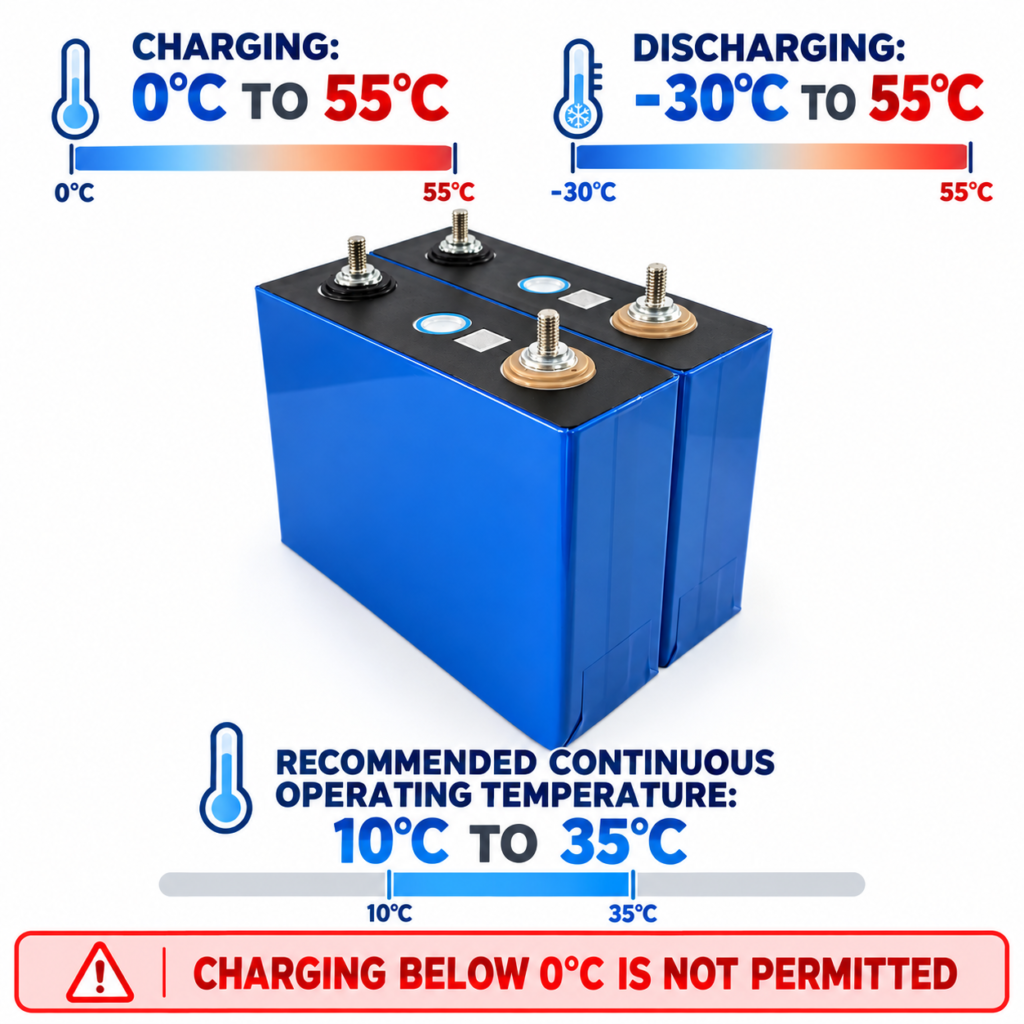
The cell’s specified temperature ranges are:
- Charging: 0°C to 55°C
- Discharging: -30°C to 55°C
- Recommended continuous operating temperature: 10°C to 35°C
Charging is not permitted below 0°C according to the cell specification. Charging current must also be adjusted according to temperature. Например, the documented maximum continuous charging current reaches 100A within the 20°C to below 45°C range, while lower limits apply at other temperatures.
Battery pack designers should incorporate appropriate temperature monitoring, current limits, protective controls, and thermal management where required.
For projects operating in cold or hot environments, the full operating profile should be reviewed before selecting the cell.
6. Potential Applications of the 100Ah LFP Cell
The 3.2V 100Ah LiFePO4 battery cell may be considered for compatible battery pack designs across several application areas.
Residential Energy Storage
Battery pack manufacturers may integrate suitable LFP cells into residential storage batteries designed to store electricity from solar photovoltaic systems or support backup power.
Commercial and Industrial Energy Storage
For commercial and industrial projects, appropriately engineered battery packs can support energy management, peak-shaving strategies, and backup power systems.
Хранение солнечной энергии
Solar energy storage systems use battery packs to store surplus electricity for later use. Cell selection should account for the system’s voltage, емкость, charging profile, and expected operating conditions.
Backup Power Systems
Compatible battery packs can be designed for backup power applications, subject to the required output power, время выполнения, protection features, and system integration requirements.
Custom Battery Pack Manufacturing
The cell may also be evaluated by battery pack manufacturers developing customized products for specific voltage, емкость, and enclosure requirements. Pack configuration and compatibility must be confirmed through engineering evaluation.
7. Important Considerations for Battery Pack Design
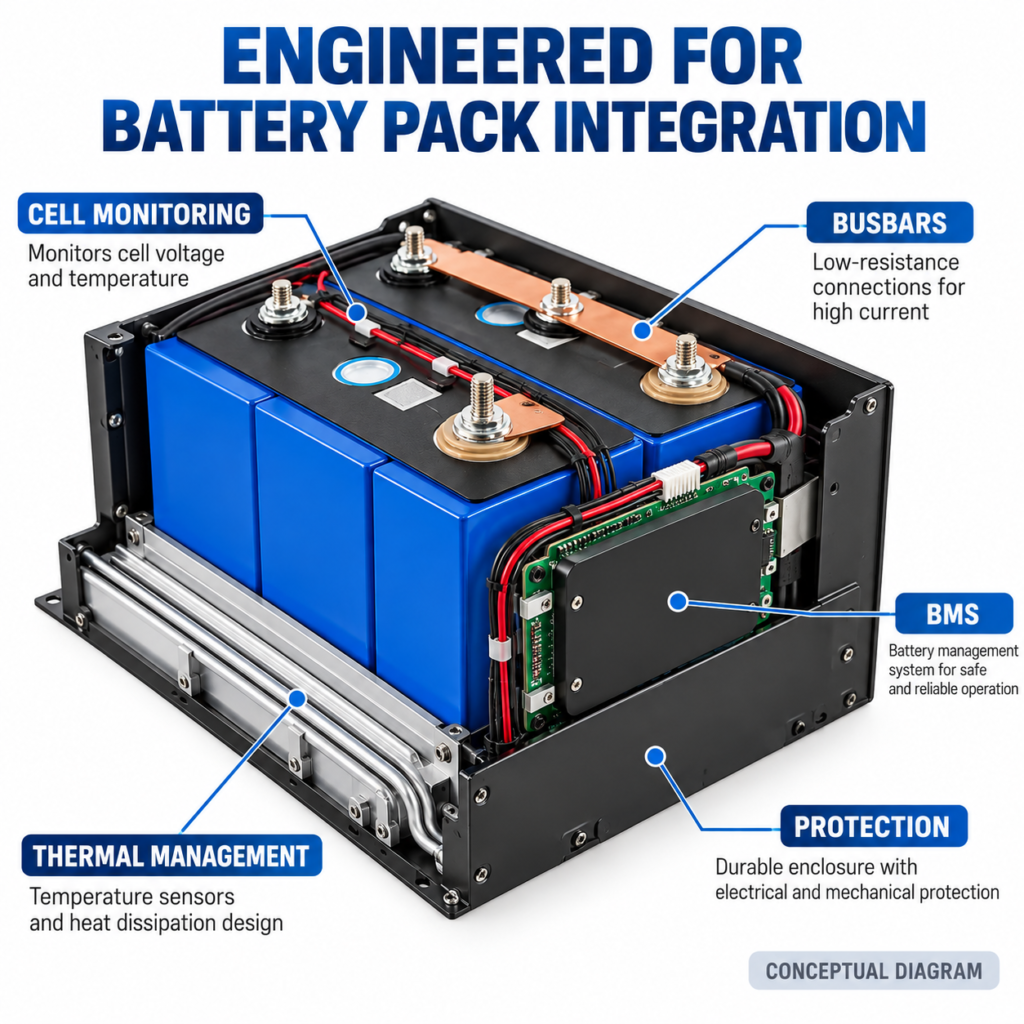
Selecting a suitable cell is only one step in developing a reliable battery system. Before using a 3.2V 100Ah LFP cell in a commercial project, battery pack manufacturers should evaluate the following factors.
Cell configuration: Determine the series and parallel arrangement based on the required nominal voltage and capacity.
Система управления батареями (БМС): Select a compatible BMS with appropriate voltage, текущий, температура, and protection limits.
Charging profile: Confirm that the charger and control strategy follow the cell’s specified voltage, текущий, and temperature limits.
Thermal management: Evaluate heat generation, вентиляция, мониторинг температуры, and cooling requirements under expected operating conditions.
Mechanical integration: Confirm cell dimensions, terminal design, mechanical preload, изоляция, and enclosure requirements using the official technical drawing.
Safety and compliance: Evaluate the complete battery pack against the applicable transportation, installation, and market requirements. Cell-level test information should not be treated as proof that a finished battery pack is certified.
Careful system design helps ensure that the selected cells are appropriate for the intended application.
8. Why B2B Buyers Should Evaluate Technical Specifications Carefully
For importers, дистрибьюторы, energy storage system integrators, and battery pack manufacturers, purchasing decisions should be based on more than nominal capacity alone.
Important evaluation criteria include:
- Verified cell specifications and traceable technical documentation
- Capacity and impedance test requirements
- Continuous and pulse discharge requirements
- Cycle-life test conditions and end-of-life criteria
- Temperature limits and charging restrictions
- Mechanical dimensions and terminal configuration
- Sample availability and project validation requirements
- Order quantity, delivery destination, and long-term supply needs
Requesting the applicable technical specification and confirming project requirements before placing a bulk order can help reduce compatibility risks during battery pack development.
9. How to Request a Quote for 3.2V 100Ah LiFePO4 Battery Cells
If you are sourcing 3.2V 100Ah LiFePO4 battery cells for an energy storage project or battery manufacturing business, preparing a clear inquiry can help suppliers assess your requirements more efficiently.
When requesting a quotation, consider providing:
- Приложение: Residential storage, commercial ESS, резервное питание, or another use
- Required quantity: Sample quantity, pilot order, or estimated bulk demand
- Project stage: Research, prototype development, тестирование, or mass production
- Target configuration: Required pack voltage and capacity, if already defined
- Destination country: For shipping and regulatory evaluation
- Technical requirements: Текущий, рабочая температура, размеры, and relevant documentation
These details help establish whether the cell’s specifications align with the intended project and identify any additional verification needed before production.
Заключение
The 3.2V 100Ah LiFePO4 battery cell is a potential building block for compatible energy storage battery packs and other rechargeable battery applications. Its nominal energy of at least 320Wh, specified discharge capability, low AC impedance, and documented cycle-life test results provide useful technical reference points for battery pack development.
For successful integration, buyers should evaluate the complete specification, charging restrictions, тепловые требования, Совместимость с БМС, and application-specific safety requirements.
Looking for LiFePO4 battery cells for your next energy storage project? Contact YIFANG to discuss your application, estimated order quantity, technical requirements, and supply needs.