

Global Residential Energy Storage Market Trends in 2026: Opportunities, Technologies and the Future of Home Batteries
Введение: Why Home Energy Storage Is Becoming a Global Priority
The global energy market is undergoing a major transformation. Rising electricity demand, changing energy prices, increasing renewable energy adoption and growing concerns about power reliability are accelerating the development of residential energy storage systems.
Для домовладельцев, solar energy is no longer just about installing photovoltaic panels on the roof. More households are recognizing the importance of storing electricity and using it when needed.
A home battery storage system allows households to store surplus electricity generated by solar panels, reduce dependence on grid electricity and improve energy flexibility. In markets with unstable electricity supplies or high energy costs, battery storage can also provide an additional layer of energy security.
In 2026, residential energy storage is evolving from a complementary solar product into an increasingly important part of modern home energy management.
This article explores the latest global residential energy storage trends, regional market opportunities, battery technology developments and the factors shaping the future of the home battery industry.
1. The Global Energy Storage Market Continues to Expand
Global battery energy storage deployment is growing rapidly.
According to the International Energy Agency (IEA), approximately 108 GW of new battery storage capacity was deployed worldwide in 2025, representing a 40% increase compared with 2024. Global installed battery storage capacity has grown to approximately eleven times its 2021 level.
Although utility-scale projects account for most new installations, residential and commercial battery storage are also becoming increasingly important.
According to InfoLink Consulting’s 2026 market outlook, global residential energy storage capacity additions are expected to reach approximately 46.1 GWh in 2026.
This growth reflects several important market drivers:
- Increasing adoption of residential solar photovoltaic systems.
- Greater interest in electricity self-consumption.
- Rising demand for backup power solutions.
- Changing electricity pricing structures.
- Government incentives and renewable energy policies.
- Improvements in battery technology and system integration.
The residential energy storage market is therefore moving beyond early adopters and attracting a broader range of homeowners, монтажники, distributors and energy solution providers.

2. Европа: A Key Market for Residential Energy Storage
Europe remains one of the most important regions for residential battery storage.
Countries such as Germany, Italy, the Netherlands, the United Kingdom, Austria and Poland are creating opportunities for home battery manufacturers and energy storage suppliers.
Several factors are supporting European market development.
Германия: Solar Self-Consumption and Energy Independence
Germany has developed a strong residential solar market. As electricity consumers become more interested in using their own renewable electricity, home battery systems are increasingly considered alongside rooftop solar installations.
Instead of exporting all surplus solar electricity to the grid, homeowners can store part of that energy for evening and nighttime consumption.
This makes solar-plus-storage systems an attractive option for households seeking greater control over their electricity usage.
Italy: Residential Solar and Battery Integration
Italy continues to offer opportunities for residential energy storage because of its solar resources and established photovoltaic market.
Homeowners are increasingly interested in combining solar panels, hybrid inverters and battery storage systems to improve energy self-consumption.
Однако, changes in government incentives and electricity regulations mean that installers and suppliers must pay close attention to local market conditions.
Netherlands: Changing Energy Consumption Patterns
The Netherlands is an important market to watch.
Changes in electricity pricing and solar export compensation arrangements are encouraging households to reconsider how they use and store their electricity.
Battery storage can help households use more of their own solar generation instead of relying entirely on electricity exports.
Польша: An Emerging Opportunity
Poland is becoming an important market for residential energy storage in Central and Eastern Europe.
The development of renewable energy, changing electricity market conditions and interest in household energy independence are creating opportunities for solar-plus-storage solutions.
Для дистрибьюторов и монтажников, Poland offers opportunities to develop residential battery portfolios and establish long-term customer relationships.
United Kingdom: Flexibility and Smart Energy Management
The UK residential energy storage market is supported by growing interest in solar self-consumption, flexible electricity tariffs and smart energy management.
Battery systems can help households shift electricity consumption toward more favorable pricing periods, depending on their tariff structure and energy management capabilities.
Overall, Europe remains a major opportunity for residential energy storage suppliers, although demand and purchasing economics differ significantly between countries.
3. North America: Backup Power and Electricity Cost Management
The United States is another important market for residential battery storage.
Unlike some European markets, where solar self-consumption is a major purchasing motivation, American homeowners often consider several factors together:
- Backup power during grid outages.
- Electricity bill management.
- Integration with rooftop solar systems.
- Time-of-use electricity tariffs.
- Participation in virtual power plant programs.
California remains a leading residential storage market, while Texas, Arizona and other states are developing additional opportunities.
The US residential battery market experienced significant growth in 2025. According to the Solar Energy Industries Association (SEIA) and Benchmark Mineral Intelligence, residential battery storage deployments reached approximately 3.1 GWh in 2025, an increase of 51% по сравнению с 2024.
Однако, policy changes and the expiration of certain federal residential incentives have affected the 2026 market outlook.
This demonstrates an important point: long-term demand for residential energy storage can remain strong even when short-term installation volumes are affected by government policy.
For battery suppliers, product compatibility, reliable backup performance and professional installation support remain important competitive factors.
4. Australia and Asia: Growing Demand for Household Energy Independence
Australia is one of the most promising residential battery storage markets.
High rooftop solar adoption, electricity price considerations and interest in energy independence have created favorable conditions for household battery installations.
The Australian Cheaper Home Batteries Program, launched in July 2025, has further supported market development.
Meanwhile, several Asian markets are experiencing increasing residential energy storage demand.
Pakistan, the Philippines and Vietnam are examples of markets where electricity reliability, power outages and household energy costs are encouraging the adoption of battery storage.
Japan also remains an important market because of its established residential solar sector and interest in energy resilience.
These markets demonstrate that residential energy storage demand is not driven by one factor alone.
In some countries, homeowners want to reduce electricity costs. In others, the priority is maintaining power during outages or improving access to reliable electricity.
This creates opportunities for different battery capacities, system configurations and installation solutions.
5. LiFePO4 Is Becoming the Preferred Battery Technology
Battery chemistry is one of the most important factors influencing the future of residential energy storage.
Литий-железо-фосфат, широко известный как LiFePO4 или LFP, has become a leading chemistry in stationary battery storage applications.
The IEA reported that LFP batteries accounted for approximately 90% of battery storage deployments in 2025.
Several characteristics make LFP suitable for residential applications:
Характеристики безопасности
LFP chemistry offers favorable thermal stability compared with several other common lithium-ion chemistries. Однако, complete system safety also depends on battery design, BMS protection, installation and operating conditions.
Long cycle life
LFP batteries are widely used in applications involving frequent charging and discharging. Actual cycle life depends on cell specifications, рабочая температура, depth of discharge and charging conditions.
Cost competitiveness
LFP battery production has benefited from manufacturing scale and improvements in supply chains, making it an attractive option for residential and commercial energy storage.
Material characteristics
LFP does not require nickel or cobalt in its cathode chemistry, which can help reduce exposure to certain material supply chain constraints.
As the residential market develops, battery suppliers will increasingly compete on more than battery capacity alone. Product quality, системная интеграция, safety management and after-sales support will also influence purchasing decisions.

6. Modular and Expandable Home Battery Systems Are Gaining Attention
Household electricity requirements vary significantly.
A small apartment, a detached house with rooftop solar and a large property with electric heating may require very different storage capacities.
По этой причине, modular and expandable battery systems are becoming increasingly attractive.
Instead of purchasing a large battery system at the beginning, homeowners may prefer a solution that can expand as their electricity consumption increases.
Например, a modular storage architecture can offer:
- Flexible initial storage capacity.
- Additional battery modules when needed.
- Better adaptation to changing household demand.
- More flexibility for installers and distributors.
- Opportunities to integrate additional energy equipment.
This development is particularly relevant as households increasingly adopt electric vehicles, heat pumps and other electricity-intensive appliances.
Однако, system expansion must follow the manufacturer’s specifications, including inverter compatibility, battery communication protocols and permitted parallel configurations.
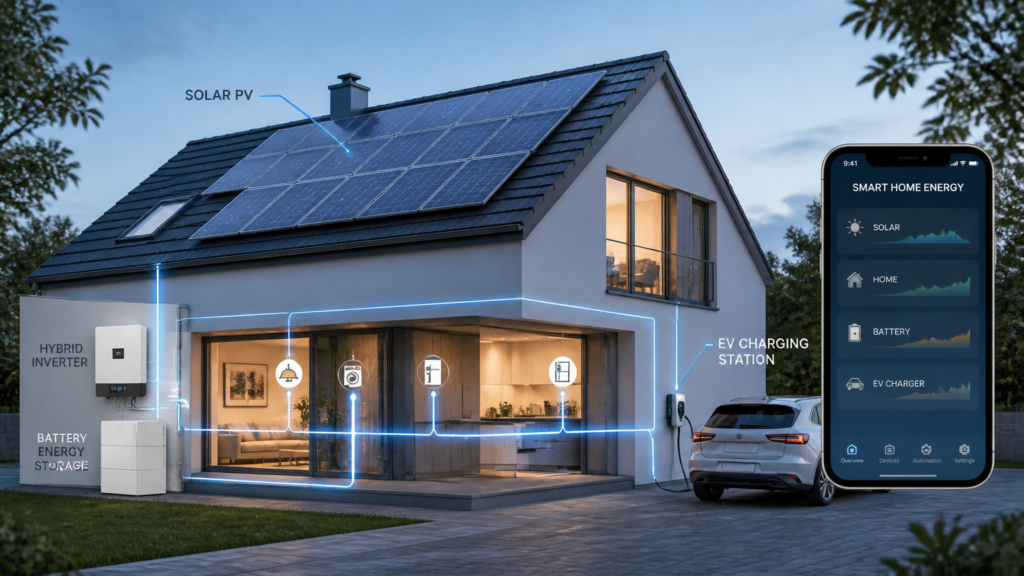

7. Smart Energy Management Will Become a Major Competitive Advantage
The future of home energy storage is not only about storing electricity. It is also about managing when and how electricity is used.
Modern residential energy systems increasingly combine:
- Solar photovoltaic panels.
- Battery energy storage.
- Hybrid inverters.
- Smart meters.
- Home energy management systems.
- Electric vehicle charging.
- Heat pumps and other household electrical loads.
With intelligent energy management, a household can potentially prioritize solar self-consumption, charge batteries during favorable electricity price periods and discharge stored electricity when grid electricity becomes more expensive.
Some systems can also participate in virtual power plant programs, allowing aggregated household batteries to provide flexibility services to the electricity grid.
The growing integration of battery storage, solar generation and smart energy management will make compatibility and communication capabilities increasingly important when selecting a home battery supplier.
8. What Will Drive the Next Stage of Residential Energy Storage?
Several major developments are likely to influence the residential energy storage industry over the coming years.
Lower Battery Costs and Better System Economics
As battery manufacturing continues to develop, improved production efficiency and technology innovation can support more competitive residential storage solutions.
Однако, the economic value of a home battery still depends on local electricity prices, солнечная генерация, installation costs, tariffs, financing and available incentives.
Growing Electricity Demand
Электромобили, тепловые насосы, smart home appliances and other electrical equipment are increasing household electricity consumption.
This creates additional opportunities for residential battery storage, particularly when combined with rooftop solar.
Greater Focus on Energy Resilience
Extreme weather events, grid constraints and concerns about electricity reliability are increasing interest in backup power solutions.
Homeowners are becoming more aware of the importance of having access to stored electricity when the grid is unavailable.
More Integrated Energy Solutions
The next generation of residential energy systems will increasingly connect solar panels, батарейки, инверторы, EV chargers and smart energy management platforms.
Suppliers capable of supporting compatible and flexible energy solutions will be better positioned to serve changing household requirements.
More Competitive International Markets
As more manufacturers enter the residential energy storage industry, competition will increase.
Product quality, transparent technical specifications, reliable supply chains, warranty policies and technical support will become important factors in building long-term customer relationships.

9. What Should Buyers and Distributors Consider When Choosing a Home Battery Supplier?
Market growth creates opportunities, but choosing the right supplier remains essential.
For residential energy storage distributors, solar installers and project developers, several factors should be evaluated before selecting a battery product.
1. Battery chemistry and cell quality
Understand the battery chemistry, cell specifications, manufacturer information and quality control processes.
2. Battery capacity and voltage
Select a battery configuration that matches the intended household application and compatible inverter requirements.
3. Система управления батареями
Evaluate the BMS protection functions, communication protocols and monitoring capabilities.
4. Совместимость с инвертором
Confirm compatibility with the intended inverter brand, model and communication protocol.
5. Certifications and transportation documents
Check the actual product certifications, applicable safety standards and transportation documentation required in the destination market.
6. Warranty and after-sales support
Understand the formal warranty terms, coverage conditions and technical support arrangements.
7. Supply capability and logistics
Evaluate production capacity, inventory availability, упаковка, shipping arrangements and delivery options.
A reliable supplier should provide clear technical information and practical support throughout the purchasing and installation process.
10. Заключение: Residential Energy Storage Has a Strong Long-Term Future
The global residential energy storage market is entering an important stage of development.
Europe continues to offer significant opportunities, while Australia and several Asian markets are expanding rapidly. North America remains an important market driven by backup power requirements, electricity cost management and evolving energy policies.
At the technology level, LiFePO4 аккумуляторы, modular storage systems, smart energy management and integrated solar-plus-storage solutions are shaping the next generation of residential energy products.
Для домовладельцев, energy storage provides more flexibility in how electricity is generated, stored and consumed.
Для дистрибьюторов, installers and project developers, the expanding market creates opportunities to develop new products, reach new customers and build long-term business partnerships.
For manufacturers and suppliers, the next stage of competition will depend not only on battery prices and capacity, but also on product reliability, technical compatibility, supply capabilities and customer support.
At EH POWERTECH, we believe that reliable battery technology and flexible energy storage solutions will play an important role in the global transition toward smarter and more sustainable homes.
As residential energy demand continues to evolve, we look forward to working with distributors, installers and energy project partners to explore new opportunities in the global home energy storage market.
Contact EH POWERTECH to discuss residential energy storage solutions, product specifications and wholesale cooperation opportunities.