Introduction
As demand for renewable energy and battery storage continues to grow, lithium iron phosphate (LiFePO4 or LFP) technology has become an important option for stationary energy storage and industrial battery applications.
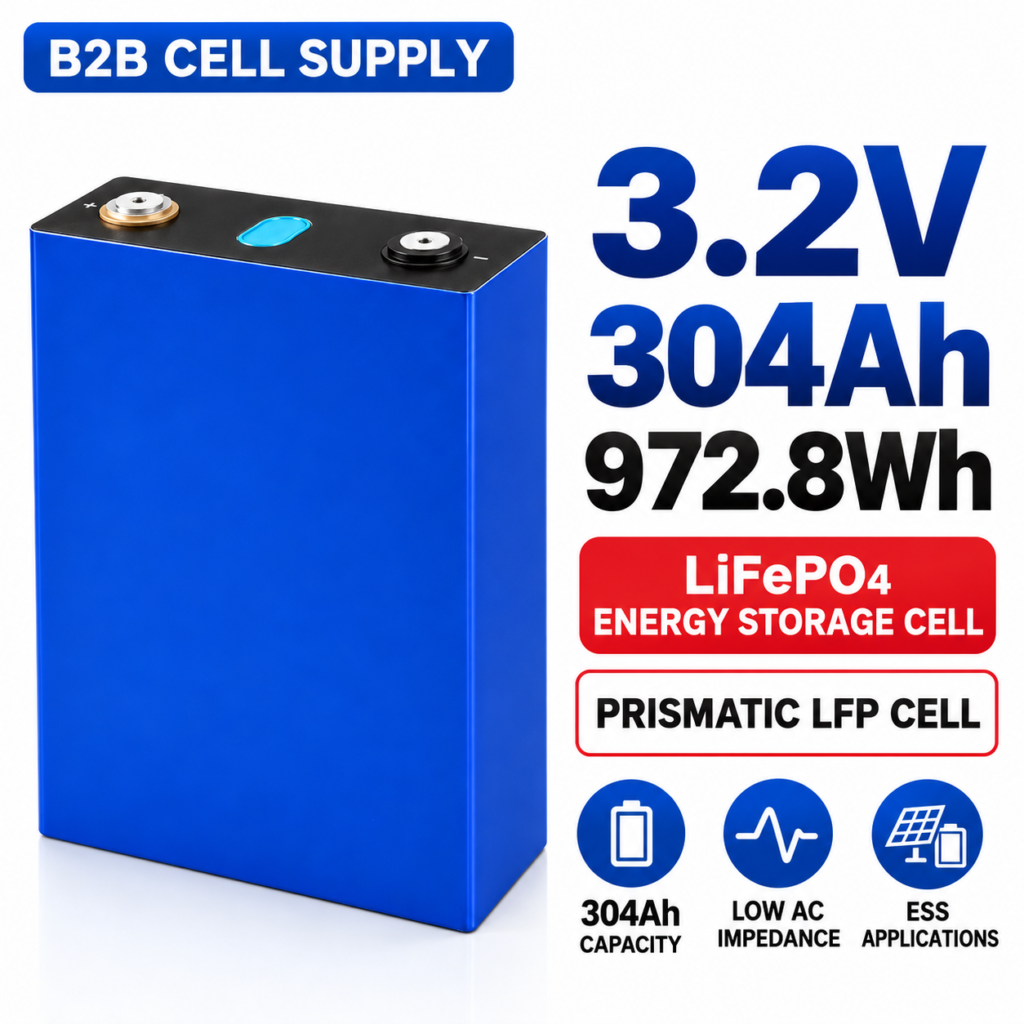
Le 3.2V 304Ah LiFePO4 battery cell is a large-format prismatic cell designed for evaluation by battery pack manufacturers, energy storage system integrators, and other B2B buyers. With a nominal capacity of 304Ah and nominal energy of 972.8Wh, it provides a technical foundation for designing compatible battery packs.
This article explains the cell’s key specifications, charging and discharging capabilities, cycle-life test data, temperature limits, and potential applications.
1. What Is a 3.2V 304Ah LiFePO4 Battery Cell?
A 3.2V 304Ah LiFePO4 battery cell is a rechargeable lithium iron phosphate cell with a nominal voltage of 3.2V and a nominal capacity of 304Ah.
LiFePO4 chemistry is widely used in battery applications where thermal behavior, cycle-life characteristics, and predictable operating limits are important considerations. Actual safety and service life depend on cell quality, system engineering, conditions de fonctionnement, and appropriate protection.
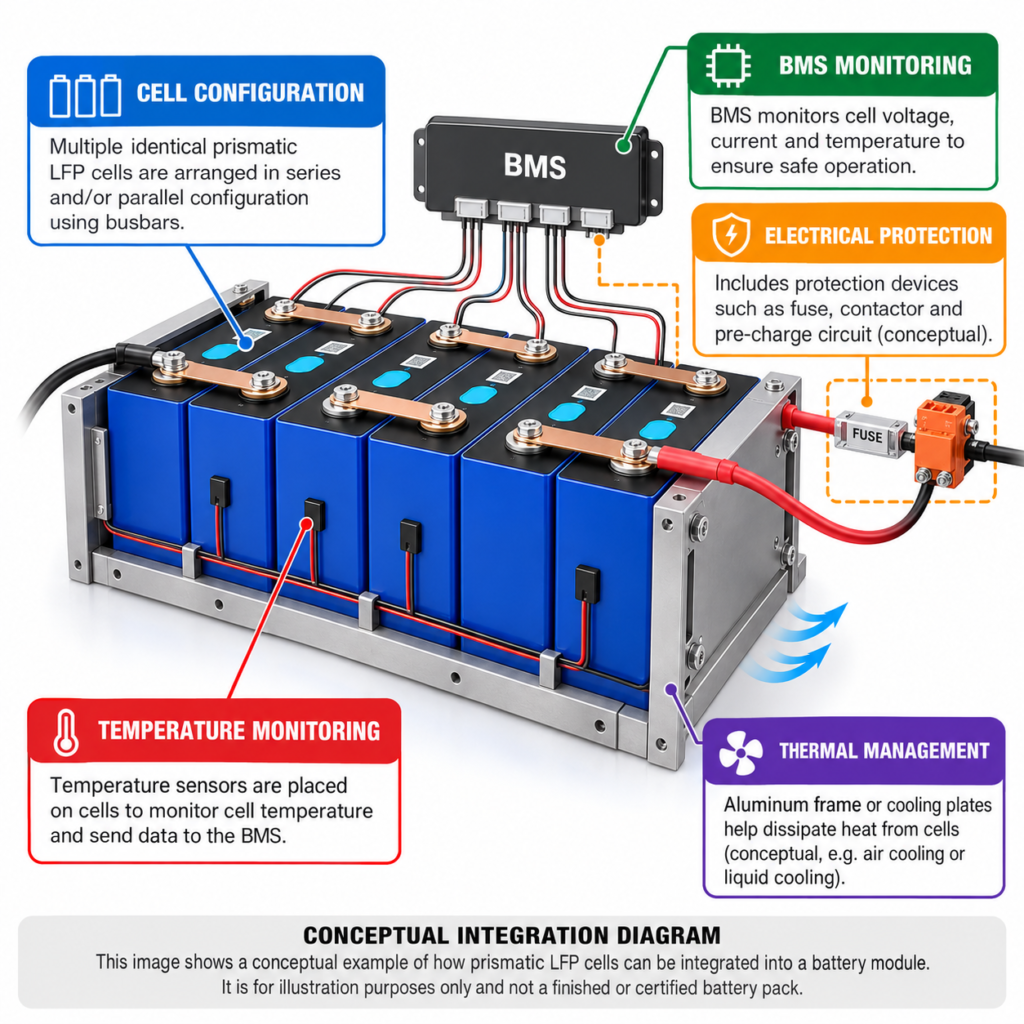
The prismatic aluminum-case format provides a defined mechanical structure for integration into a battery module or pack.
Key Technical Specifications
| Paramètre | Spécification |
|---|---|
| Chimie des batteries | LiFePO4 / LFP |
| Tension nominale | 3.2V |
| Capacité nominale | 304Ah |
| Énergie nominale | 972.8Wh |
| Impédance CA | ≤0.5mΩ at 1kHz, at ≥25°C |
| Maximum Continuous Charging Current | 250UN |
| Courant de décharge continu maximum | 304UN |
| Pulse Charge/Discharge Current | 456A for 60 secondes |
| Charging Temperature | 0°C à 60°C |
| Discharging Temperature | -30°C à 60°C |
| Poids | 5.47 ± 0.05kg |
These values are based on the applicable product specification. Current ratings must be interpreted within the specified operating and test conditions.
2. Understanding the Cell’s Nominal Energy
Nominal energy is calculated by multiplying nominal voltage by nominal capacity.
Nominal Energy = Nominal Voltage × Nominal Capacity
For this cell:
3.2V × 304Ah = 972.8Wh
This means each cell provides approximately 0.973kWh of nominal energy.
When designing a battery pack, engineers can use this value for preliminary energy calculations. Cependant, usable energy will depend on the selected operating voltage range, profondeur de décharge, BMS settings, conversion losses, température, and system requirements.
Par exemple, a battery pack’s final nominal energy is determined by the number of cells and their series-parallel configuration. The pack should also be evaluated for voltage compatibility, current limits, gestion thermique, and safety protection.
3. Charging and Discharging Performance
Current capability is an important selection criterion for battery cells used in energy storage and industrial battery systems.
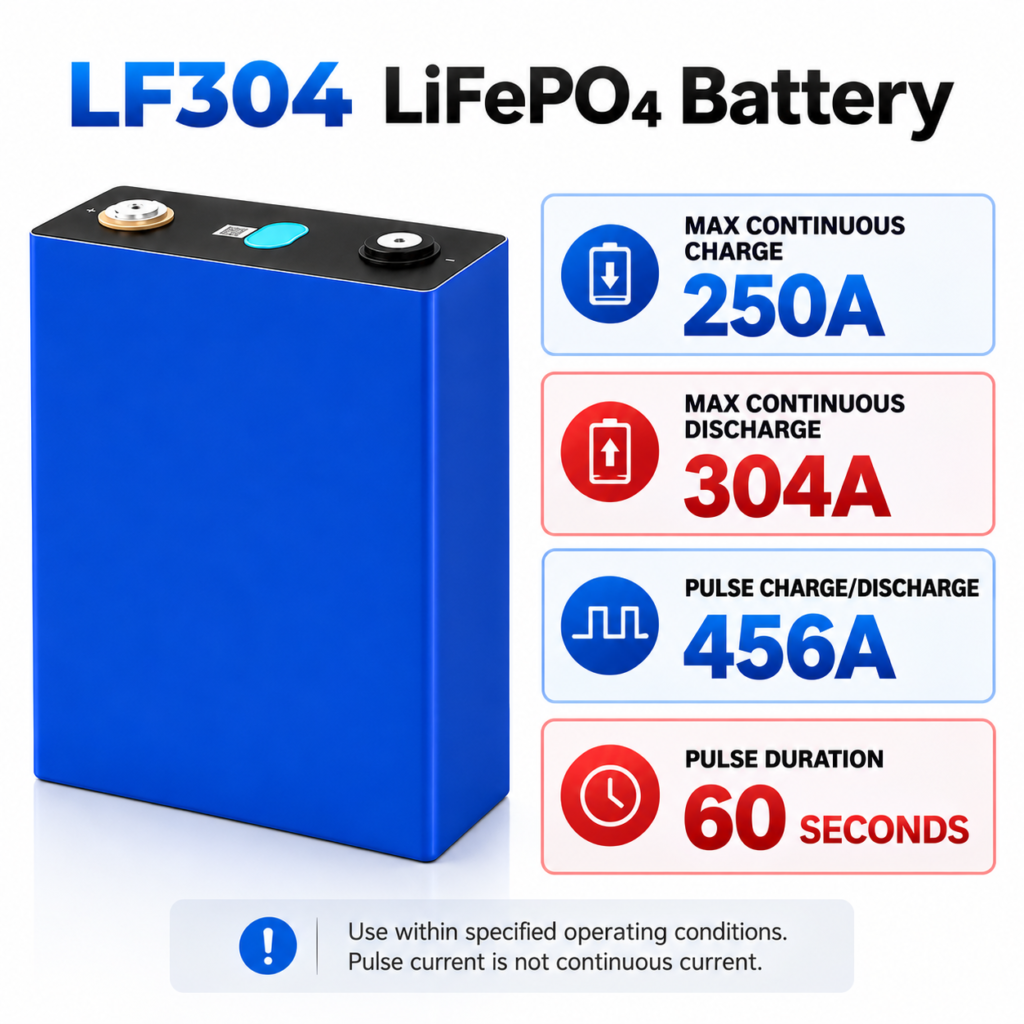
The documented maximum continuous charging current for this cell is 250A. Its maximum continuous discharging current is 304A, equivalent to 1C based on the nominal 304Ah capacity.
The specification also lists a pulse charging and discharging current of 1.5C, or 456A, for 60 secondes.
These ratings should be understood separately:
- Continuous charging current: The maximum specified continuous charging current is 250A.
- Continuous discharging current: The maximum specified continuous discharge current is 304A.
- Pulse current: The specified 456A pulse current is limited to 60 seconds under the applicable conditions.
A pulse rating must not be used as a continuous operating current. Battery pack designers should confirm the permitted current profile against cell temperature, limites de tension, conductor sizing, BMS settings, and thermal performance.
The cell specification identifies 0.5C as the standard charge and discharge rate for its standard test procedure.
4. Low AC Impedance and Electrical Evaluation
The specified AC impedance is no more than 0.5mΩ at 1kHz when the test temperature is at least 25°C.
AC impedance is a useful parameter when comparing cells and assessing electrical behavior. In a battery pack, impedance can influence voltage response and heat generation, particularly when current demand is high.
Cependant, the cell’s AC impedance value alone does not determine total battery pack efficiency. Busbars, connecteurs, correspondance de cellules, température de fonctionnement, BMS components, and system design also affect overall performance.
Pour les acheteurs B2B, it is useful to define impedance measurement methods and acceptance criteria before cell qualification or bulk procurement.
5. Durée de vie: What Do the Test Results Mean?
Cycle life helps battery pack manufacturers evaluate how a cell may perform over repeated charging and discharging.
The documented specification includes the following cycle-life results:
- At 25°C: At least 3,500 cycles under the specified test procedure.
- At 45°C: At least 1,800 cycles under the specified test procedure.
The test procedures define charging and discharging currents, limites de tension, température, and mechanical clamping conditions. These details matter when comparing the results with other battery cells.
The specification also describes a life-end management criterion under which use should stop when capacity falls below 70% of nominal capacity. The precise test method and its stated termination conditions should be reviewed when using the cycle-life data for engineering or commercial comparisons.
Actual cycle life varies with operating temperature, profondeur de décharge, charge and discharge current, storage conditions, gestion thermique, and battery system design. Laboratory test results should not be interpreted as a universal warranty or guaranteed service life.
6. Operating Temperature and Storage Requirements
Temperature management is important for both battery performance and safety.
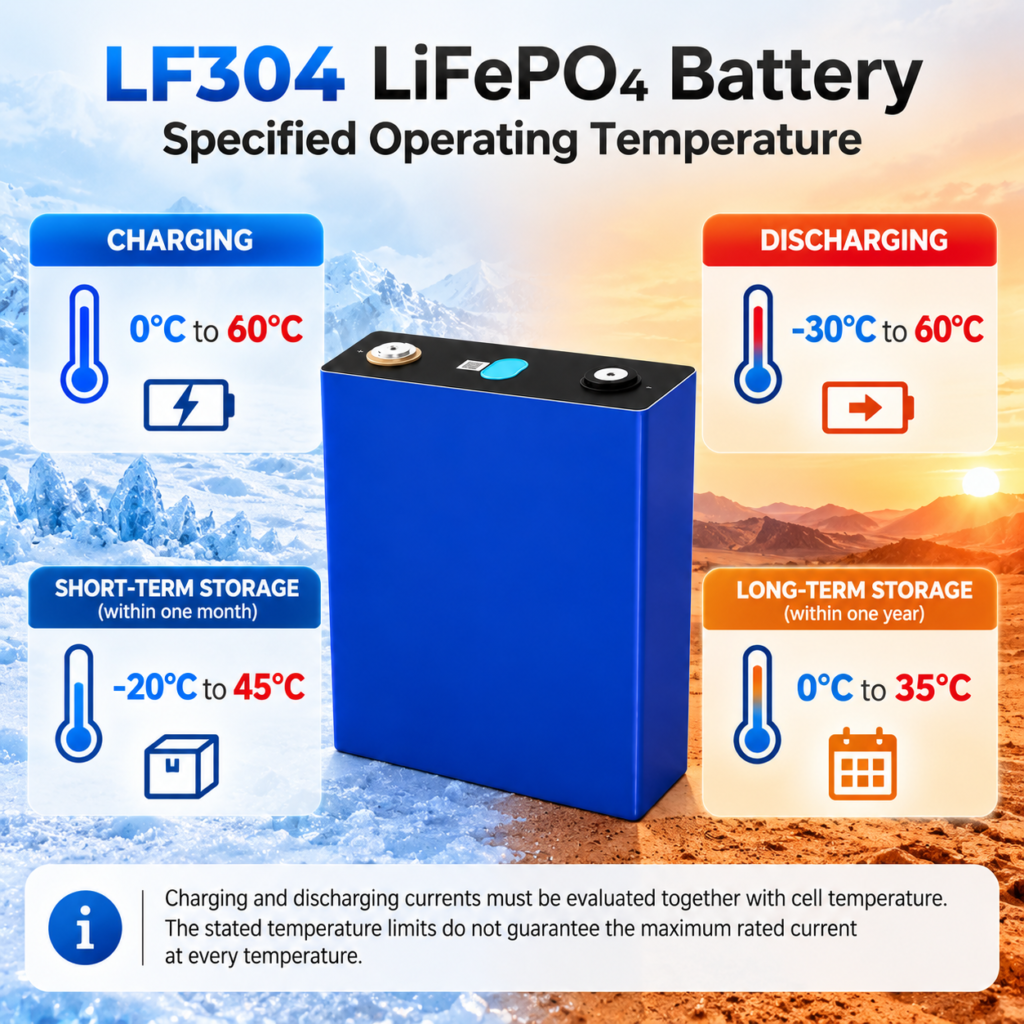
The specified operating temperature ranges for this cell are:
- Charging: 0°C à 60°C
- Discharging: -30°C à 60°C
- Short-term storage: -20°C to 45°C for storage within one month
- Long-term storage: 0°C to 35°C for storage within one year
The specification also recommends a storage state of charge of 30% à 50% for extended periods without use.
These ranges define specified limits, not a guarantee that all current ratings are available at every temperature. A suitable battery system should monitor cell voltage, actuel, and temperature, and apply appropriate protective limits.
For projects exposed to cold winters or high ambient temperatures, buyers should review the actual operating profile and required output before choosing a cell.
7. Mechanical Dimensions and Battery Pack Integration
The cell uses a prismatic aluminum-case format. Its documented mechanical dimensions are:
| Dimension | Spécification |
|---|---|
| Largeur | 173.70 ± 0.50mm |
| Épaisseur | 71.70 ± 0.50mm under specified clamping conditions |
| Total Height | 207.20 ± 0.50mm |
| Body Height | 204.40 ± 0.50mm |
| Terminal Center Distance | 123.00 ± 0.30mm |
| Poids | 5.47 ± 0.05kg |
The thickness measurement is defined under a specified clamping force and state-of-charge range. Donc, the final mechanical design should use the official dimensional drawing rather than relying only on a summary table.
Battery pack manufacturers should evaluate:
- Cell spacing and mechanical support
- Clamping or compression requirements
- Terminal and busbar compatibility
- Electrical insulation
- Enclosure dimensions and tolerances
- Gestion thermique
- Voltage and temperature monitoring
These factors help determine whether the cell is suitable for a particular battery module or system design.
8. Potential Applications of 304Ah LFP Cells
Stationary Energy Storage
The cell may be evaluated for stationary energy storage battery packs designed for compatible system voltages, capacities, and current profiles.
Stockage de l'énergie solaire
Battery packs incorporating LFP cells can be designed to store surplus solar electricity for later use. The complete system must be matched to the solar inverter, charge controller, GTC, and installation requirements.
Commercial and Industrial Energy Storage
Commercial and industrial storage projects may use engineered battery packs for energy management, alimentation de secours, and other application-specific functions.
Battery Pack Manufacturing
Battery pack manufacturers may evaluate the cell for customized products requiring a particular voltage, capacité, enceinte, and operating profile.
System Integration Projects
Energy storage integrators should verify the electrical, mechanical, thermal, and safety requirements of the complete system before selecting a cell for production.
The cell is a battery component rather than a complete plug-and-play energy storage system.
9. What Should B2B Buyers Check Before Purchasing?
When sourcing 304Ah LiFePO4 battery cells, buyers should consider more than nominal capacity alone.
Technical documentation: Request the applicable specification, dimensional drawing, and relevant quality documentation.
Current requirements: Compare continuous and pulse current needs with the specified cell ratings.
Cycle-life criteria: Check test temperatures, charge and discharge procedures, and end-of-life definitions.
Mechanical compatibility: Verify dimensions, terminal positions, spacing, and mechanical support requirements.
System protection: Confirm the BMS, charging equipment, surveillance de la température, and electrical protection strategy.
Compliance requirements: Check the applicable requirements for the destination market, transportation, and final battery system. Cell-level safety test results do not automatically certify a complete battery pack.
Supply planning: Discuss sample evaluation, expected order quantity, project schedule, destination country, and required documents with the supplier.
A clear technical and commercial inquiry helps suppliers determine whether the product is appropriate for the intended project.
10. How to Request a Quote
If you are sourcing a 3.2V 304Ah LiFePO4 battery cell for an energy storage or battery manufacturing project, provide the following information when requesting a quotation:
- Application and target market
- Required quantity
- Project stage: research, sample testing, pilot production, or mass production
- Target pack voltage and capacity
- Expected charging and discharging current
- Destination country
- Required technical documentation
- Any specific mechanical or integration requirements
This information supports a more efficient technical review and quotation process.
Conclusion
The 3.2V 304Ah LiFePO4 battery cell offers 972.8Wh nominal energy in a prismatic aluminum-case format. Its specified current capability, AC impedance, temperature limits, and documented cycle-life test results provide useful reference data for evaluating the cell in compatible energy storage battery packs.
Successful integration requires a complete review of electrical limits, mechanical dimensions, temperature management, Compatibilité GTC, and system-level safety requirements.
YIFANG supports B2B customers evaluating battery cells and energy storage products for their projects. Contact the team with your application, quantity, target configuration, and destination market to discuss your sourcing requirements.