
大容量 21700 リチウムイオン電池セル: 高出力バッテリーパックの開発をサポート
As demand for high-performance battery systems continues to grow, battery manufacturers are paying increasing attention to cell capacity, 放電能力, operating temperature and cycle performance. These factors directly influence battery pack design, application suitability and long-term operating reliability.
Among cylindrical lithium ion battery formats, の 21700 cell has become an important option for battery pack development. Its cylindrical structure and available capacity range make it suitable for various applications requiring a balance between energy capacity and power output.
1. Why Are High Capacity 21700 Battery Cells Important?
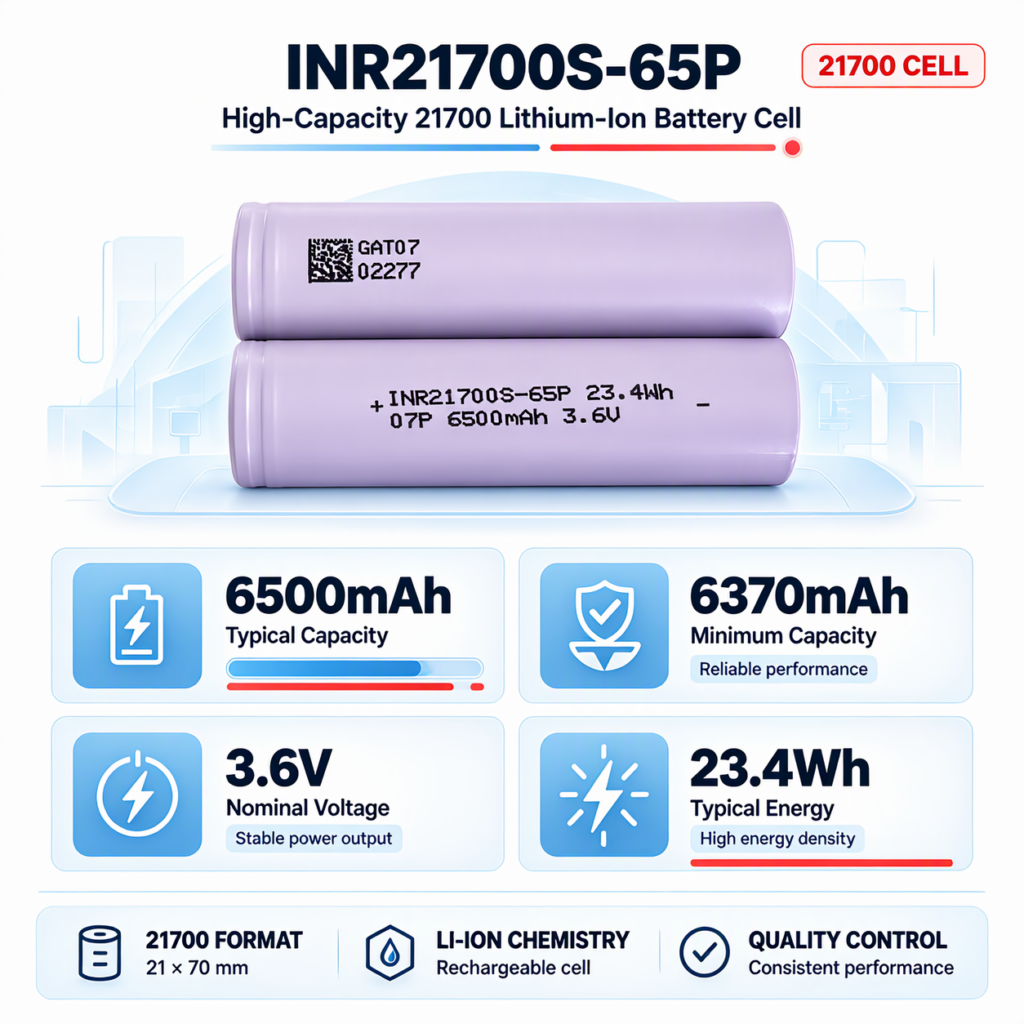
Battery capacity determines how much electrical energy a cell can store. A higher-capacity cell can help battery pack designers achieve their target energy requirements with fewer individual cells, depending on the pack configuration.
電池メーカー向け, this can provide several design considerations:
-
Optimizing battery pack space utilization
-
Reducing the number of parallel cells required for certain configurations
-
Supporting higher energy requirements
-
Simplifying battery pack structural design
-
Providing flexibility for customized battery solutions
しかし, capacity should never be considered independently. 放電能力, 熱管理, protection design and operating conditions must also be evaluated.
2. High Discharge Capability for Power Demanding Applications
Some battery applications require more than energy storage. They also need sufficient current output to support demanding operating conditions.
A high discharge capability lithium ion cell can provide battery pack designers with more flexibility when developing power-oriented battery systems.
Important factors to evaluate include:
-
連続放電電流
-
Pulse discharge capability
-
内部抵抗
-
動作温度
-
Battery management system requirements
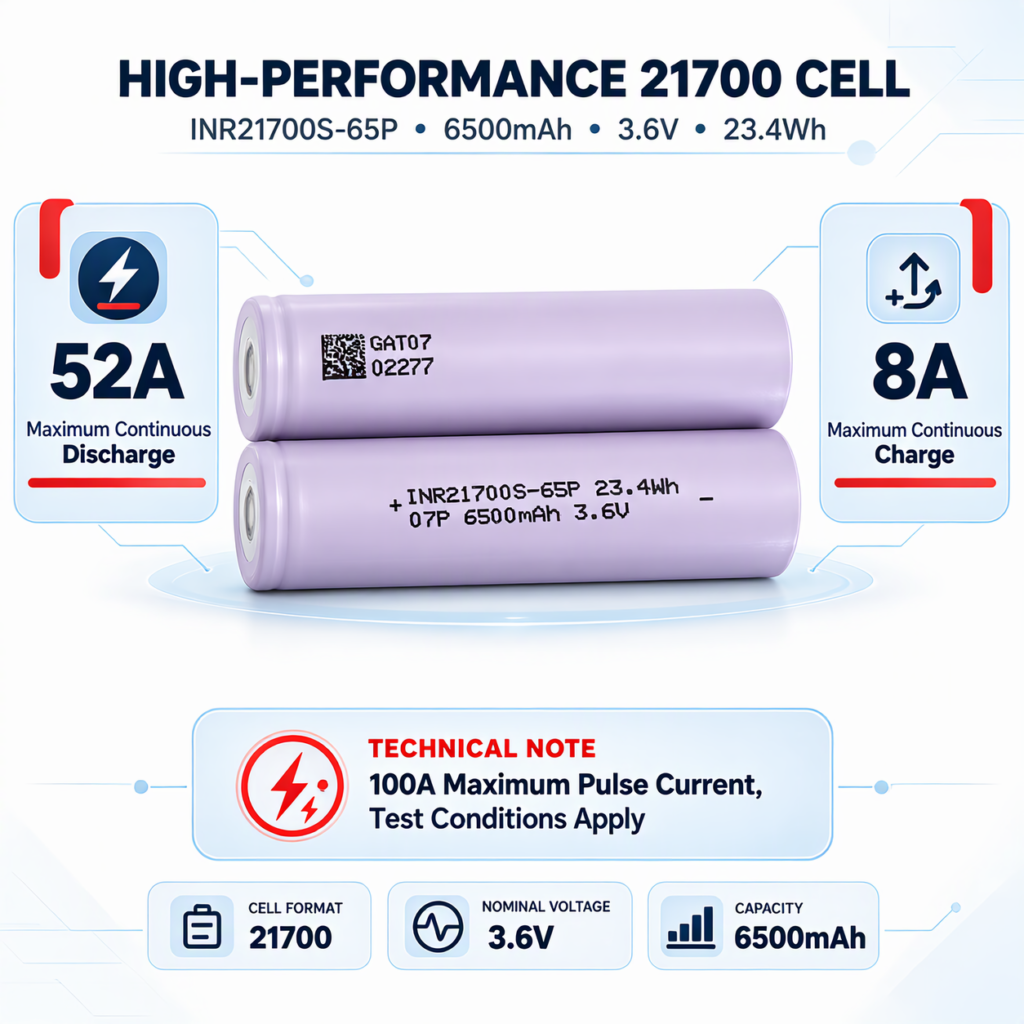
例えば, a cylindrical 21700 lithium ion cell with a nominal capacity of 6500mAh and a nominal voltage of 3.6V provides 23.4Wh of nominal energy. Its documented continuous discharge capability is up to 52A under the specified test conditions.
The actual performance of a finished battery pack depends on cell configuration, 温度, 配線, protection systems and thermal management. Cell-level specifications should not automatically be treated as battery-pack performance guarantees.
3. Low Temperature Performance Matters
Operating temperature is an important consideration for battery systems used in cold environments.
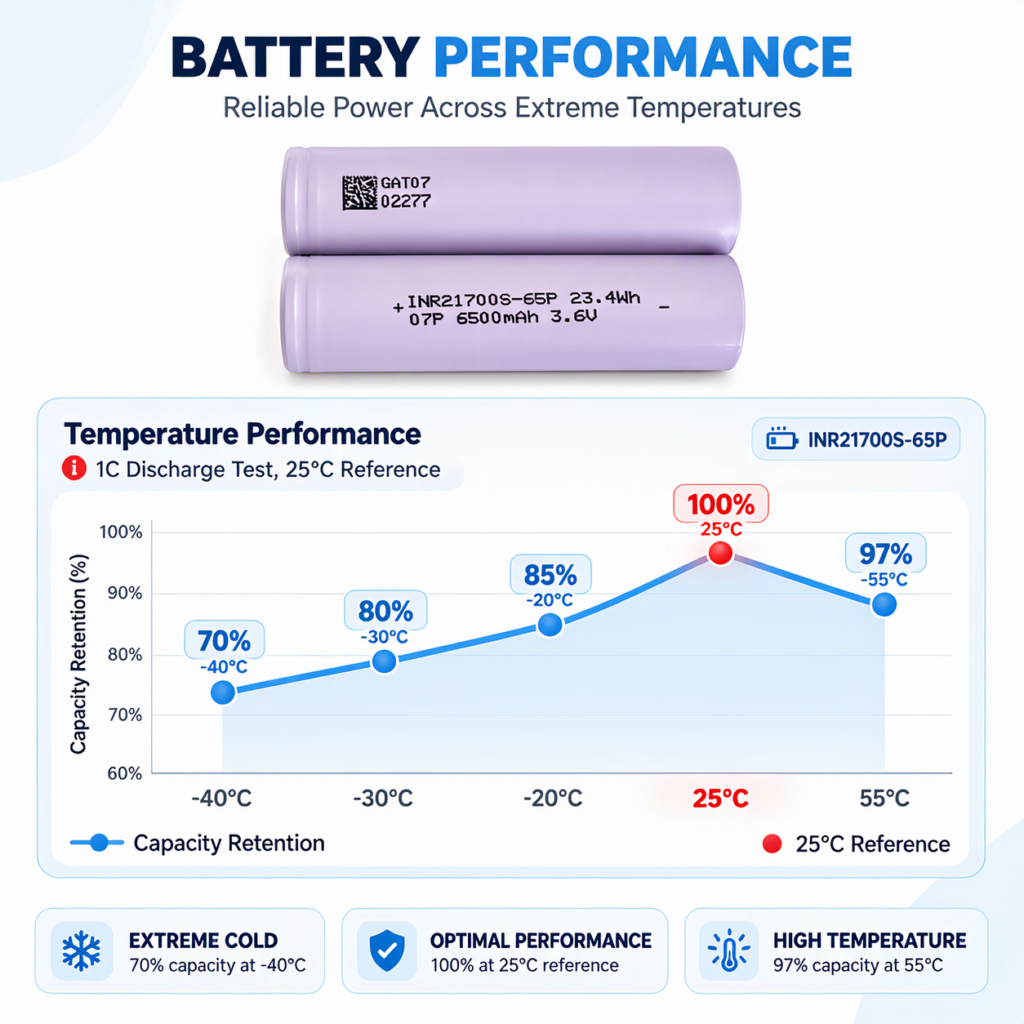
Low temperatures can affect battery capacity, internal resistance and available power output. したがって, battery manufacturers should evaluate cell performance under the temperature conditions expected in the target application.
Low temperature discharge testing provides useful reference data for battery pack development.
When selecting cells for cold-weather applications, buyers should consider:
-
Discharge capacity at different temperatures
-
Permitted charging temperature range
-
Charging current limitations
-
熱管理要件
-
Battery protection and monitoring functions
Charging and discharging have different temperature limitations. A cell’s low temperature discharge performance does not mean that charging is permitted at the same low temperature.
4. Cycle Performance and Long Term Reliability
Cycle performance is another important factor when evaluating lithium ion battery cells.
Battery manufacturers should review test conditions carefully rather than comparing cycle numbers alone. 充電電流, discharging current, 温度, depth of discharge and capacity retention criteria can all influence test results.
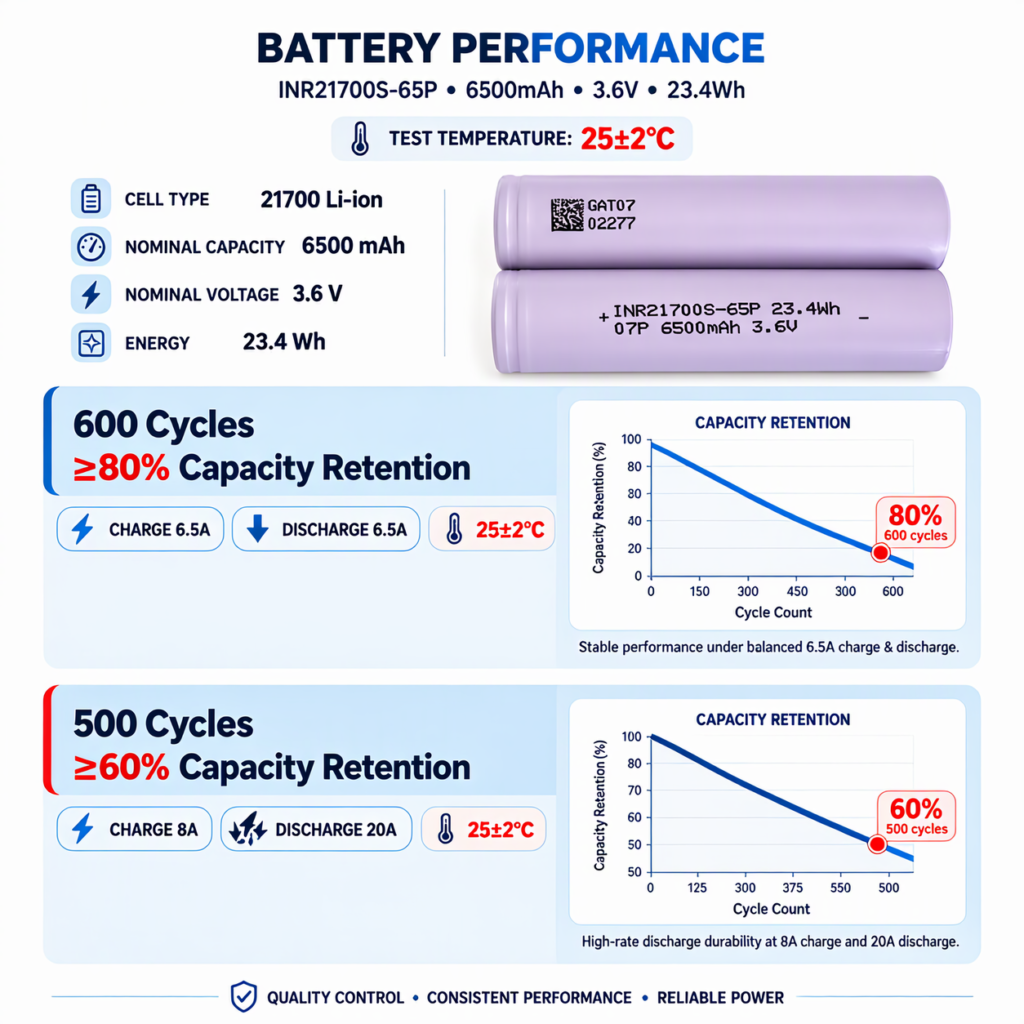
例えば, documented test results for a high-capacity cylindrical cell include:
-
At 6.5A charging and 6.5A discharging, capacity retention is at least 80% after 600 サイクル.
-
At 8A charging and 20A discharging, capacity retention is at least 60% after 500 サイクル.
-
Both tests are conducted at an ambient temperature of 25 ±2℃.
These results provide reference information for engineering evaluation. Actual battery life will vary according to application conditions, operating strategy and battery pack design.
5. What Should B2B Buyers Consider When Selecting 21700 細胞?
電池パックメーカー様向け, distributors and energy solution providers, choosing a suitable cell requires more than comparing capacity and price.
A comprehensive evaluation should include:
電気仕様
公称電圧を確認してください, nominal capacity, minimum capacity, charging voltage, discharge cut-off voltage and current limits.
機械的寸法
Confirm cell diameter, 身長, weight and dimensional tolerances to ensure compatibility with the intended battery enclosure.
Temperature requirements
Evaluate both charging and discharging temperature limits according to the actual application environment.
安全性と保護
The battery pack should incorporate appropriate overcharge, overdischarge and overcurrent protection, together with suitable temperature monitoring and thermal management.
Consistency and quality control
For series or parallel battery pack assembly, セルマッチング, voltage consistency and internal resistance consistency should be considered.
Technical documentation
Request the latest specification sheet and relevant test documentation before making purchasing and engineering decisions.
6. Building Better Battery Solutions Through Cell Selection
The development of a reliable battery system starts with selecting cells that match the intended application.
High-capacity cylindrical lithium ion cells can offer battery manufacturers additional flexibility in designing compact and power-oriented battery packs. それにもかかわらず, successful integration depends on a complete engineering approach that considers electrical performance, 熱挙動, mechanical design and protection systems.
B2Bバイヤー向け, comparing verified specifications and test conditions is an important step toward selecting the right battery cell for each project.
Whether developing customized battery packs or evaluating new battery supply options, working with accurate technical data helps reduce design uncertainty and supports more efficient product development.
Looking for high-capacity cylindrical lithium ion cells for your next battery project? Share your target capacity, 退院要件, 動作温度, battery configuration and estimated order quantity to begin a technical evaluation.