


11600mAh 3.4V High Energy Lithium Ion Polymer Pouch Battery Cell
11600mAh High Energy Lithium Ion Polymer Pouch Battery Cell
Product Overview
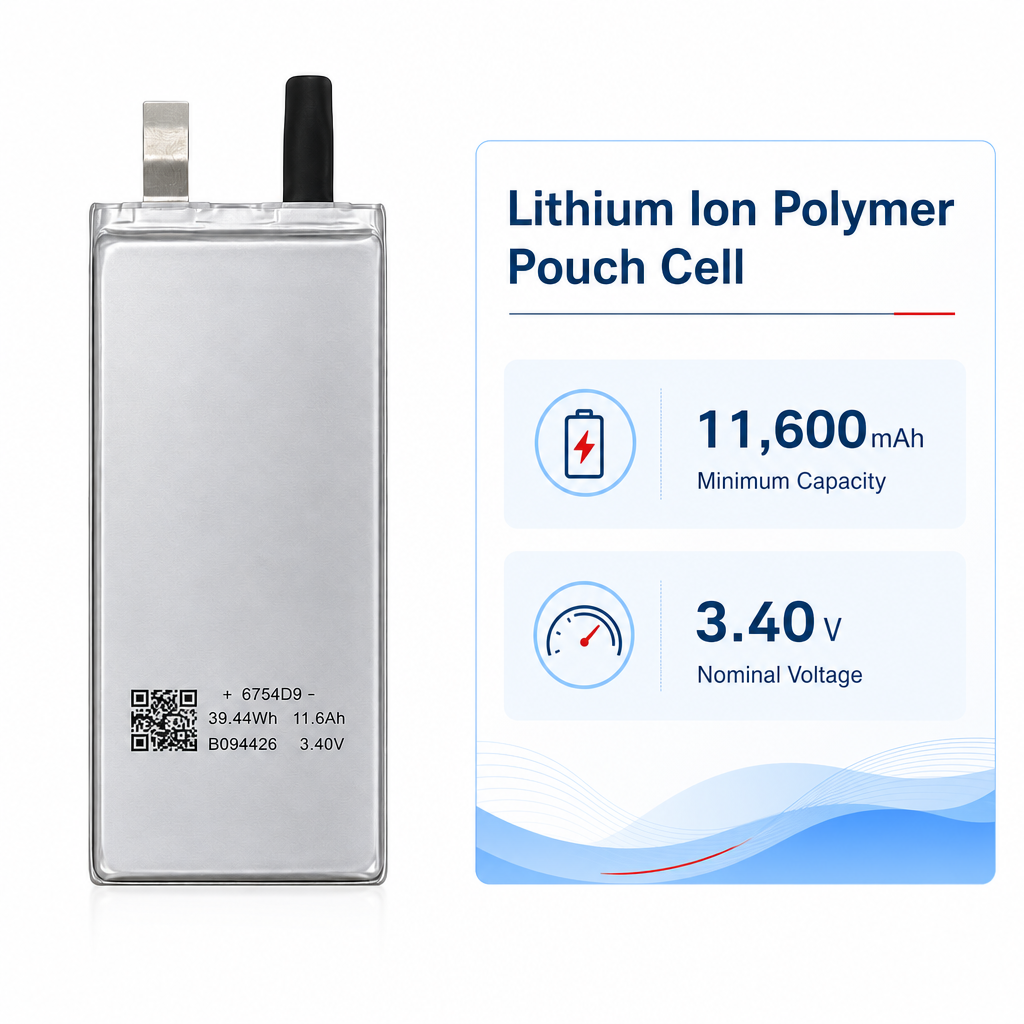
This 11,600mAh lithium ion polymer pouch battery cell is designed for specialized rechargeable battery applications requiring high capacity, lightweight construction and reliable electrical performance.
Featuring a nominal voltage of 3.40V and a minimum capacity of 11,600mAh, this rechargeable pouch cell provides a compact energy storage solution for professional battery pack development. Its lightweight pouch construction and slim mechanical profile offer flexibility for equipment designers and battery manufacturers working with space and weight constraints.
The cell specification identifies aerospace and aviation as its application area. Final application suitability must be evaluated through system level engineering, testing and qualification.
Electrical Performance
The cell features a nominal voltage of 3.40V, a maximum charge cut off voltage of 4.2V and a minimum discharge cut off voltage of 2.5V.
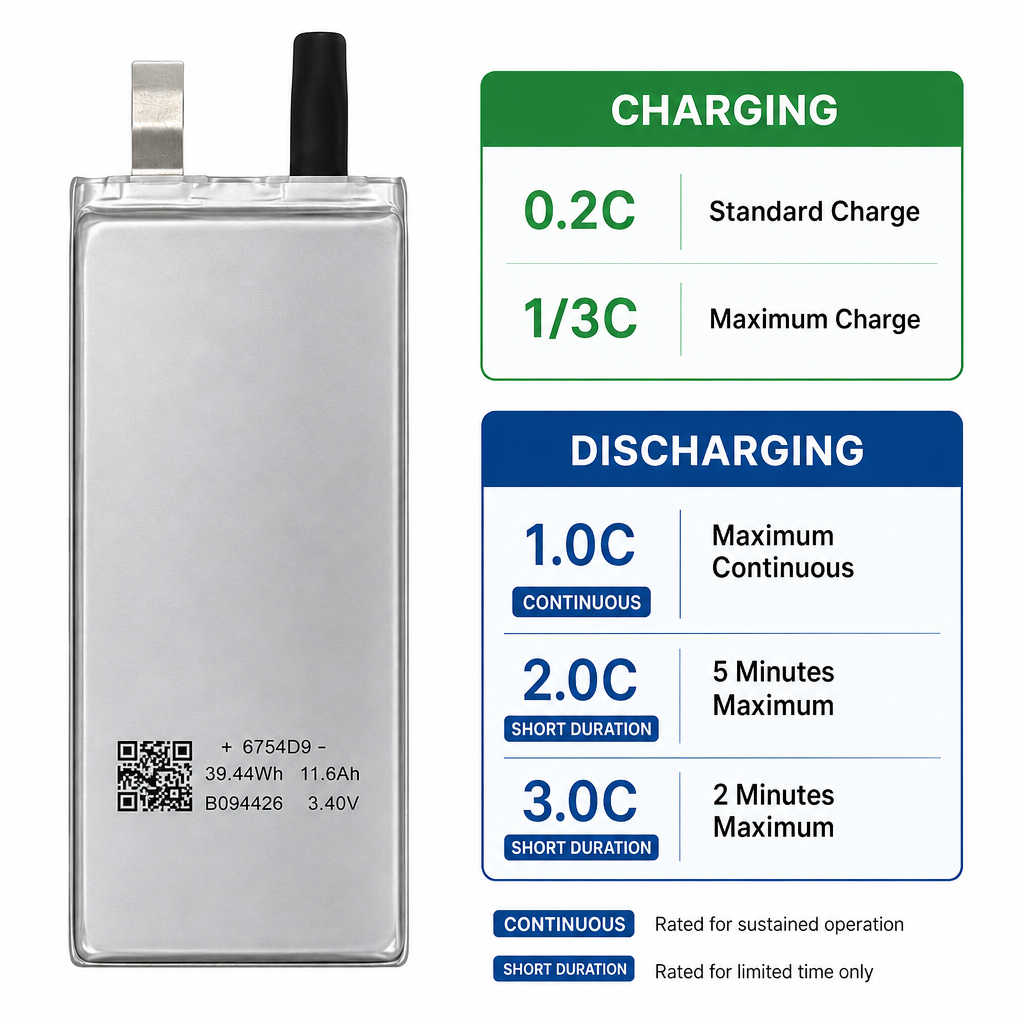
Its standard charging process uses 0.2C constant current charging to 4.2V, followed by constant voltage charging until the current decreases to 0.02C.
The specified maximum charging rate is 1/3C, while the maximum discharge rate is 1.0C. For short duration discharge requirements, the cell supports 2.0C discharge for 5 minutes and 3.0C discharge for 2 minutes under the specified conditions.
These characteristics provide battery pack engineers with important design references when evaluating electrical configurations and load requirements.
Temperature Performance
Temperature management is essential for lithium ion battery operation.
The specified cell surface temperature range is:
- Charging: 10°C to 55°C
- Discharging: minus 20°C to 55°C
The specification also provides low and high temperature discharge performance data at a 0.2C discharge rate. The stated capacity criteria include at least 70% at minus 20°C, 75% at minus 10°C, 85% at 0°C and 95% at 55°C.
Charging and discharging temperature limits are different. Appropriate temperature monitoring and protection functions are required in the final battery system.
Cycle Life Performance
The product specification includes multiple cycle testing conditions:
- Room temperature cycle test: at least 80% capacity retention after 200 cycles.
- Room temperature test at 70% depth of discharge: at least 80% energy retention after 500 cycles.
- 45°C cycle test: at least 80% capacity retention after 150 cycles.
These results are based on the specified laboratory procedures. Actual battery service life depends on charging and discharging conditions, temperature, system design and application requirements.
Lightweight and Slim Pouch Design
The cell has a documented weight of 103.0 ± 1.0g and a slim pouch format.
Mechanical dimensions:
- Length: 139.5 ± 0.6mm
- Width: 52.5 ± 1.5mm
- Thickness: 6.32 ± 0.25mm at 30% SOC
The compact profile can support battery pack layout planning where available installation space and product weight are important design considerations.
Battery Pack Integration and Protection
For safe battery pack development, the specification requires appropriate protection against overcharge, overdischarge, overcurrent, overheating and short circuit.
Battery pack designers should also consider secure cell fixing, insulation, suitable tab welding, temperature monitoring and charging control.
The cell should not be treated as a complete battery pack. Final system performance and safety must be validated according to the intended equipment and operating environment.
Applications
The specification identifies aerospace and aviation as the stated application area.
Potential project evaluation may include:
- Aerospace battery development
- Aviation power system development
- Specialized rechargeable battery packs
- Lightweight battery system projects
- Professional equipment battery development
Any use in aircraft, aerospace equipment or other safety critical systems requires independent engineering assessment and qualification for the final device.
B2B Supply and Project Cooperation
We support professional battery manufacturers, engineering teams, equipment developers and project purchasers evaluating rechargeable pouch cells.
For product inquiries, please provide your target battery voltage, required capacity, discharge profile, charging conditions, operating temperature, application and estimated order quantity.
This information helps establish the technical requirements for cell selection and battery pack development. Sample availability, order quantity, lead time and commercial terms are subject to confirmation for each project.
General Information
| Item | Specification |
|---|---|
| Battery Chemistry | Lithium Ion Polymer |
| Cell Format | Pouch Cell |
| Application Listed in Specification | Aerospace and Aviation |
| Nominal Voltage | 3.40V |
| Minimum Capacity | 11,600mAh |
| Calculated Energy | 39.44Wh |
| Cell Weight | 103.0 ± 1.0g |
39.44Wh is calculated from 11,600mAh minimum capacity × 3.40V nominal voltage. It is not a separately specified typical energy rating.
Electrical Characteristics
| Item | Specification |
|---|---|
| Charge Cut Off Voltage | 4.2V Maximum |
| Discharge Cut Off Voltage | 2.5V Minimum |
| Standard Charge Condition | 0.2C CC to 4.2V, then CV to 0.02C cut off |
| Maximum Charge Rate | 1/3C |
| Maximum Discharge Rate | 1.0C |
| Short Duration Discharge | 2.0C for 5 minutes |
| Short Duration Discharge | 3.0C for 2 minutes |
| Initial Impedance | ≤20mΩ at 1kHz AC after 50% charge |
Operating Temperature
| Operating Condition | Temperature Range |
|---|---|
| Charging | 10°C to 55°C |
| Discharging | minus 20°C to 55°C |
Low and High Temperature Discharge Performance
| Test Temperature | Capacity Criterion |
|---|---|
| minus 20°C | ≥70% |
| minus 10°C | ≥75% |
| 0°C | ≥85% |
| 55°C | ≥95% |
Test rate: 0.2C. Capacity percentages follow the reference conditions in the product specification.
Cycle Life Test Results
| Test Condition | Test Cycles | Performance Criterion |
|---|---|---|
| Room Temperature | 200 | Capacity retention ≥80% |
| Room Temperature, 70% DOD | 500 | Energy retention ≥80% |
| 45°C | 150 | Capacity retention ≥80% |
Mechanical Characteristics
| Item | Specification |
|---|---|
| Cell Length | 139.5 ± 0.6mm |
| Cell Width | 52.5 ± 1.5mm |
| Cell Thickness | 6.32 ± 0.25mm |
| Thickness Measurement Condition | 30% SOC |
| Cell Weight | 103.0 ± 1.0g |
Storage Conditions
| Storage Period | Temperature |
|---|---|
| Less than 3 months | minus 20°C to 45°C |
| Less than 12 months | 15°C to 25°C |
-
Regularly monitor cell voltage during storage.
-
Recharge cells when voltage is equal to or below 3.0V.
-
Cell voltage should not exceed 3.9V during storage.
-
Follow the specification’s shipping status and storage requirements.
Warranty and Protection Requirements
| Item | Specification |
|---|---|
| Warranty Period | 6 months after manufacture |
| Overcharge Protection | Required |
| Overdischarge Protection | Required |
| Overcurrent Protection | Required |
| Overheat Protection | Required |
| Short Circuit Protection | Required |
Important Technical Notes
-
The minimum capacity specification applies to unused fresh cells within 30 days after manufacture.
-
Cell surface temperature must remain within the specified charging and discharging ranges.
-
Manual soldering is not allowed for tab connections according to the specification.
-
Battery packs require suitable insulation, secure cell fixing and protection circuits.
-
Cell level test results do not certify the completed battery pack or host device.
Related Products
Related Blogs

11600mAh High Energy Lithium Ion Polymer Pouch Battery Cell
Product Overview
This 11,600mAh lithium ion polymer pouch battery cell is designed for specialized rechargeable battery applications requiring high capacity, lightweight construction and reliable electrical performance. Featuring a nominal voltage of 3.40V and a minimum capacity of 11,600mAh, this rechargeable pouch cell provides a compact energy storage solution for professional battery pack development. Its lightweight pouch construction and slim mechanical profile offer flexibility for equipment designers and battery manufacturers working with space and weight constraints. The cell specification identifies aerospace and aviation as its application area. Final application suitability must be evaluated through system level engineering, testing and qualification.Electrical Performance
The cell features a nominal voltage of 3.40V, a maximum charge cut off voltage of 4.2V and a minimum discharge cut off voltage of 2.5V. Its standard charging process uses 0.2C constant current charging to 4.2V, followed by constant voltage charging until the current decreases to 0.02C. The specified maximum charging rate is 1/3C, while the maximum discharge rate is 1.0C. For short duration discharge requirements, the cell supports 2.0C discharge for 5 minutes and 3.0C discharge for 2 minutes under the specified conditions. These characteristics provide battery pack engineers with important design references when evaluating electrical configurations and load requirements.Temperature Performance
Temperature management is essential for lithium ion battery operation. The specified cell surface temperature range is:- Charging: 10°C to 55°C
- Discharging: minus 20°C to 55°C
Cycle Life Performance
The product specification includes multiple cycle testing conditions:- Room temperature cycle test: at least 80% capacity retention after 200 cycles.
- Room temperature test at 70% depth of discharge: at least 80% energy retention after 500 cycles.
- 45°C cycle test: at least 80% capacity retention after 150 cycles.
Lightweight and Slim Pouch Design
The cell has a documented weight of 103.0 ± 1.0g and a slim pouch format. Mechanical dimensions:- Length: 139.5 ± 0.6mm
- Width: 52.5 ± 1.5mm
- Thickness: 6.32 ± 0.25mm at 30% SOC
Battery Pack Integration and Protection
For safe battery pack development, the specification requires appropriate protection against overcharge, overdischarge, overcurrent, overheating and short circuit. Battery pack designers should also consider secure cell fixing, insulation, suitable tab welding, temperature monitoring and charging control. The cell should not be treated as a complete battery pack. Final system performance and safety must be validated according to the intended equipment and operating environment.Applications
The specification identifies aerospace and aviation as the stated application area. Potential project evaluation may include:- Aerospace battery development
- Aviation power system development
- Specialized rechargeable battery packs
- Lightweight battery system projects
- Professional equipment battery development
B2B Supply and Project Cooperation
We support professional battery manufacturers, engineering teams, equipment developers and project purchasers evaluating rechargeable pouch cells. For product inquiries, please provide your target battery voltage, required capacity, discharge profile, charging conditions, operating temperature, application and estimated order quantity. This information helps establish the technical requirements for cell selection and battery pack development. Sample availability, order quantity, lead time and commercial terms are subject to confirmation for each project.Key Product Benefits
- 11,600mAh Minimum Capacity
Provides a specified minimum capacity of 11,600mAh under the documented 0.2C discharge test condition. - 3.40V Nominal Voltage
Offers a defined nominal voltage for rechargeable lithium ion battery system development. - Lightweight Construction
Weighs 103.0 ± 1.0g, supporting projects where battery weight is an important design factor. - Slim Pouch Format
Features a thickness of 6.32 ± 0.25mm at 30% SOC for compact mechanical integration. - 1C Discharge Capability
Supports a specified maximum discharge rate of 1.0C to the 2.5V cut off voltage. - Short Duration High Rate Support
Supports 2.0C discharge for 5 minutes and 3.0C discharge for 2 minutes under specified conditions. - Controlled Charging Process
Uses a standard CC CV charging method with a 4.2V charge cut off voltage. - Defined Temperature Window
Supports specified charging and discharging temperature ranges with documented low temperature discharge performance. - Documented Cycle Testing
Includes room temperature and elevated temperature cycle test results under defined laboratory conditions. - Mechanical Test Information
Includes drop, vibration and shock test procedures with specified acceptance criteria. - Battery Pack Engineering Reference
Provides detailed protection and integration requirements for professional battery pack development. - Professional B2B Project Support
Suitable for technical evaluation by battery manufacturers, equipment developers and specialized project purchasers.


Related Products
What products does YiFang offer?
YiFang specializes in batteries, chargers, battery packs, and power solutions, including Li-ion, LiMn (IMR), Ni-MH, and LiFePO₄ batteries.
Does YiFang provide OEM/ODM services?
Yes, we offer flexible OEM and ODM customization, including product design, specifications, and packaging to meet your exact requirements.
What industries use YiFang products?
Our products are widely used in e-cigarettes, UAVs, balance scooters, electric bikes, electronic equipment, toys, flashlights, and other commercial and industrial applications.
What is YiFang’s production capacity?
YiFang operates its own factory with automated production lines, producing up to 100,000 units daily, ensuring consistent quality and timely delivery.
How can I contact YiFang for orders or inquiries?
You can contact us via our website inquiry form, email, or phone. Our team is ready to provide professional guidance and customized solutions.
What industries use YiFang products?
Our products are widely used in e-cigarettes, UAVs, balance scooters, electric bikes, electronic equipment, toys, flashlights, and other commercial and industrial applications.
What industries use YiFang products?
Our products are widely used in e-cigarettes, UAVs, balance scooters, electric bikes, electronic equipment, toys, flashlights, and other commercial and industrial applications.
What warranty and after-sales support does YiFang offer?
We provide 6–12 months warranty, responsive customer support, and global insurance coverage for long-term reliability and customer peace of mind.