
Как высокоэнергетические литий-ионные полимерные элементы поддерживают конструкцию легкой батареи
As battery-powered equipment continues to evolve, manufacturers are looking for battery technologies that combine high energy capacity, lightweight construction, and reliable electrical performance. In applications where weight and available installation space are important, lithium ion polymer pouch cells offer an attractive solution for advanced battery pack development.
With their flexible packaging structure and high capacity in a compact format, pouch cells are increasingly considered by battery manufacturers and engineering teams developing specialized power systems.
1. What Makes Lithium Ion Polymer Pouch Cells Different?
Lithium ion polymer pouch cells use a lightweight flexible packaging structure instead of a traditional rigid cylindrical or prismatic metal casing.
This design offers several potential advantages:
-
Lightweight cell construction
-
Гибкая конструкция аккумуляторной батареи
-
Efficient use of available installation space
-
High capacity in a relatively slim form factor
-
Adaptability to customized battery configurations
Для производителей аккумуляторных батарей, these characteristics provide greater flexibility when developing power solutions for equipment with specific weight, размер, and energy requirements.
2. Key Performance Characteristics
When selecting a pouch cell for battery pack development, engineers should evaluate more than nominal capacity. Напряжение, требования к зарядке, возможность разряда, рабочая температура, физические размеры, and cycle performance all influence the final battery system.
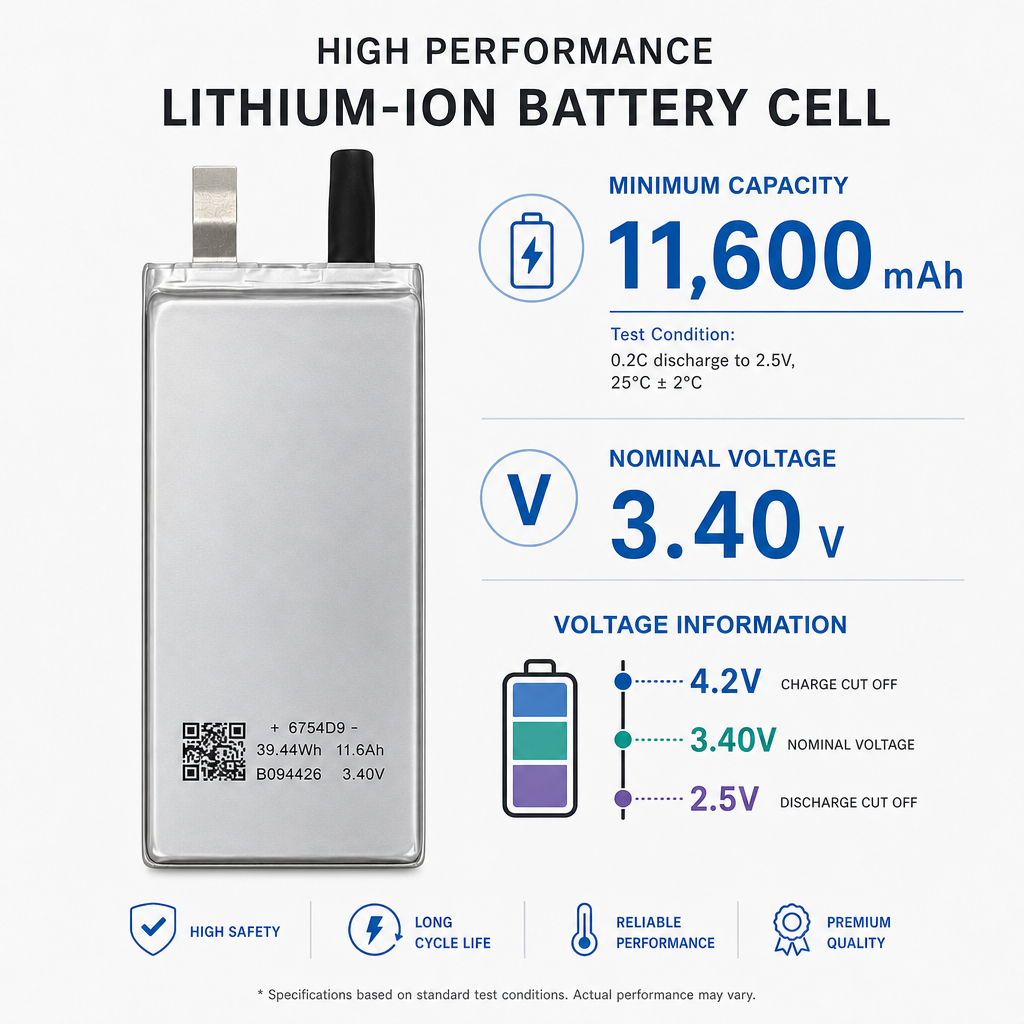
A high-capacity lithium ion polymer pouch cell with a nominal voltage of 3.40V and a minimum capacity of 11,600mAh can support battery designs that require substantial energy in a lightweight format.
Important electrical characteristics include:
| Параметр | Спецификация |
|---|---|
| Клеточная химия | Lithium Ion Polymer |
| Клеточная структура | Pouch Cell |
| Номинальное напряжение | 3.40В |
| Минимальная емкость | 11,600мАч |
| Charge Cutoff Voltage | 4.20В |
| Напряжение отсечки разряда | 2.50В |
| Maximum Continuous Charge Rate | 1/3С |
| Maximum Discharge Rate | 1.0С |
| Short Time Discharge | 2.0С для 5 минуты |
| Short Time Discharge | 3.0С для 2 минуты |
These specifications provide a starting point for battery engineers evaluating cell integration. The final battery pack must be designed around the actual operating conditions and the cell manufacturer’s requirements.
3. Why Lightweight Construction Matters
Weight is an important consideration in many modern battery-powered applications.
For aerospace-related equipment, aviation systems, портативные устройства, and specialized electronic equipment, reducing battery weight can help engineers manage overall system weight and installation space.
A pouch cell measuring approximately 139.5 × 52.5 × 6.32mm and weighing approximately 103g offers a slim format for applications where battery dimensions and mass need careful consideration.
Однако, selecting a lightweight cell is only one part of the engineering process. Структура аккумуляторной батареи, управление температурным режимом, электрические соединения, mechanical protection, and safety controls must also be considered.

4. Temperature Performance and Operating Conditions
Battery performance can change with temperature. This is particularly important for equipment expected to operate in environments with significant temperature variation.
The cell specification defines a charging surface temperature range from 10°C to 55°C and a discharging surface temperature range from minus 20°C to 55°C.
Its low-temperature discharge performance is also specified:
| Температура нагнетания | Capacity Performance |
|---|---|
| Minus 20°C | По меньшей мере 70% |
| Minus 10°C | По меньшей мере 75% |
| 0°С | По меньшей мере 85% |
| 55°С | По меньшей мере 95% |
These values are based on the specified test conditions and should not be interpreted as guaranteed performance under every operating environment.
Для производителей аккумуляторных батарей, temperature monitoring and appropriate thermal design remain essential to maintaining safe and stable operation.
5. Cycle Performance and Battery Development
Cycle performance is another important factor when evaluating cells for long-term applications.
В заданных условиях испытаний, the cell demonstrates the following results:
-
По меньшей мере 80% capacity retention after 200 cycles at room temperature.
-
По меньшей мере 80% energy retention after 500 cycles at room temperature under 70% глубина разряда.
-
По меньшей мере 80% capacity retention after 150 cycles at 45°C.
These results help battery engineers understand cell behavior under defined laboratory conditions.
Actual battery pack service life can vary depending on charging and discharging conditions, рабочая температура, глубина разряда, настройки защиты, and system design.

6. Потенциальные применения
Lithium ion polymer pouch cells can be considered for battery development projects where lightweight construction, компактные размеры, and high capacity are important.
Потенциальные области применения включают в себя:
Aerospace and Aviation Related Equipment
Lightweight battery design can be valuable in specialized aerospace and aviation equipment. Any safety-critical or flight-related application requires independent engineering assessment, qualification, and approval of the complete battery system.
Портативное энергетическое оборудование
Slim pouch cell structures can support customized battery packs for portable equipment with limited installation space.
Specialized Electronic Equipment
Battery manufacturers can evaluate pouch cells for electronic systems that require customized voltage, емкость, and packaging configurations.
Индивидуальные аккумуляторные блоки
Pouch cells provide battery pack developers with flexibility when designing application-specific battery solutions.
7. Important Considerations for Battery Pack Manufacturers
Choosing the right cell is only the first step. A reliable battery pack requires a complete engineering and manufacturing process.
Before integrating a pouch cell into a battery pack, manufacturers should evaluate:
-
Series and parallel configuration requirements.
-
Battery management system compatibility.
-
Overcharge and overdischarge protection.
-
Overcurrent and short circuit protection.
-
Overtemperature protection.
-
Thermal management and heat dissipation.
-
Mechanical support and cell compression requirements.
-
Charging and discharging control strategies.
-
Electrical connection and assembly methods.
-
Application-specific safety testing.
The battery pack must incorporate appropriate protection against overcharge, переразряд, сверхток, перегрев, and short circuits. Cell handling and electrical connection procedures must also follow the manufacturer’s technical instructions.
8. How to Select a Suitable Pouch Cell Supplier
Для B2B-покупателей, selecting a battery cell supplier involves more than comparing prices and nominal capacity.
A professional supplier should be able to provide:
-
Detailed product specifications
-
Consistent technical documentation
-
Battery application support
-
Cell configuration recommendations
-
OEM and ODM cooperation options
-
Sample availability for evaluation
-
Clear communication about product limitations and testing conditions
Прежде чем разместить оптовый заказ, buyers should confirm the intended application, необходимое количество, конфигурация батареи, sample testing requirements, and destination market.
Заключение
High-capacity lithium ion polymer pouch cells provide battery pack manufacturers with a flexible option for developing lightweight and space-efficient power systems.
Their slim structure, defined electrical characteristics, температурные характеристики, and cycle test data make them worth evaluating for specialized battery applications.
For engineering teams and B2B buyers, the most important step is matching the cell specifications with the actual application requirements. Careful battery pack design, appropriate protection systems, and application-specific testing are essential to achieving reliable performance.
If you are developing a customized battery pack, provide your target voltage, емкость, приложение, and estimated order quantity to discuss cell selection and potential OEM or ODM cooperation.