
As demand for rechargeable battery solutions continues to grow, lithium iron phosphate (LiFePO4) batteries have become an important option for industrial equipment, backup power systems and energy storage applications.
For battery pack manufacturers and system integrators, selecting the right individual battery cell is essential. Capacity, voltage, discharge performance, operating temperature, dimensions and cycle life all influence the final battery system.
A 15Ah LiFePO4 cylindrical battery cell in the 32135 format offers a combination of practical capacity, cylindrical construction and defined discharge characteristics. It can be evaluated for customized battery packs and various industrial power applications.
In this article, we explore its main specifications, technical advantages and potential applications.
1. What Is a 15Ah LiFePO4 Battery Cell?
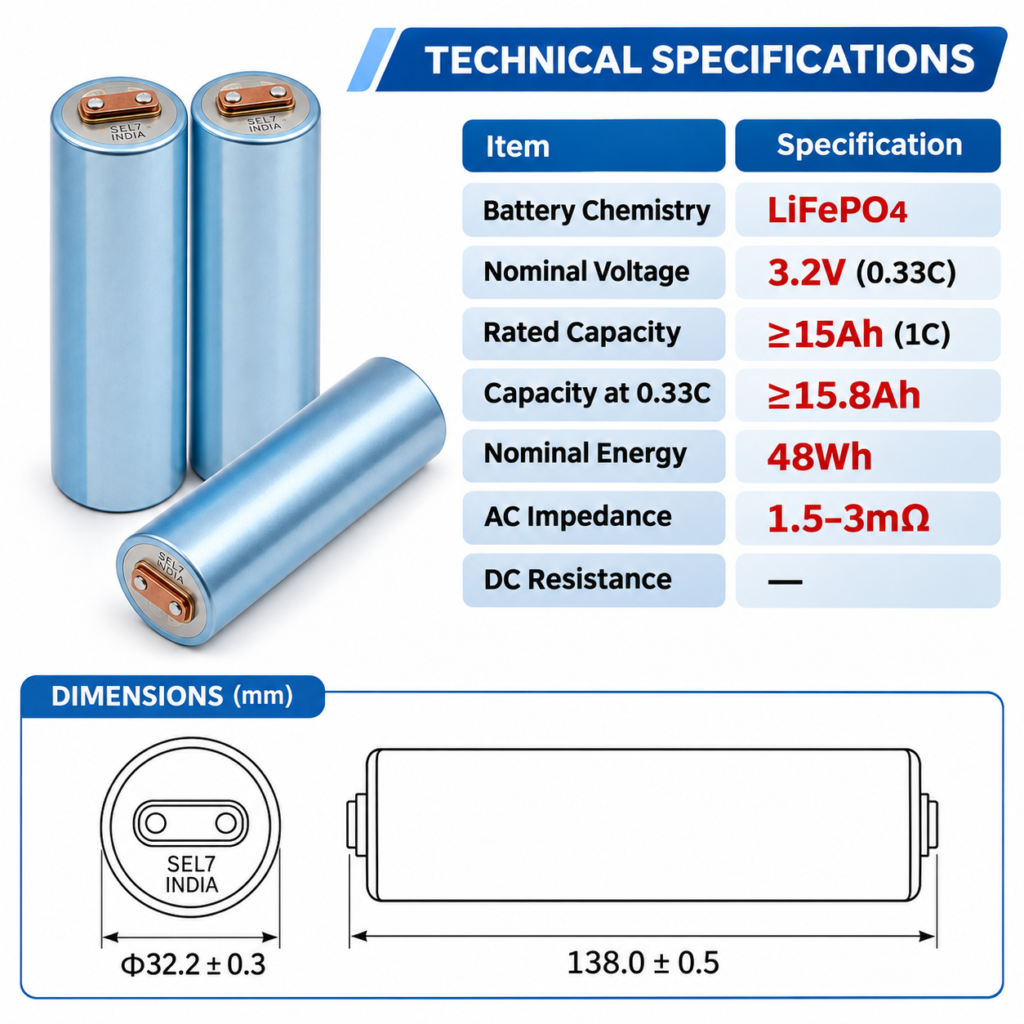
A 15Ah LiFePO4 battery cell is a rechargeable lithium iron phosphate cell with a nominal voltage of 3.2V under the specified 0.33C test condition.
The cylindrical 32135 format provides a standardized physical form for battery pack design and assembly.
Its main specifications include:
| Parameter | Specification |
|---|---|
| Chemistry | LiFePO4 |
| Nominal Voltage | 3.2V at 0.33C |
| Capacity | ≥15Ah at 1C |
| Capacity at 0.33C | ≥15.8Ah |
| Cell Format | 32135 |
| Dimensions | φ33.4 × 140.0mm |
| Weight | 267 ±4g |
| Continuous Discharge | 1C |
| Pulse Discharge | 3C/30s, 5C/10s |
These specifications provide a starting point for engineers and procurement teams evaluating cells for customized battery pack projects.
2. Key Advantages of LiFePO4 Cylindrical Cells
2.1 Lithium Iron Phosphate Chemistry
LiFePO4 chemistry is widely used in rechargeable battery applications because of its established electrochemical characteristics and suitability for repeated charge and discharge operation.
It is commonly considered for industrial battery packs, energy storage equipment and backup power applications.
2.2 Practical 15Ah Capacity
With a rated capacity of at least 15Ah at 1C discharge, this cell offers a useful capacity level for modular battery pack configurations.
Its nominal energy is approximately 48Wh, calculated using 3.2V × 15Ah.
For battery pack designers, the final system capacity depends on the number of cells connected in series and parallel.
2.3 High Pulse Discharge Capability
The cell specification provides the following discharge ratings:
-
Maximum continuous discharge: 1C
-
Pulse discharge: 3C for 30 seconds
-
Pulse discharge: 5C for 10 seconds
These pulse ratings may support applications with temporary power demands. They must be evaluated according to the specified test conditions, temperature limits and system design.
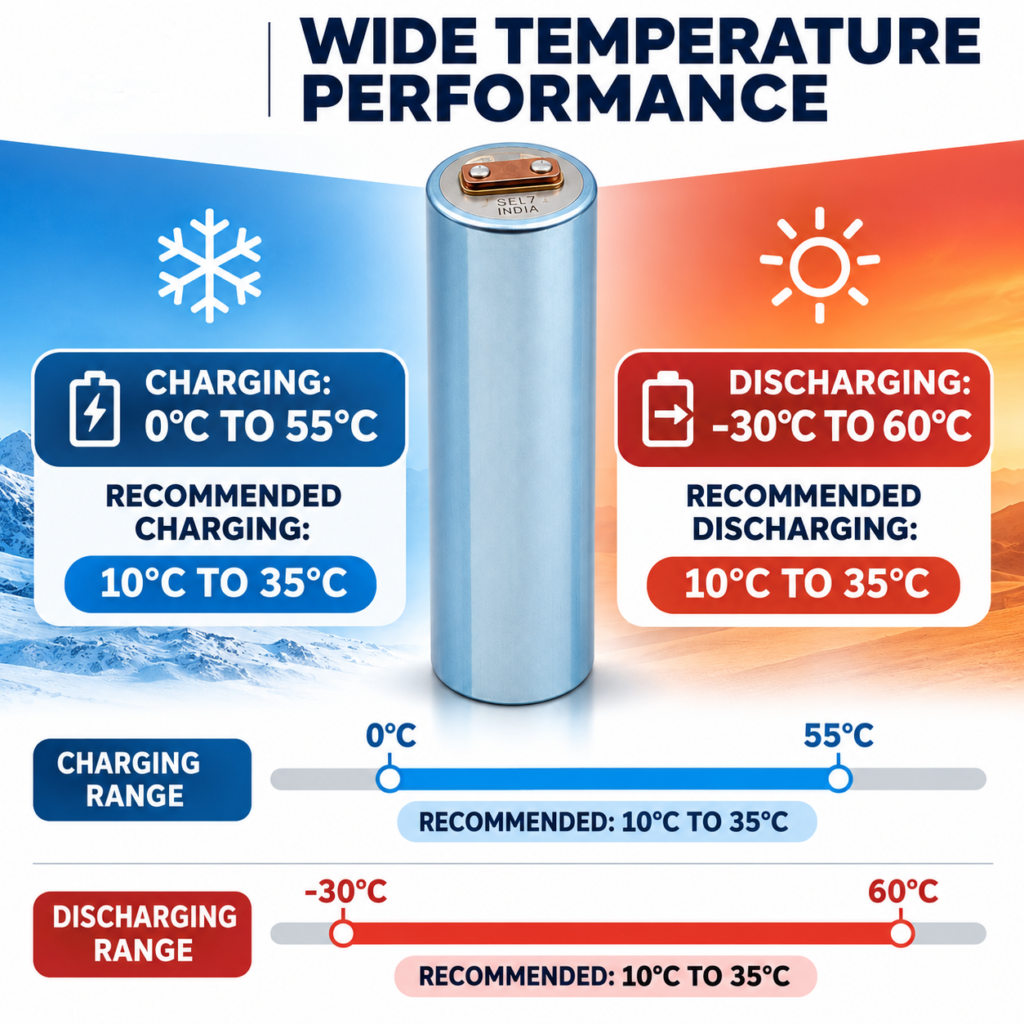
2.4 Wide Discharge Temperature Range
The specified discharge temperature range is -30°C to 60°C.
Low-temperature capacity retention is also provided in the technical specification:
| Temperature | Capacity Retention |
|---|---|
| 0°C | ≥85% |
| -10°C | ≥75% |
| -20°C | ≥70% |
| -30°C | ≥55% |
These figures are based on the specified 1C discharge test conditions and should not be interpreted as guaranteed performance under every operating environment.
3. Electrical Performance and Technical Characteristics
When selecting a LiFePO4 battery cell, engineers should review more than its nominal capacity.
Other important factors include voltage limits, internal resistance, efficiency and discharge capability.
The technical specification provides the following information:
| Performance Item | Specification |
|—|—|
| Standard Charging Voltage | 3.65V |
| Maximum Allowable Charging Voltage | 3.9V |
| Standard Discharge Cut-off | 2.50V |
| AC Impedance | 1.5–3mΩ |
| DC Resistance |
Industrial Battery Packs
Battery pack manufacturers can evaluate the cell for industrial equipment requiring rechargeable power solutions.
Energy Storage Battery Modules
The cell may be considered for modular energy storage designs, subject to system voltage, capacity and power requirements.
Backup Power Systems
Battery system developers can assess its suitability for backup power applications based on load profiles, operating duration and system configuration.
Customized Battery Solutions
For OEM and ODM projects, cell selection should be coordinated with pack structure, BMS parameters, thermal management and application-specific requirements.
5. What Should Battery Pack Manufacturers Consider?
Selecting a suitable cell is only one part of battery pack development.
Before purchasing cells in bulk, manufacturers should evaluate several important factors.
1. Series and Parallel Configuration
Determine the required battery voltage and capacity before calculating the number of cells needed.
2. BMS Compatibility
Ensure the BMS supports the cell’s charging voltage, discharge limits, temperature requirements and protection settings.
3. Thermal Management
Consider heat generation during continuous and pulse discharge, especially in high-density battery pack designs.
4. Mechanical Design
Check cell dimensions, terminal structure, insulation requirements and mounting arrangements.
5. Testing and Validation
Conduct sample testing and verify performance under the intended operating conditions before mass production.
6. Cycle Life and Long-Term Performance
Cycle life is an important consideration when evaluating rechargeable battery cells.
The provided specification lists the following cycle-life references:
| Test Condition | Cycle Life Reference |
|---|---|
| Standard Condition | 2,000 cycles |
| 45°C Condition | 1,000 cycles |
A separate test-method section also describes a 3,000-cycle test with at least 80% capacity retention.
These results refer to different test conditions and methods. Buyers should request the applicable test protocol and complete supporting reports before using cycle-life figures in product guarantees or project calculations.
The specification also lists a calendar life of at least 10 years under specified conditions.
Actual service life depends on charging and discharging profiles, temperature, storage conditions and battery management.

7. How to Choose a Reliable LiFePO4 Battery Cell Supplier
For B2B buyers, product specifications are important, but supplier evaluation is equally necessary.
Consider the following points:
-
Complete technical datasheets and traceable product specifications.
-
Consistent cell quality between production batches.
-
Sample availability for engineering evaluation.
-
Technical support for battery pack integration.
-
Clear communication about MOQ, lead time and delivery arrangements.
-
Relevant safety and transportation documentation.
-
OEM/ODM cooperation capabilities where required.
For larger procurement projects, it is recommended to confirm the application, target quantity, technical requirements and delivery destination before requesting a quotation.
8. Frequently Asked Questions
Q1: What is the nominal voltage of this 15Ah LiFePO4 cell?
The nominal voltage is 3.2V at 0.33C. The specification also lists 3.1V at 1C.
Q2: What is its rated capacity?
The capacity is at least 15Ah at 1C discharge and at least 15.8Ah at 0.33C discharge.
Q3: What is the maximum continuous discharge rate?
The maximum continuous discharge rate is 1C.
Q4: Can it support high pulse discharge?
Yes. The specification lists 3C for 30 seconds and 5C for 10 seconds under specified conditions.
Q5: What is the discharge temperature range?
The specified discharge temperature range is -30°C to 60°C.
Q6: What is the standard charging voltage?
The standard charging voltage is 3.65V. The maximum allowable charging voltage is 3.9V, which should not be confused with the standard charging target.
9. Conclusion
The 15Ah LiFePO4 cylindrical battery cell combines a 3.2V nominal voltage, 32135 format, defined pulse discharge capability and a wide specified discharge temperature range.
For battery pack manufacturers, industrial equipment developers and energy storage system integrators, it offers a cell option worth evaluating for customized rechargeable battery projects.
The most effective way to select the right battery cell is to compare its actual technical specifications with the project’s voltage, capacity, discharge, temperature and service-life requirements.
Looking for a 15Ah LiFePO4 battery cell for your next project?
Contact our team with your target application, required quantity, battery configuration and delivery country to discuss technical specifications, sample evaluation and B2B supply options.