
1. Introduction: What Is an 18650 2000mAh Lithium-Ion Battery Cell?
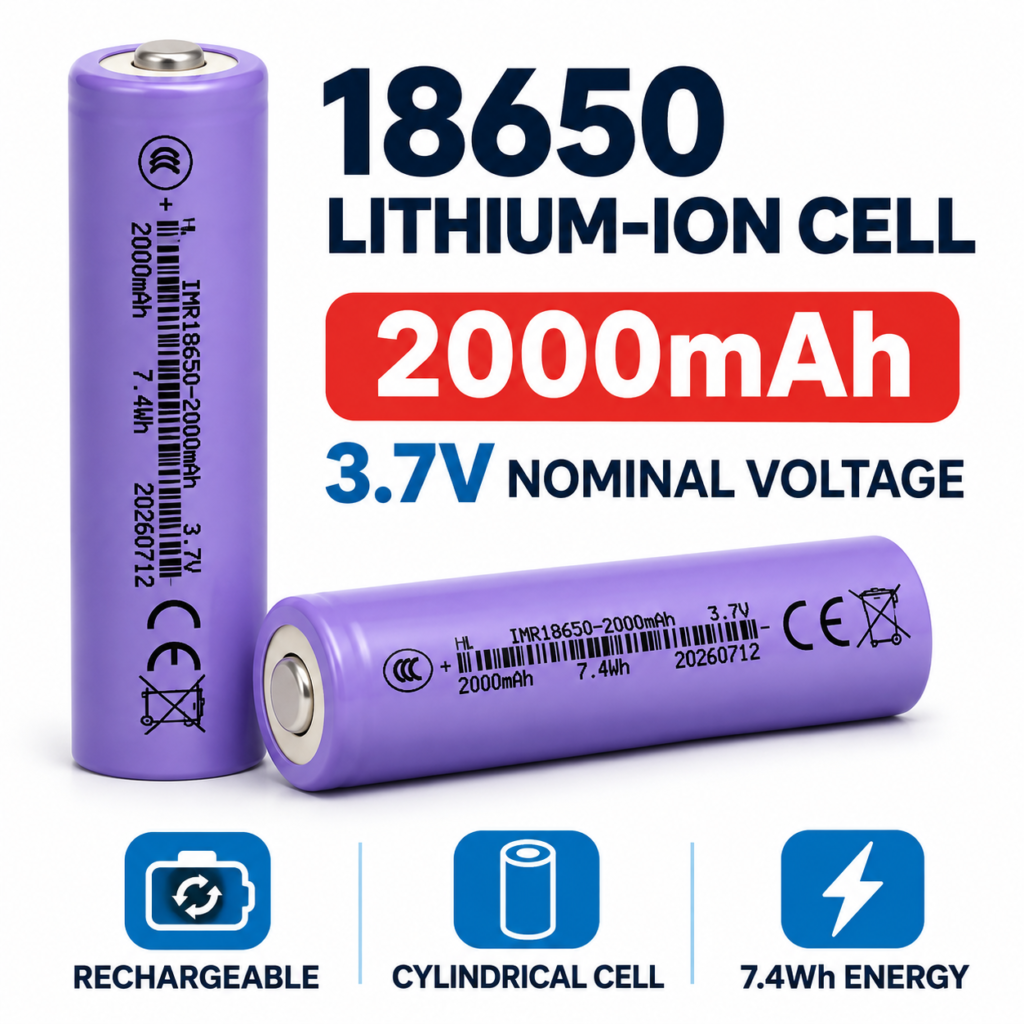
The 18650 2000mAh lithium-ion battery cell is a rechargeable cylindrical battery designed for compatible electronic devices and battery pack applications. With a nominal voltage of 3.7V and a rated capacity of 2000mAh, it provides 7.4Wh of rated energy in a compact cylindrical format.
The 18650 format is widely used in rechargeable battery pack designs because of its standardized dimensions and convenient integration into multi-cell configurations.
For battery manufacturers, distributors, and equipment producers, selecting a suitable 18650 cell requires evaluating more than capacity alone. Voltage, charging current, discharge current, internal impedance, operating temperature, and physical dimensions all need to match the target application.
2. Key Specifications of the 18650 2000mAh Battery
Understanding the technical specifications is essential when selecting a lithium-ion cell for battery pack development.
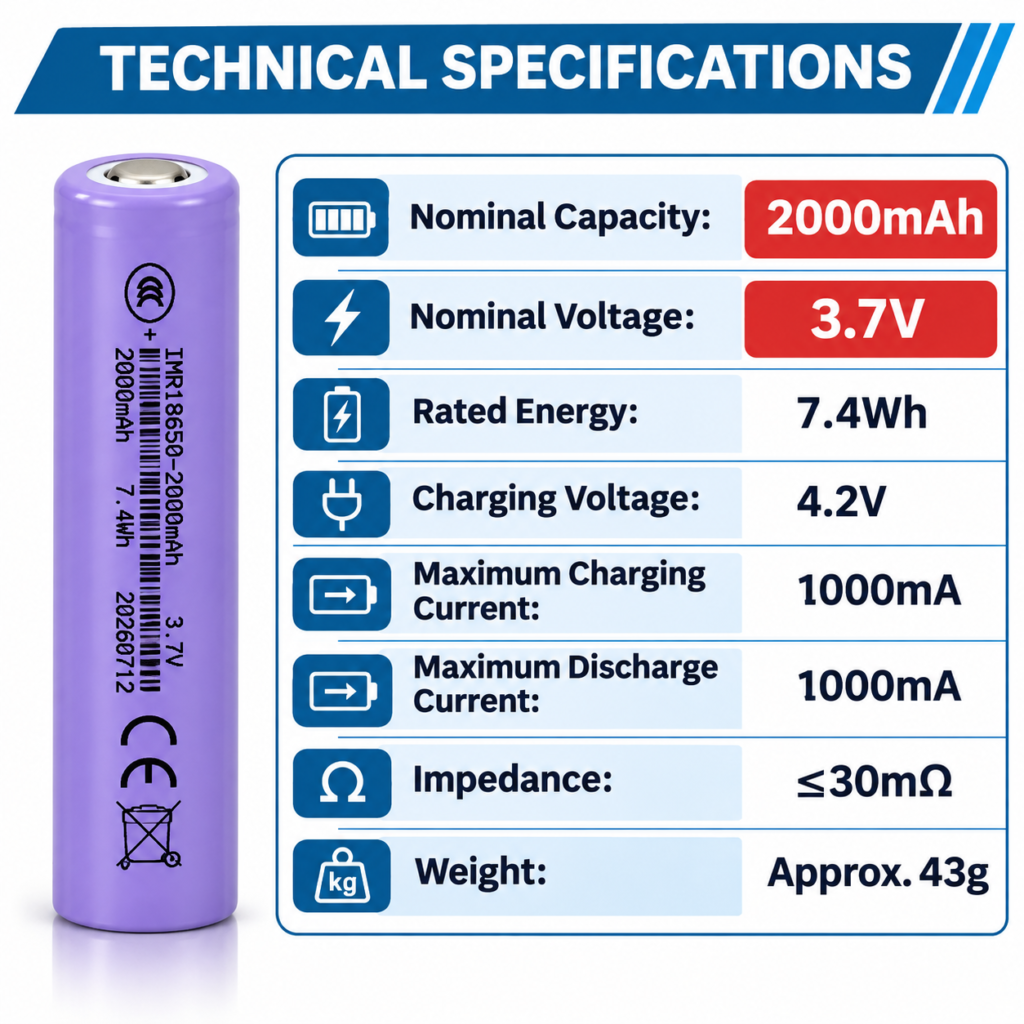
The main specifications of this cell include:
| Parameter | Specification |
|---|---|
| Cell Format | 18650 Cylindrical |
| Battery Chemistry | Lithium-Ion |
| Nominal Voltage | 3.7V |
| Nominal Capacity | 2000mAh |
| Rated Energy | 7.4Wh |
| Standard Charging Voltage | 4.2V |
| Recommended Charging Current | 400mA |
| Maximum Charging Current | 1000mA |
| Maximum Discharge Current | 1000mA |
| Internal Impedance | ≤30mΩ |
| Approximate Weight | 43g |
| Diameter | 18.2 ± 0.3mm |
| Flat-top Height | 65.0 ± 0.5mm |
| Button-top Height | 67.3 ± 0.5mm |
These specifications provide a reference for engineers and purchasing teams when evaluating compatibility with battery management systems, charging circuits, and battery pack structures.
3. Why Choose a 2000mAh 18650 Lithium-Ion Cell?
3.1 Standard 3.7V Nominal Voltage
The 3.7V nominal voltage makes this cell suitable for battery designs developed around conventional rechargeable lithium-ion configurations.
Battery pack designers can connect multiple compatible cells in series and parallel to achieve the required voltage and capacity. The final configuration should be determined by the equipment’s electrical requirements and an appropriate battery management system.
3.2 Compact Cylindrical Design
The 18650 cylindrical format provides a compact form factor for battery pack assembly.
Its specified diameter and height help engineers evaluate cell spacing, holder compatibility, enclosure dimensions, and overall battery pack layout.
3.3 7.4Wh Rated Energy
With a nominal voltage of 3.7V and capacity of 2000mAh, the rated energy is 7.4Wh.
This provides a useful reference for estimating the energy capacity of compatible battery pack configurations.
3.4 Defined Charging and Discharging Parameters
The cell has a recommended charging current of 400mA and a maximum charging current of 1000mA. Its specified maximum discharge current is also 1000mA.
Following the manufacturer’s charging and discharging limits is important for battery performance and safe system design.
4. Charging and Discharging Considerations
Proper charging and discharging conditions are essential for rechargeable lithium-ion batteries.
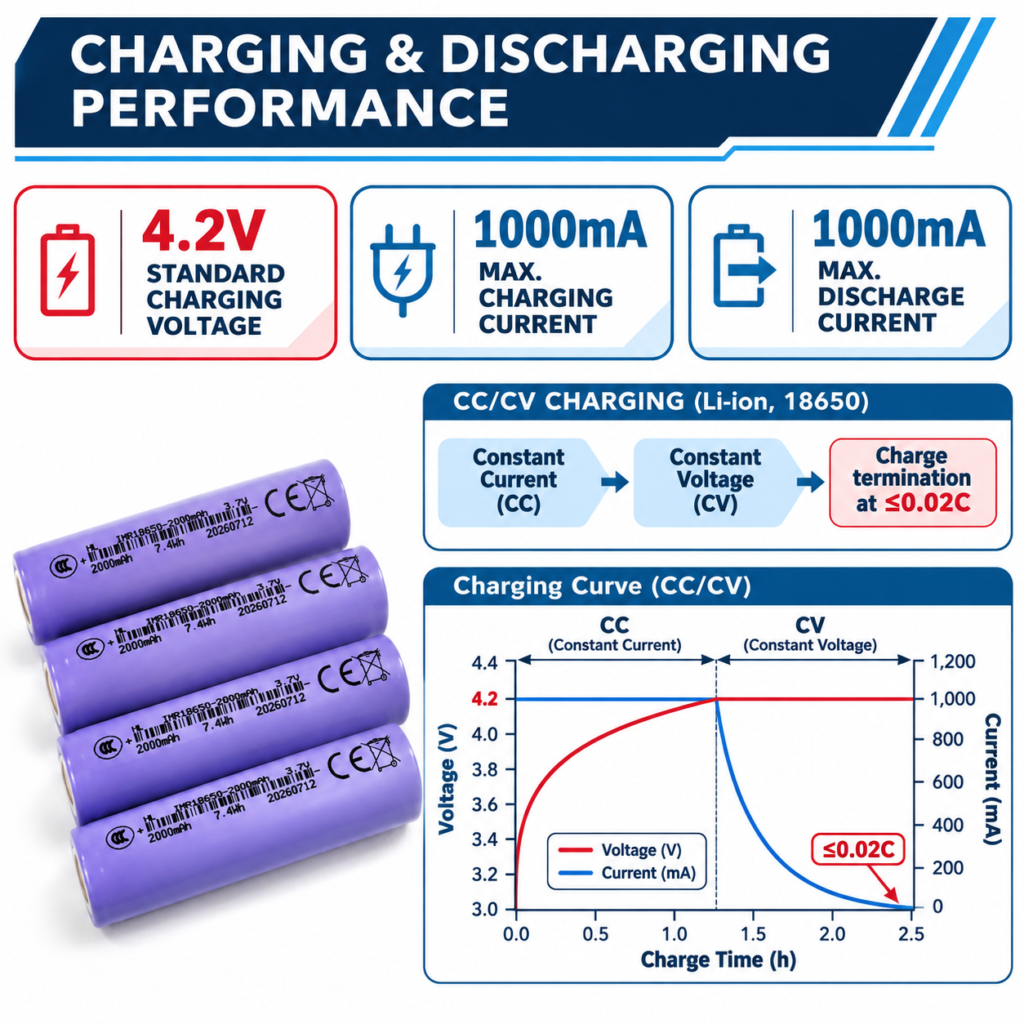
For this 18650 2000mAh cell, the manufacturer’s specification provides the following charging parameters:
-
Standard charging voltage: 4.2V
-
Recommended charging current: 400mA
-
Maximum charging current: 1000mA
-
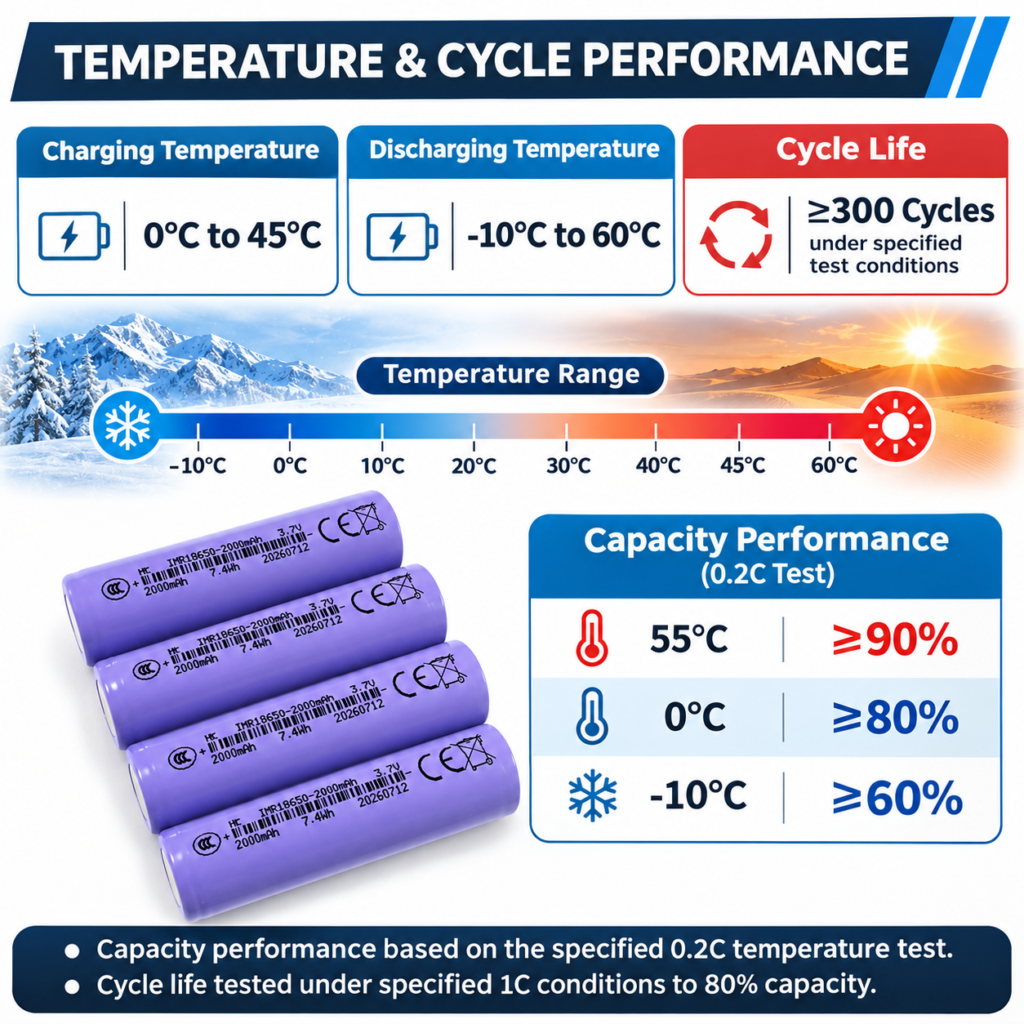
Charging temperature: 0°C to 45°C
The specified maximum discharge current is 1000mA, and the operating discharge temperature range is -10°C to 60°C.
Battery pack manufacturers should select compatible charging circuits and protection systems based on the final application.
The discharge cut-off voltage should also be confirmed with the manufacturer before finalizing the battery pack design, because different sections of the supplied specification contain different end-of-discharge references.
5. Operating Temperature and Cycle Life
Temperature conditions influence the performance and service life of lithium-ion battery cells.
According to the supplied product specification, the operating temperature ranges are:
| Operation | Temperature Range |
|---|---|
| Charging | 0°C to 45°C |
| Discharging | -10°C to 60°C |
| Storage | -10°C to 45°C |
The specification also states a cycle life of at least 300 cycles under its defined 1C charge/discharge test method to 80% capacity.
It is important to understand that cycle life depends on testing conditions, including charging and discharging current, temperature, voltage limits, and operating environment. Actual results in a finished battery pack may differ.
6. Applications of 18650 2000mAh Lithium-Ion Battery Cells
18650 lithium-ion cells can be considered for different battery pack projects, provided the electrical characteristics and safety requirements are compatible.
Potential application areas include:
Battery Pack Manufacturing
Battery pack manufacturers can evaluate 18650 cells for customized rechargeable battery assemblies. Cell quantity and series-parallel configuration depend on the required voltage and capacity.
Portable Electronic Equipment
The compact cylindrical format may be suitable for compatible portable electronic products that require rechargeable lithium-ion power.
Industrial Electronic Equipment
Equipment manufacturers can assess this cell for devices with matching voltage, current, capacity, and environmental requirements.
Customized OEM/ODM Battery Projects
For OEM and ODM projects, buyers can discuss cell selection, pack configuration, dimensions, electrical requirements, and production quantities with their battery supplier.
Note: These are potential application categories, not a claim that the cell has been approved or certified for every application listed.
7. What Should Buyers Consider When Sourcing 18650 Battery Cells?
For B2B buyers, selecting the right battery cell involves evaluating technical suitability and supplier reliability.
Consider the following factors before placing an order:
-
Capacity consistency: Confirm the rated capacity and capacity testing method.
-
Voltage compatibility: Check the cell’s nominal and charging voltage against the intended system.
-
Current requirements: Ensure charging and discharging limits meet the application.
-
Physical dimensions: Confirm diameter, height, and terminal type.
-
Internal impedance: Review the manufacturer’s specified impedance.
-
Operating temperature: Check the actual operating environment.
-
Quality documentation: Request available test reports and product specifications.
-
Sample evaluation: Test samples before confirming mass production.
-
Battery pack compatibility: Verify the BMS, protection circuit, and pack configuration.
-
Supply cooperation: Discuss order quantity, delivery requirements, and long-term sourcing needs.
A professional supplier should be able to provide clear technical information and communicate with buyers about their project requirements.
8. Frequently Asked Questions
Q1: What is the nominal voltage of this 18650 battery cell?
The nominal voltage is 3.7V.
Q2: What is its rated capacity?
The rated capacity is 2000mAh.
Q3: How much energy does it provide?
Its rated energy is 7.4Wh.
Q4: What is the standard charging voltage?
The standard charging voltage is 4.2V.
Q5: What is the recommended charging current?
The recommended charging current is 400mA.
Q6: What is the maximum charging current?
The specified maximum charging current is 1000mA.
Q7: What is the maximum discharge current?
The specified maximum discharge current is 1000mA.
Q8: What are the cell dimensions?
The diameter is 18.2 ± 0.3mm. The flat-top height is 65.0 ± 0.5mm, while the button-top height is 67.3 ± 0.5mm.
Q9: What is the operating temperature range?
The charging temperature range is 0°C to 45°C, and the discharging temperature range is -10°C to 60°C.
Q10: Can this cell be used for customized battery packs?
It can be evaluated for compatible battery pack projects. The final configuration should be based on the equipment’s electrical and mechanical requirements.
9. Conclusion: Choosing the Right 18650 Battery Cell for Your Project
The 18650 2000mAh 3.7V rechargeable lithium-ion battery cell offers a compact cylindrical format, 7.4Wh rated energy, and clearly defined charging and discharging parameters.
For battery manufacturers, distributors, and equipment producers, it can be considered for compatible battery pack projects where its capacity, current limits, dimensions, and operating temperature meet the design requirements.
Before starting mass production, buyers should confirm the technical specifications, evaluate samples, and verify compatibility with the complete battery system.
Looking for a reliable 18650 lithium-ion battery cell supplier?
Contact our team to discuss your required quantity, application, battery pack configuration, sample requirements, and OEM/ODM project details.