
Introduction
Rechargeable lithium-ion battery cells are widely used in modern electronic devices, portable equipment and customized battery packs. Among the available cylindrical cell formats, the 18650 battery remains a popular option for manufacturers and battery pack assemblers.
The 18650 2500mAh lithium ion battery combines a nominal voltage of 3.7V with a rated capacity of 2500mAh. It is a rechargeable cylindrical cell that can be considered for various battery-powered applications, depending on the electrical requirements and design of the final product.
For B2B buyers, selecting the right battery cell involves more than comparing capacity and price. Cell specifications, application requirements, compatibility, quality consistency and supplier capabilities should all be evaluated before placing a bulk order.
1. What Is an 18650 2500mAh Lithium Ion Battery?
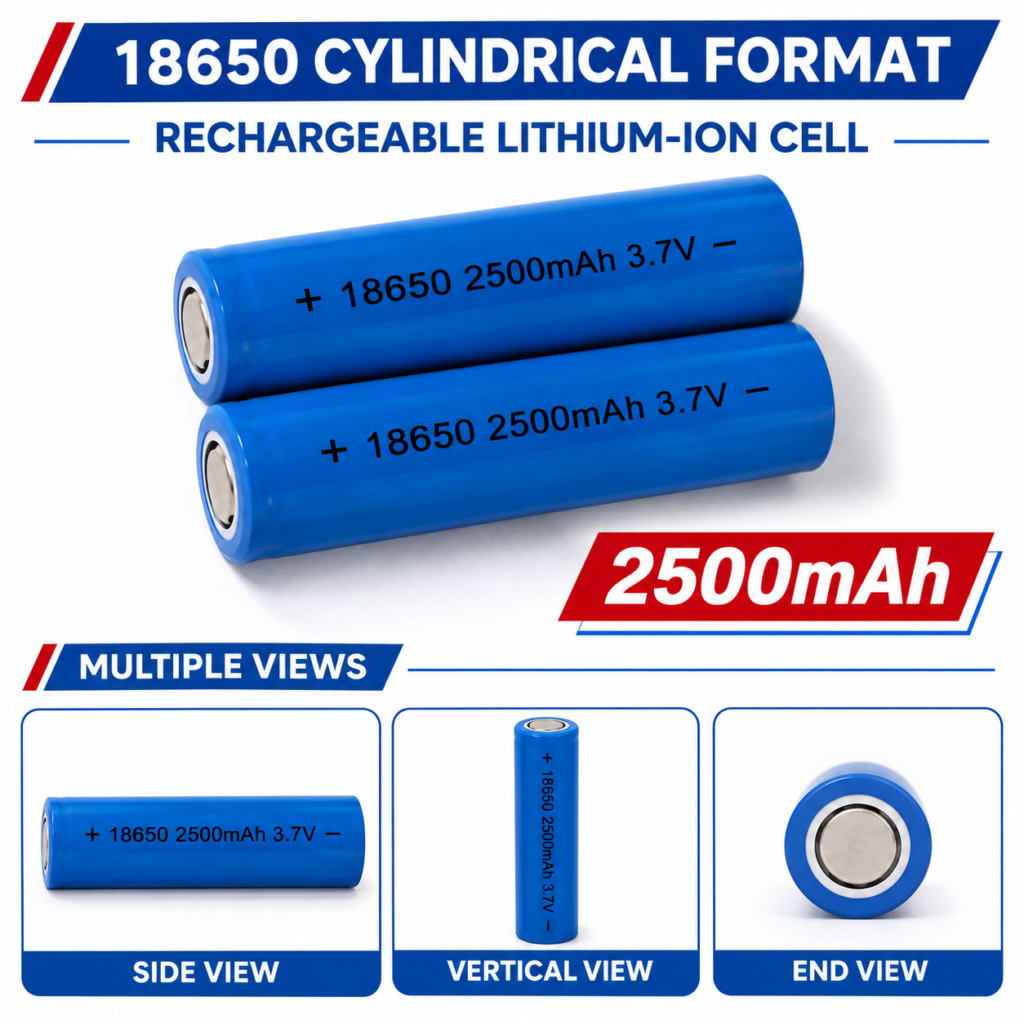
An 18650 battery is a cylindrical rechargeable lithium-ion cell format commonly used in battery-powered equipment and custom battery pack assemblies.
The name “18650” refers to its nominal size category:
- 18: Approximately 18 mm in diameter
- 65: Approximately 65 mm in length
- 0: Cylindrical cell format
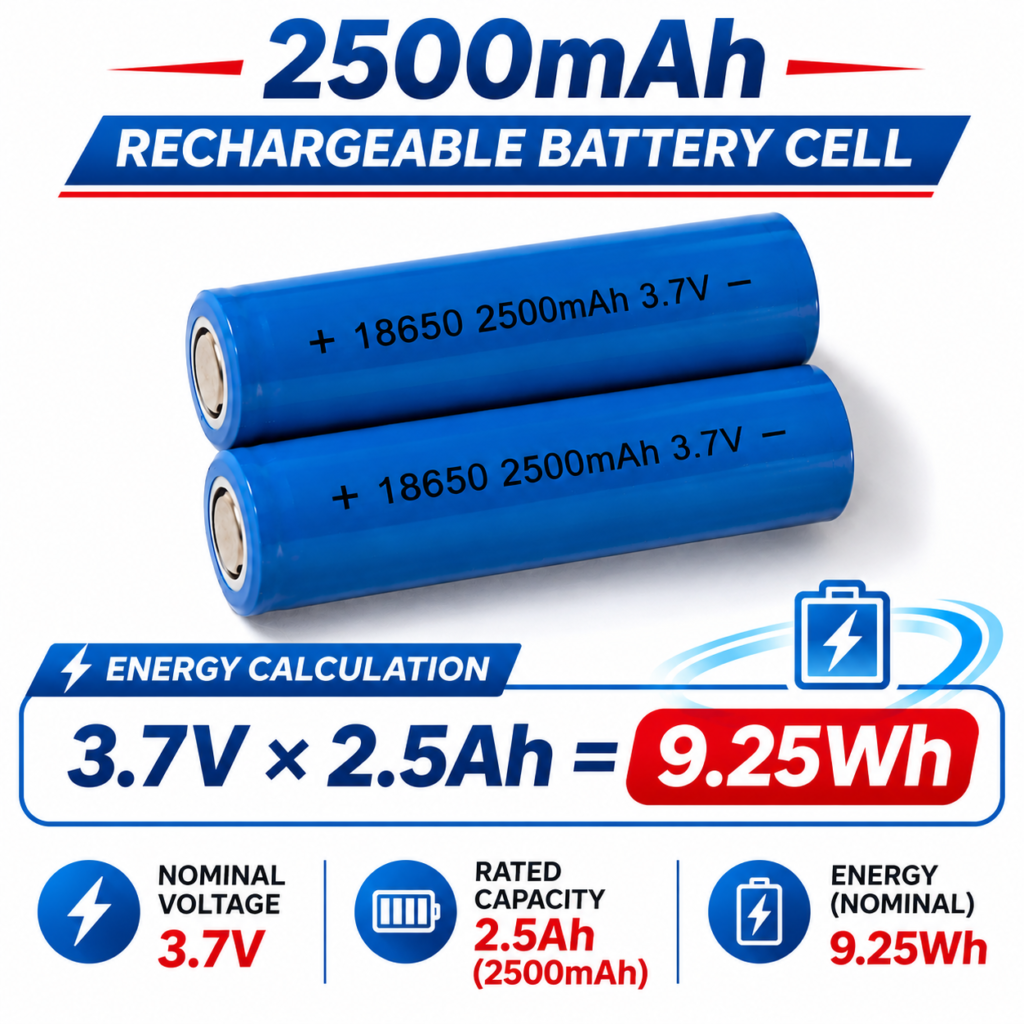
The product discussed in this article has the following confirmed specifications:
| Parameter | Specification |
|---|---|
| Battery Type | Lithium Ion Battery |
| Cell Format | 18650 |
| Nominal Voltage | 3.7V |
| Capacity | 2500mAh |
| Rechargeable | Yes |
| Nominal Energy | 9.25Wh (calculated) |
The nominal energy is calculated by multiplying nominal voltage by capacity: 3.7V × 2.5Ah = 9.25Wh. Actual usable energy depends on the cell’s operating conditions and the design of the battery system.
2. Key Features of a 2500mAh 18650 Battery Cell
3.7V Nominal Voltage
The 3.7V nominal voltage makes this cell a candidate for battery-powered designs that use compatible lithium-ion cell configurations. The required voltage of the finished battery pack depends on the number of cells connected in series.
2500mAh Capacity
A capacity of 2500mAh represents the cell’s rated charge capacity. For battery pack manufacturers, capacity is an important factor when calculating the overall energy capacity of a pack.
Standard 18650 Cylindrical Format
The 18650 format is widely recognized in the battery industry. It can be considered for compatible battery holders, modules and custom battery pack designs. Buyers should confirm the actual cell dimensions and mechanical tolerances with the supplier before finalizing their design.
Rechargeable Lithium-Ion Technology
As a rechargeable lithium-ion cell, it is intended for repeated charging and discharging under the operating limits specified by its manufacturer. Charging and discharging parameters must be confirmed before integration.
3. Potential Applications of 18650 2500mAh Battery Cells
The 18650 2500mAh cell may be evaluated for different applications where its confirmed electrical specifications meet the system requirements.
Potential application areas include:
- Portable electronic equipment
- Customized rechargeable battery packs
- Battery-powered consumer devices
- Industrial electronic equipment
- Portable lighting products
- Other compatible battery-powered systems
The suitability of a cell depends on factors such as operating current, required runtime, temperature range, protection design and applicable safety standards. These requirements should be checked against the complete cell datasheet before mass production.
4. How to Calculate Battery Pack Capacity For battery pack manufacturers, understanding series and parallel connections is essential.
Series Connection
Connecting cells in series increases the total nominal voltage while keeping the ampere-hour capacity unchanged.
For example, a theoretical 3S configuration using 3.7V, 2500mAh cells would have:
- Nominal Voltage: 11.1V
- Capacity: 2500mAh
- Calculated Nominal Energy: 27.75Wh
Parallel Connection
Connecting cells in parallel increases the total capacity while keeping the nominal voltage unchanged.
For example, a theoretical 2P configuration using two 3.7V, 2500mAh cells would have:
- Nominal Voltage: 3.7V
- Capacity: 5000mAh
- Calculated Nominal Energy: 18.5Wh
These are theoretical electrical calculations, not validated battery pack specifications. Actual pack design must account for cell matching, protection circuitry, wiring, thermal management and operating limits.
5. What Should B2B Buyers Check Before Purchasing?
Choosing a suitable 18650 battery cell requires a detailed evaluation of the product and its intended application.
Confirm the Electrical Requirements
Check the nominal voltage, rated capacity, charging parameters, continuous discharge current and discharge cut-off voltage. Do not assume that cells with the same format and capacity have identical performance.
Confirm Mechanical Compatibility
Verify the cell’s actual diameter, length, terminal configuration and dimensional tolerances. This is particularly important for automated battery assembly and existing pack designs.
Review Operating Conditions
The working temperature range and expected operating environment should match the application. These details must be confirmed using the manufacturer’s official technical documentation.
Evaluate Supplier Consistency
For bulk purchasing, buyers should discuss batch consistency, quality inspection procedures, production arrangements and traceability with the supplier.
Request Technical Documentation
Before approving a cell for mass production, request the available datasheet, test information and relevant compliance documents. Confirm that the documentation applies to the exact cell being purchased.
6. OEM and ODM Battery Pack Solutions
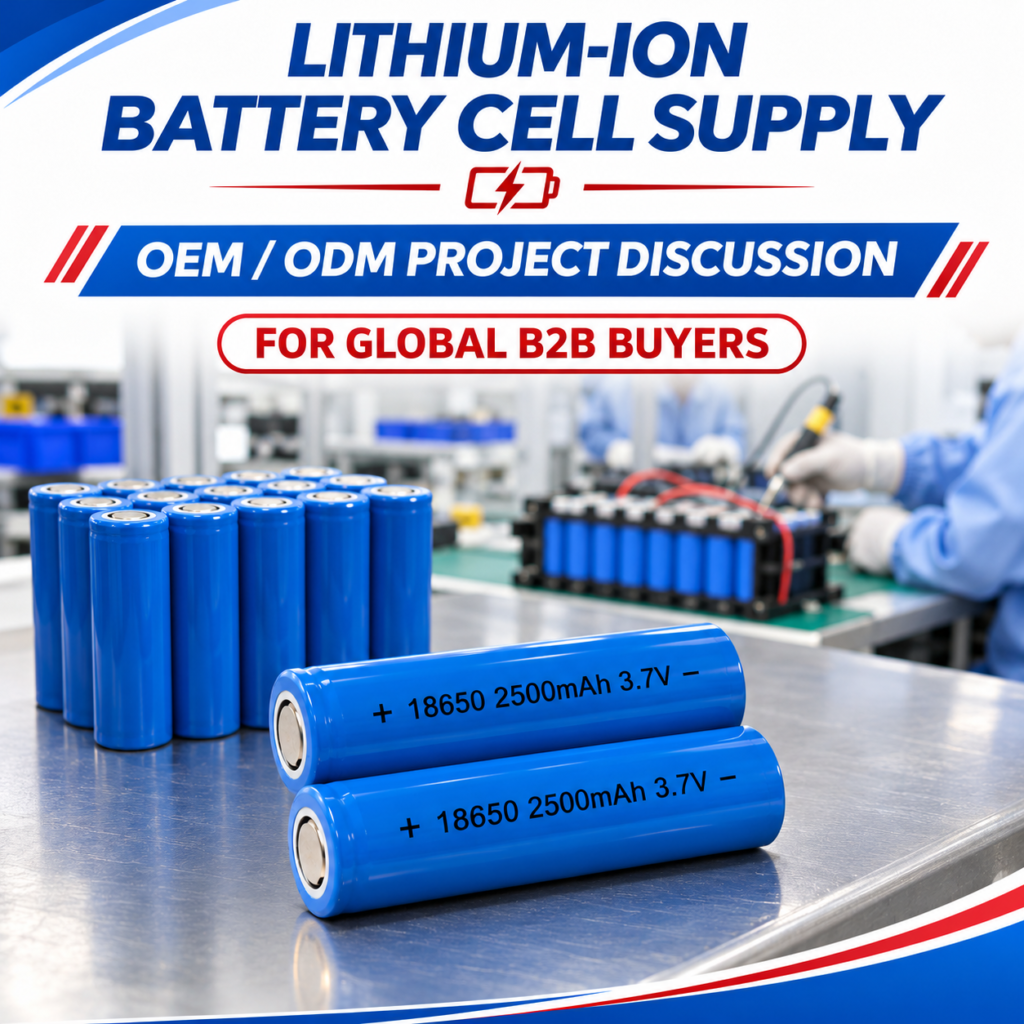
Different applications require different battery configurations. Battery pack manufacturers and equipment producers may need customized voltage, capacity, dimensions, connectors, protection systems and enclosure designs.
When discussing OEM or ODM requirements, buyers should prepare the following information:
- Target application and equipment type
- Required battery pack voltage
- Required capacity or energy
- Maximum charging and discharging current
- Available installation space
- Operating temperature requirements
- Expected order quantity
- Prototype or sample requirements
- Target delivery country
Providing these details helps suppliers evaluate whether the selected 18650 cell is suitable for the proposed battery pack.
7. Why Choose the Right 18650 Battery Cell Supplier?
A reliable battery supply partner should provide clear technical communication and consistent product information.
For B2B buyers, important evaluation points include:
- Clear and accurate product specifications
- Technical documentation for product evaluation
- Communication about application requirements
- Support for OEM and ODM discussions
- Sample evaluation before bulk purchasing
- Transparent order and delivery arrangements
- Quality control information
A supplier should not only offer a competitive quotation but also help buyers confirm whether the cell matches their product design and project requirements.
8. Frequently Asked Questions
Q1: What is the nominal voltage of this 18650 battery?
The confirmed nominal voltage is 3.7V.
Q2: What is the capacity?
The confirmed capacity is 2500mAh.
Q3: Is this battery rechargeable?
Yes. It is a rechargeable lithium-ion battery cell.
Q4: What is its nominal energy?
The calculated nominal energy is 9.25Wh, based on 3.7V × 2.5Ah.
Q5: Can this cell be used in a custom battery pack?
It may be considered for compatible battery pack designs. The electrical, mechanical and safety requirements must be verified before integration.
Q6: What is the maximum discharge current?
The maximum discharge current has not been confirmed in the available specifications. Please request the official datasheet.
Q7: What charging voltage should be used?
The charging voltage must be confirmed from the manufacturer’s technical documentation before use.
Q8: Can buyers request samples?
Sample availability and arrangements should be confirmed with the supplier.
Q9: Is OEM or ODM cooperation available?
OEM and ODM requirements can be discussed according to the project specifications, customization needs and order quantity.
Q10: What information is needed for a quotation?
Please provide the required quantity, application, battery configuration, project stage, destination country and sample requirements.
Conclusion
The 18650 2500mAh 3.7V rechargeable lithium-ion battery is a cylindrical cell option for compatible electronic products and customized battery pack projects.
For B2B buyers, the right purchasing decision should be based on verified electrical specifications, mechanical compatibility, application requirements and supplier evaluation—not capacity alone.
If you are sourcing 18650 battery cells for a new project or existing production line, prepare your technical requirements and contact a supplier to discuss samples, documentation and bulk supply options.