
Introducción
The demand for high-capacity rechargeable lithium-ion battery cells continues to grow across industrial equipment, portable electronics, y aplicaciones de paquetes de baterías personalizadas. Among the widely used cylindrical cell formats, el 18650 lithium-ion battery remains a popular choice for manufacturers looking for a balance between energy capacity, compact dimensions, and flexible battery pack design.
A 18650 lithium-ion battery cell with a typical capacity of 3500mAh and a nominal voltage of 3.6V offers a practical solution for applications that require reliable rechargeable power and efficient space utilization.
Para fabricantes de baterías, distribuidores, and industrial buyers, understanding the cell’s electrical characteristics, rendimiento de temperatura, and integration requirements is essential when selecting a suitable battery solution.
1. ¿Qué es un 18650 3500mAh Lithium-Ion Battery Cell?
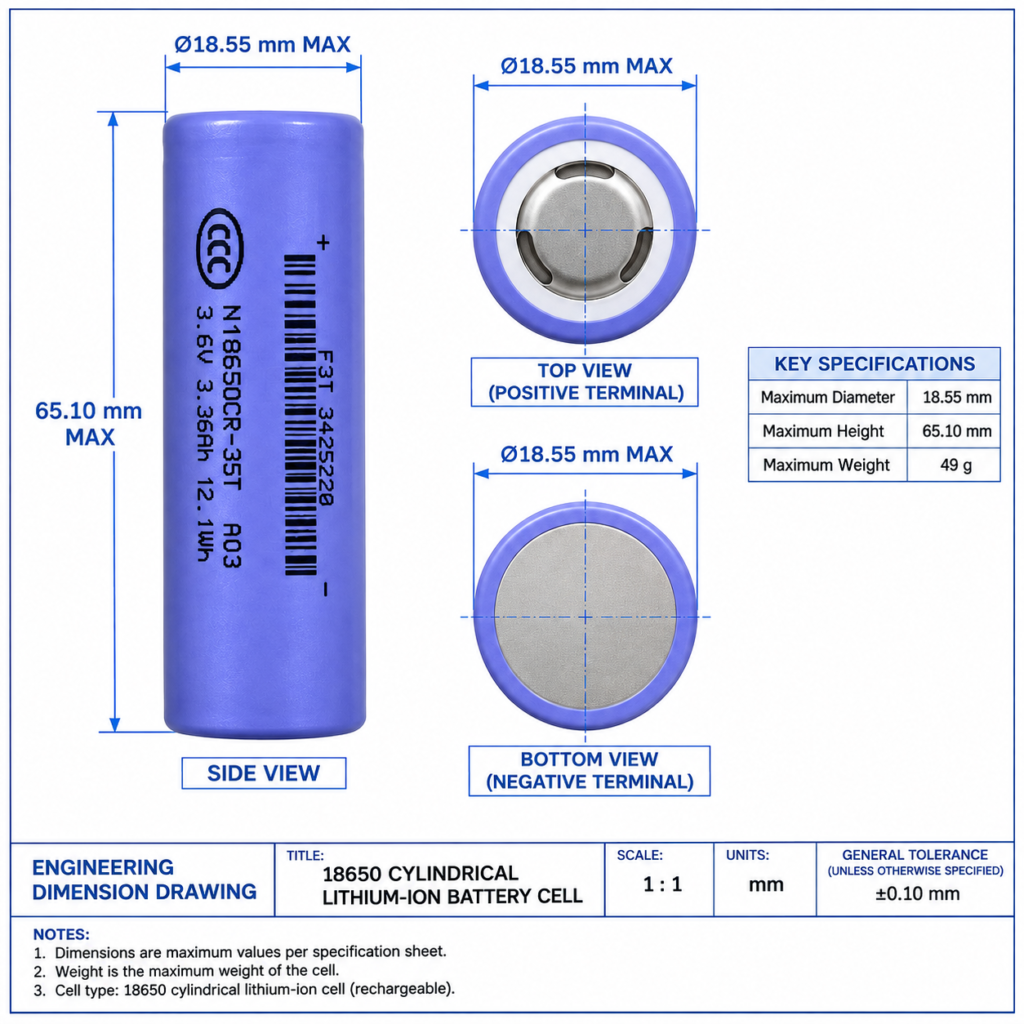
A 18650 battery is a cylindrical rechargeable lithium-ion cell with a standard nominal diameter of approximately 18mm and a length of approximately 65mm.
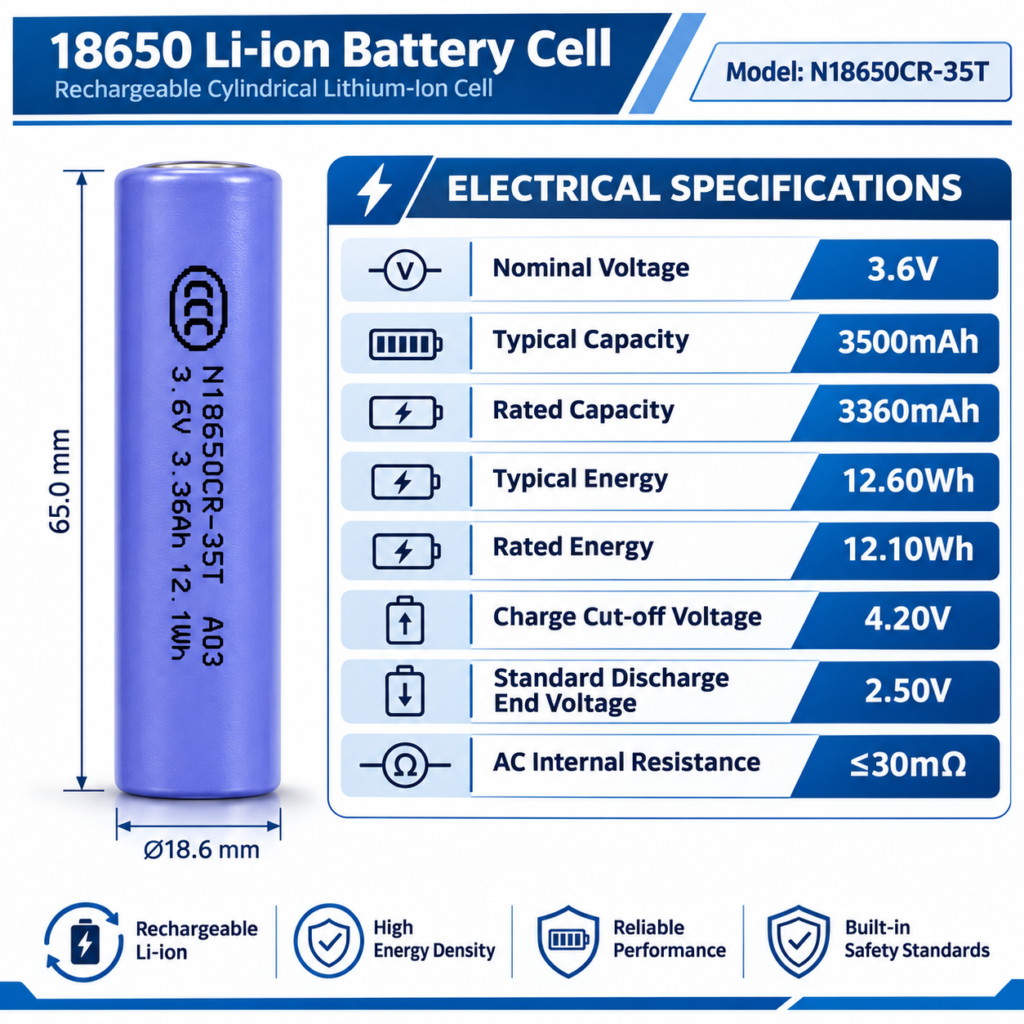
The 3500mAh version provides a typical capacity of 3500mAh, while its rated capacity is 3360mAh. Its nominal voltage is 3.6V, with a typical energy of 12.60Wh.
These characteristics make it suitable for battery pack designs where capacity, tamaño compacto, and integration flexibility are important.
Las especificaciones clave incluyen:
- Formato de celda: 18650
- Química de la batería: Iones de litio
- Capacidad típica: 3500mAh
- Capacidad nominal: 3360mAh
- Tensión nominal: 3.6V
- Energía típica: 12.60¿Qué?
- Diámetro máximo: 18.55milímetros
- Altura máxima: 65.10milímetros
- Maximum Weight: 49gramo
The distinction between typical capacity and rated capacity is important for battery pack calculations, product design, and procurement specifications.
2. Key Advantages of a High-Capacity 18650 Batería
High Capacity in a Compact Cylindrical Format
With a typical capacity of 3500mAh, this cell provides substantial energy capacity within a compact cylindrical structure.
Its standardized format allows battery designers to arrange multiple cells in series and parallel configurations according to the voltage and capacity requirements of their applications.
Amplio rango de temperatura de descarga
Temperature performance is an important consideration for battery systems operating in different environmental conditions.
This 18650 lithium-ion cell supports a discharge temperature range from -40°C to 60°C.
Its tested discharge capacity retention at different temperatures is as follows:
| Temperatura de descarga | Retención de capacidad |
|---|---|
| 60°C | ≥95% |
| 45°C | ≥95% |
| 10°C | ≥88% |
| 0°C | ≥85% |
| -10°C | ≥75% |
| -20°C | ≥70% |
| -40°C | ≥65% |
These figures are relative to the reference discharge capacity at 25°C under the specified test conditions.
This temperature characteristic can be useful when developing battery packs for equipment exposed to cold or changing environmental conditions.
It is important to note that the specified low-temperature range applies to discharging. The charging temperature range is 0°C to 45°C.
High-Rate Discharge Performance
For applications requiring higher output current, discharge-rate performance should be evaluated carefully.
The cell’s specified discharge capacity performance is:
- 0.5do: ≥96%
- 1do: ≥93%
- 2do: ≥90%
- 3do: ≥88%
These values are measured relative to the 0.2C reference capacity under specified test conditions.
The maximum specified discharge current is 10080mA at 25°C. Actual operating current should be determined based on battery pack design, gestión térmica, y requisitos de aplicación.
3. Technical Specifications and Electrical Characteristics
Understanding the electrical specifications of a lithium-ion cell helps battery manufacturers select appropriate components and develop reliable battery systems.
The main technical parameters are summarized below.
| Parámetro | Especificación |
|---|---|
| Tensión nominal | 3.6V |
| Capacidad típica | 3500mAh |
| Capacidad nominal | 3360mAh |
| Energía típica | 12.60¿Qué? |
| Voltaje de carga | 4.20V |
| Voltaje de corte de descarga estándar | 2.50V |
| Corriente de carga estándar | 1680mamá |
| Corriente de carga máxima | 3360mamá |
| Standard Discharging Current | 672mamá |
| Maximum Discharging Current | 10080mamá |
| Impedancia interna de CA | ≤30mΩ |
| Temperatura de carga | 0°C a 45°C |
| Temperatura de descarga | -40°C a 60°C |
The standard charging method is CC-CV (Constant Current–Constant Voltage), with a charging voltage of 4.20V.
Para fabricantes de baterías, the charging profile, circuito de protección, and thermal design must be matched to the cell specifications.
4. Applications of 18650 Lithium-Ion Battery Cells
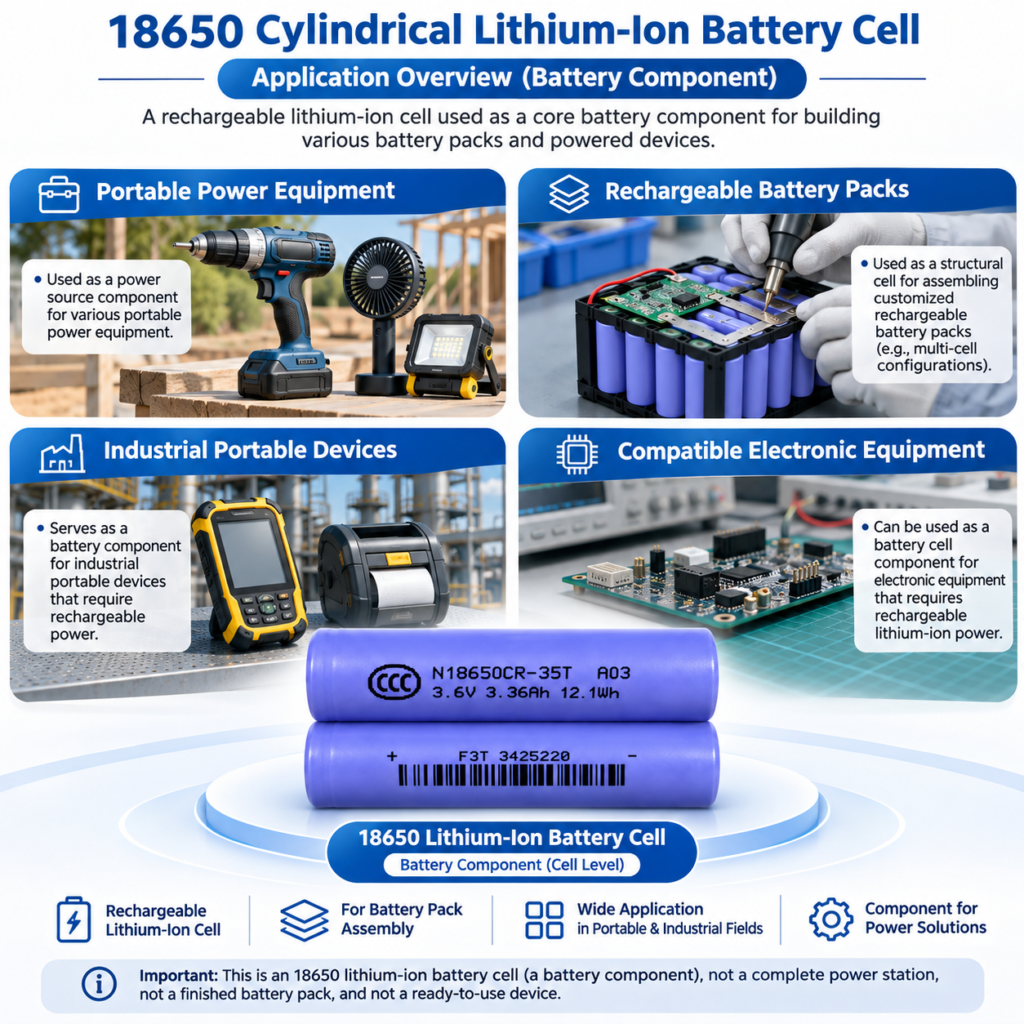
El 18650 cylindrical cell format is widely used in rechargeable battery pack development.
Potential application areas include:
Equipos industriales
Battery pack manufacturers can integrate cylindrical lithium-ion cells into portable industrial equipment and other rechargeable power systems, subject to application-specific electrical and safety requirements.
Dispositivos electrónicos portátiles
The compact cylindrical format is suitable for selected portable electronic products that require rechargeable battery power.
Customized Battery Packs
Multiple cells can be connected in series and parallel to achieve the required voltage and capacity.
This flexibility makes 18650 cells useful for OEM and ODM battery pack development.
Specialized Equipment
For equipment exposed to different operating temperatures, cell-level temperature performance can be an important factor in the battery selection process.
Final suitability should always be verified through system-level testing.
5. What Should Buyers Consider When Purchasing 18650 Celdas de batería?
Selecting a suitable lithium-ion cell involves more than comparing capacity and price.
Professional buyers should evaluate several technical and commercial factors.
1. Capacity and Energy
Confirm whether the supplier specifies typical capacity, rated capacity, or minimum guaranteed capacity. These values should not be treated as interchangeable.
2. Corriente de descarga
Check the standard and maximum discharge current, together with the corresponding temperature and testing conditions.
3. Temperature Performance
If the battery pack will operate in cold environments, review the cell’s low-temperature discharge performance and charging limitations.
4. Dimensiones y peso
Verify the maximum diameter, height, and weight to ensure compatibility with the intended battery pack structure.
5. Battery Management and Protection
A complete battery pack requires appropriate protection design, incluyendo sobrecarga, sobredescarga, sobrecorriente, and temperature protection where applicable.
6. Supplier Documentation
Request the latest technical datasheet, applicable safety documents, información del lote, and supporting test records before placing a bulk order.
7. Sample Evaluation
Para proyectos OEM y ODM, sample testing is recommended before mass production. Evaluate capacity, internal impedance, temperature behavior, and performance under the intended operating conditions.
6. Why Work with a Professional Battery Cell Supplier?
For battery manufacturers and industrial buyers, a reliable supply partner can help improve procurement efficiency and reduce technical uncertainty.
When evaluating a battery cell supplier, consider:
- Consistency of technical specifications
- Product documentation and traceability
- Procedimientos de inspección de calidad.
- Sample availability
- Bulk supply capability
- Technical communication and application support
- OEM and ODM cooperation requirements
A professional supplier should be able to provide clear product specifications and discuss whether the cell is suitable for the buyer’s intended battery pack design.
7. Preguntas frecuentes
Q1: What is the typical capacity of this 18650 celda de batería?
The typical capacity is 3500mAh, while the rated capacity is 3360mAh under the specified test conditions.
Q2: What is the nominal voltage?
The nominal voltage is 3.6V.
Q3: What is the typical energy?
The typical energy is 12.60Wh.
Q4: Can this cell discharge at -40°C?
The specified discharge temperature range is -40°C to 60°C. At -40°C, the tested discharge capacity retention is at least 65% relative to the 25°C reference capacity.
Q5: Can the cell be charged at -40°C?
No. The specified charging temperature range is 0°C to 45°C.
Q6: What is the maximum discharge current?
The maximum specified discharge current is 10080mA at 25°C under the specified conditions. Actual application current should be determined through battery pack engineering and testing.
Q7: What is the standard charging voltage?
The standard charging voltage is 4.20V using the specified CC-CV charging method.
Q8: Can multiple cells be connected together?
Sí. Multiple cells can be integrated into series and parallel configurations by qualified battery pack manufacturers, with appropriate electrical matching and protection design.
Conclusión
A 18650 3500mAh lithium-ion rechargeable battery cell offers a combination of high capacity, compact cylindrical dimensions, and a wide discharge temperature range.
With a nominal voltage of 3.6V and typical energy of 12.60Wh, it can be considered for various customized battery pack and industrial power applications.
Para fabricantes de baterías profesionales, importadores, and distributors, evaluating the complete technical specifications and application requirements is essential before selecting a cell for mass production.
Looking for a 18650 3500mAh lithium-ion battery cell supplier?
Contact EH to discuss your battery cell requirements, technical specifications, sample evaluation, and bulk purchasing plans.
Request a Quote | Contact EH for B2B Cooperation