
21700 5500Celda de batería de iones de litio de mAh: Especificaciones clave y aplicaciones del paquete de baterías
As demand for high-capacity rechargeable batteries continues to grow, 21700 cylindrical lithium-ion cells are becoming an important option for professional battery pack manufacturers and energy solution providers.
For companies developing lithium-ion battery packs, selecting the right cell involves more than comparing capacity. Voltaje, capacidad de descarga, internal impedance, dimensiones, operating temperature and battery management requirements all influence the final system performance.
A 21700 lithium-ion cell with a minimum standard discharge capacity of 5500mAh and a nominal voltage of 3.636V offers a high-capacity specification for compatible battery pack engineering projects.
En este artículo, we explore its key technical specifications, performance characteristics, design considerations and potential applications.
1. ¿Qué es un 21700 Lithium-Ion Battery Cell?
A 21700 battery cell is a cylindrical rechargeable lithium-ion cell with a nominal form factor of approximately 21mm in diameter and 70mm in height.
Compared with smaller cylindrical formats, el 21700 design provides more internal volume for active materials, making it suitable for battery designs that require a combination of capacity and compact cylindrical packaging.
Para fabricantes de baterías, 21700 cells can be arranged in series and parallel configurations to achieve the required voltage and capacity.
The final configuration depends on the electrical requirements, available installation space, thermal design and battery management system.
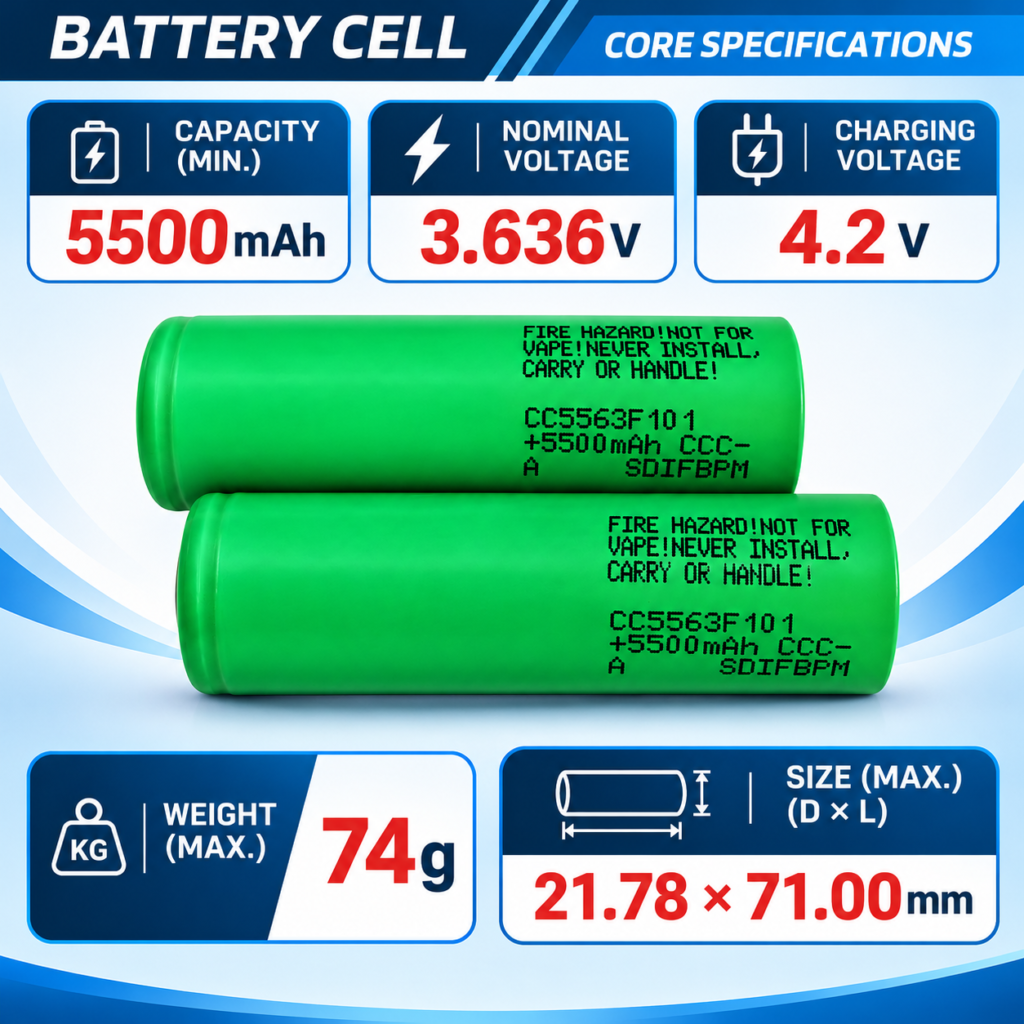
2. Key Specifications of a 21700 5500mAh Battery Cell
Understanding the technical parameters is essential when evaluating a lithium-ion cell for a new battery project.
The following specifications provide a reference for battery pack engineering.
| Technical Parameter | Especificación |
|---|---|
| Formato de celda | 21700 Cilíndrico |
| Química de la batería | Iones de litio |
| Tensión nominal | 3.636V |
| Capacidad de descarga estándar | mín.. 5500mAh |
| Voltaje de carga | 4.2V |
| Método de carga | CC-CV |
| Corriente de carga estándar | 0.2do |
| Corriente de carga máxima | 1do |
| Maximum Continuous Discharge Rate | 2do |
| Maximum Non-continuous Discharge Rate | 3do |
| Voltaje de corte de descarga | 2.50V |
| Initial AC Impedance | máx.. 15mΩ |
| Peso máximo de celda | 74gramo |
| Diámetro máximo | 21.78milímetros |
| Altura máxima | 71.00milímetros |
| Temperatura de carga | 0°C a 45°C |
| Temperatura de descarga | -20°C a 60°C |
These values should be evaluated under their specified test conditions. Actual battery pack performance depends on the complete system design and operating environment.
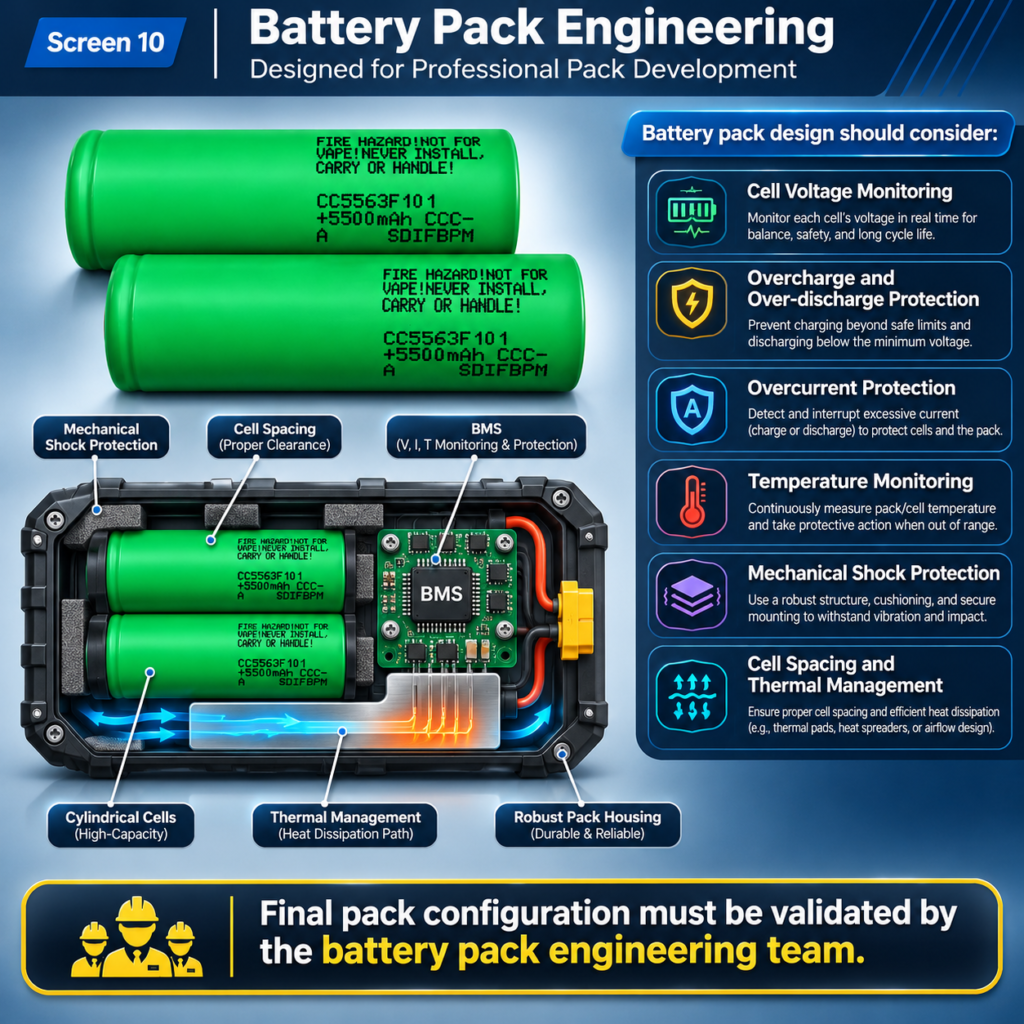
3. High Capacity for Battery Pack Development
Capacity is one of the most important factors when selecting lithium-ion cells.
With a minimum standard discharge capacity of 5500mAh, a 21700 cell can provide a high-capacity option for compatible battery pack configurations.
Por ejemplo, connecting cells in parallel increases the overall capacity, while connecting cells in series increases the pack voltage.
Sin embargo, the final configuration must be determined by qualified battery engineers according to the required voltage, capacidad, actual, protection strategy and thermal characteristics.
Choosing a suitable cell configuration helps manufacturers develop battery packs that meet their specific project requirements.
4. Understanding Continuous and Non-continuous Discharge
Discharge capability is another important parameter for battery pack applications.
The cell specification defines:
- Maximum continuous discharge rate: 2do
- Maximum non-continuous discharge rate: 3do
These two values should not be confused.
Continuous discharge refers to current that can be maintained under the specified operating conditions. Non-continuous discharge refers to a higher current capability that is not intended to be maintained continuously.
For a battery pack project, engineers should evaluate the actual operating current, peak current duration, temperature rise and protection settings.
A suitable BMS and thermal management design are essential for safe and reliable battery operation.
5. Charging Method and Operating Temperature
The cell uses a constant-current and constant-voltage charging method, commonly known as CC-CV.
During the charging process, the charger first supplies a controlled constant current. When the cell reaches the specified charging voltage, the charger maintains constant voltage while the charging current gradually decreases.
The specified charging voltage is 4.2V.
The operating temperature ranges are:
- Cargando: 0°C a 45°C
- Descarga: -20°C a 60°C
Battery pack designers must consider temperature monitoring, charging control and over-temperature protection when developing the complete system.
Using an appropriate charger and battery management system helps ensure that the cell operates within its specified limits.
6. Why Internal Impedance Matters
Internal impedance influences voltage drop and heat generation when a battery cell delivers current.
The initial AC impedance of this cell is specified at a maximum of 15mΩ under the test conditions described in the specification.
When evaluating cells for battery pack production, manufacturers should consider:
- Initial impedance consistency
- Consistencia del voltaje de la celda
- Consistencia de capacidad
- Temperature rise under load
- Batch-to-batch quality control
For multi-cell battery packs, cell matching and consistent assembly processes are important parts of overall system design.
7. Potential Applications of 21700 Lithium-Ion Cells
El 21700 cylindrical format can be evaluated for a range of battery pack projects, depending on the electrical requirements and approved end-use applications.
Potential areas for technical evaluation include:
Portable Energy Storage
Portable energy storage products require appropriate cell configurations, charging systems and protection circuits. Battery pack engineers must evaluate the required capacity, output power and operating conditions.
Electric Mobility Battery Packs
Electric mobility battery projects require careful consideration of continuous current, peak current, vibration resistance, thermal management and battery protection.
Cell suitability must be confirmed against the specific vehicle and pack requirements.
Industrial Battery Systems
Industrial battery systems may require customized voltage, capacity and discharge configurations. The cell can be evaluated as part of a professionally engineered battery pack.
Robotics and Automated Equipment
Battery-powered robotics and automated equipment require suitable battery capacity, stable output and reliable protection systems. Engineers should verify operating current, duty cycle and thermal requirements before selecting a cell.
8. Important Considerations Before Selecting a 21700 Celúla
Before purchasing lithium-ion cells for a battery pack project, professional buyers should evaluate several factors.
1. Compatibilidad eléctrica
Confirm that the nominal voltage, voltaje de carga, discharge current and capacity match the intended battery system.
2. Mechanical Compatibility
Verifique las dimensiones de la celda, holder design, insulation and available installation space.
3. Thermal Management
Evaluate heat generation, cell spacing, cooling conditions and temperature monitoring.
4. Sistema de gestión de batería
The BMS should provide appropriate overcharge, sobredescarga, overcurrent and temperature protection.
5. Cell Consistency
For mass production, assess capacity matching, consistencia del voltaje, impedance consistency and incoming inspection procedures.
6. Supplier Documentation
Request the applicable formal product specification, traceability information, transport documentation and any relevant test reports or certifications.
9. Working with a Professional Battery Pack Supplier
Selecting the right battery cell is only one part of developing a reliable battery solution.
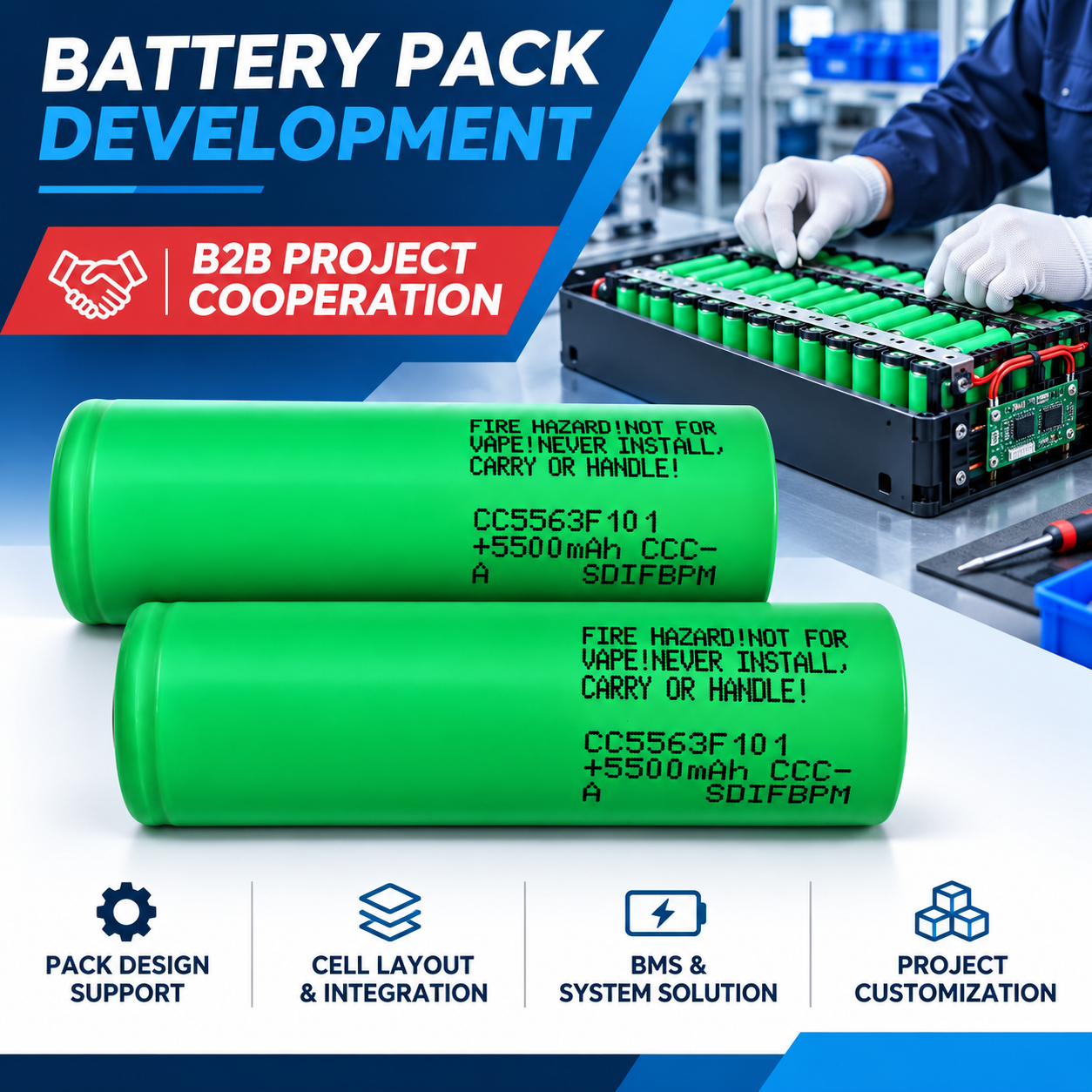
Battery pack manufacturers and system integrators also need to consider cell configuration, conexiones electricas, selección de BMS, diseño de recinto, thermal management and application-specific testing.
YIFANG focuses on lithium battery cells, battery packs and energy storage solutions, supporting B2B customers with product evaluation, technical communication and battery pack OEM/ODM project discussions.
When evaluating a battery cell for your project, providing detailed requirements helps suppliers understand your application and assess technical compatibility.
10. Request a Battery Cell or Battery Pack Quotation
Are you sourcing 21700 lithium-ion cells for a battery pack manufacturing project?
Contact YIFANG and share the following information:
- Aplicación prevista
- Required battery cell quantity
- Target battery pack voltage
- Required battery capacity
- Continuous and peak discharge current
- Battery pack dimensions
- Project development stage
- País de destino
- OEM/ODM requirements
Our team can discuss your project requirements and help evaluate suitable battery solutions.
YIFANG – Your Partner for Lithium Battery Cells and Battery Pack Solutions.