
A lithium-ion rechargeable cell does not lose capacity simply because it has been used a certain number of times. Its aging is closely related to how it is charged, discharged, stored, and operated. In a real battery pack, 温度, 現在の需要, セルマッチング, and system design also play a part.
This is why cycle life should not be treated as a single number on a datasheet. 電池設計者向け, the more useful question is whether a cell can maintain stable performance under the conditions of the finished product.
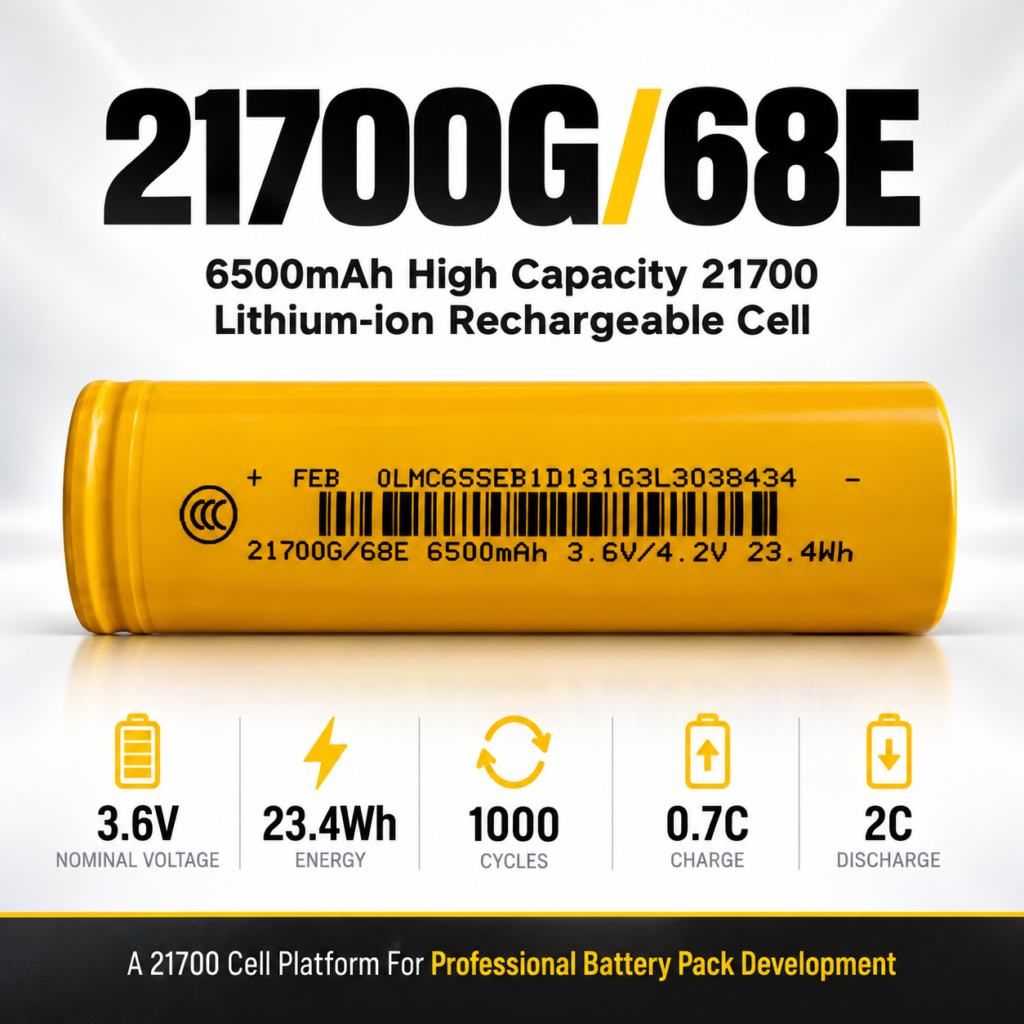
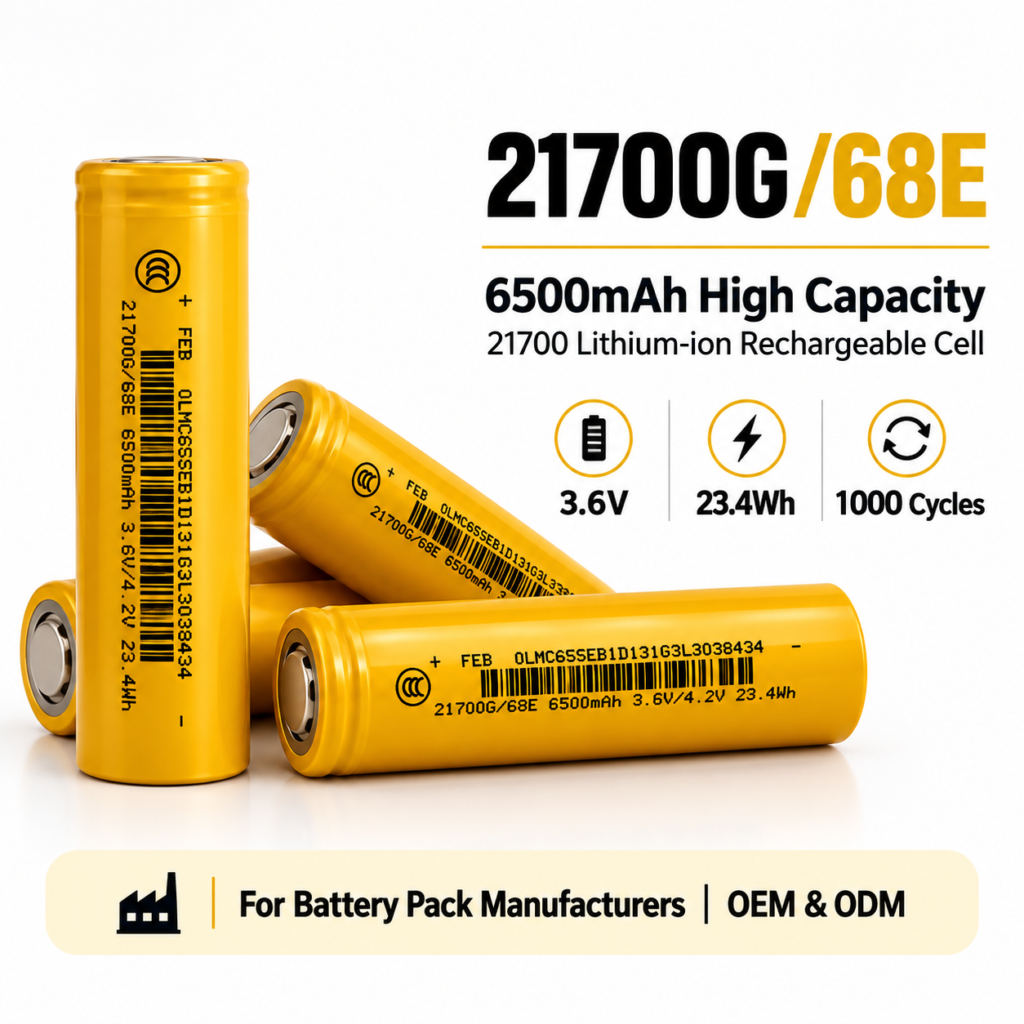
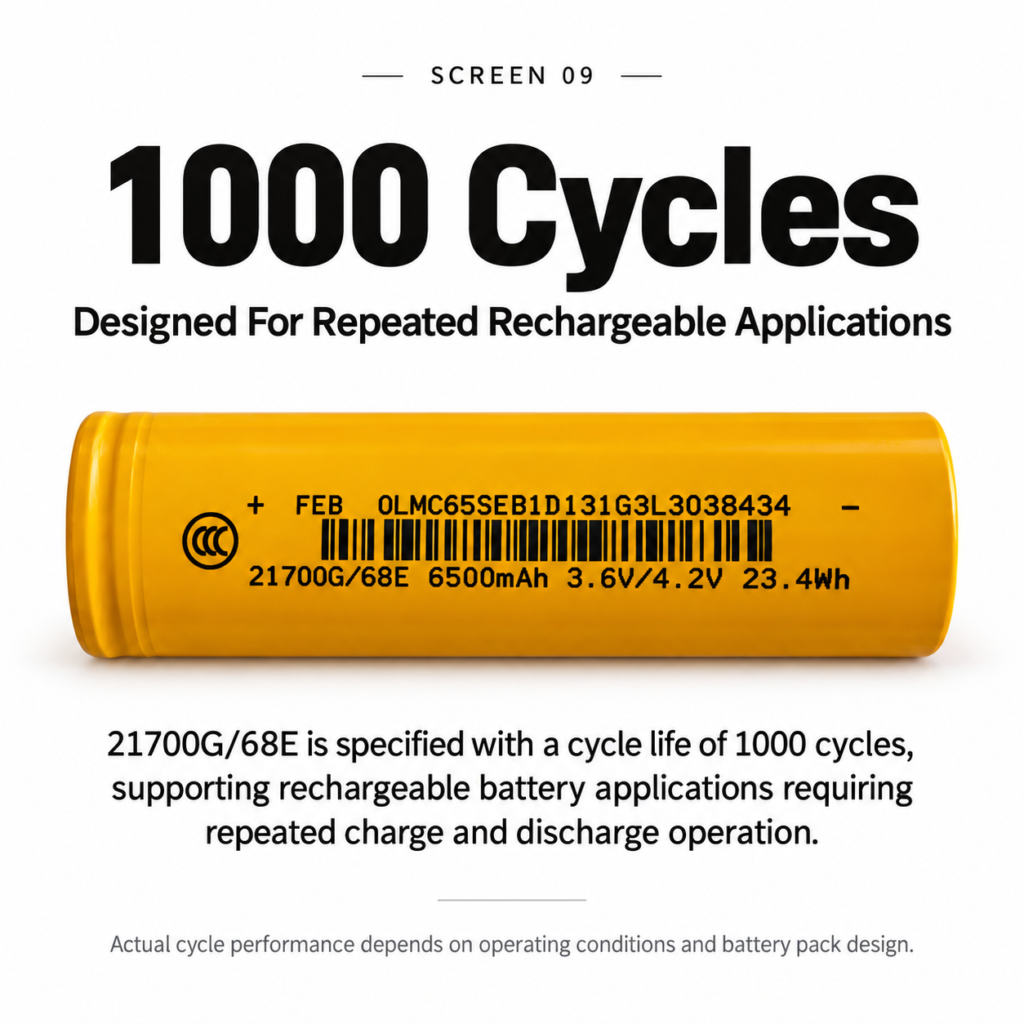
Yifang’s 21700G/68E is a 6500mAh high-capacity リチウムイオン二次電池 developed in a compact 21700 円筒形. It has a 3.6V nominal voltage, a rated 0.7C charge rate, and a 2C discharge rate. Its rated cycle life is 1000 サイクル, providing a reference point for applications that require repeated charging and discharging.
Cycle Life Is More Than a Number
When manufacturers specify cycle life, they test the cell under defined conditions. These conditions normally include charging and discharge rates, 温度, 放電の深さ, and a capacity-retention limit.
The result gives buyers a useful basis for comparison. It does not mean that every cell will reach exactly the same number of cycles in every application.
Consider two battery packs using the same cell. One may operate in a moderate environment with regular partial charging. The other may face high temperatures, heavy loads, and frequent deep discharge. Their aging patterns can be very different. このため, designers should always read the cycle-life figure together with the test conditions behind it.
Charging Has a Direct Impact on Cell Aging
Charging is one of the most important operating conditions.
The 21700G/68E supports a 0.7C charge rate. Staying within the specified charging conditions helps the cell operate within its intended range.
Charging at a higher rate can increase heat generation and place additional stress on the cell. The effect becomes more significant when fast charging occurs repeatedly or when the battery cannot remove heat effectively.
The charging system also matters. A suitable battery management system should control charging according to the requirements of the cell and the complete pack.
For product developers, the goal is not simply to charge the battery as quickly as possible. A practical charging profile should balance charging time, 熱条件, user requirements, and long-term battery performance.
Discharge Current Matters Too
The same principle applies when the battery delivers power.
The 21700G/68E has a rated 2C discharge rate, giving designers a reference for applications with repeated energy demands. Actual battery behavior, しかし, depends on the load profile.
A device that draws a moderate current for several hours puts a different demand on the cell than equipment that repeatedly requires high current for short periods.
High current can increase heat and electrical stress. If this happens frequently, it may contribute to faster capacity loss. Battery designers should therefore look at the complete load profile. Peak current, 平均電流, 放電期間, and frequency all matter when assessing a cell for a particular application.
Temperature Can Change the Aging Process
Heat is one of the common concerns in lithium-ion battery design.
As cell temperature rises, chemical reactions inside the cell can accelerate. Long periods of operation at elevated temperatures may therefore increase degradation.
Low temperatures create a different set of challenges. They can reduce available performance and affect charging behavior. Charging a lithium-ion cell under unsuitable low-temperature conditions can also create additional risks.
Temperature is not always uniform inside a battery pack. Cells positioned near heat sources may operate differently from cells located in cooler areas. This makes thermal design important. Airflow, cell spacing, enclosure design, and the position of heat-generating components can all influence the operating environment.
Deep Discharge Can Increase Battery Stress
A battery does not need to use all of its available capacity during every cycle.
Depth of discharge (DoD) describes how much of the battery’s available capacity is used before recharging. Repeated deep discharge can place more stress on a cell than a shallower operating range.
This does not mean that every application should use a shallow discharge. The required operating range depends on the product. Portable power equipment may need more available energy, while a backup system may follow a very different operating pattern. The important point is to match the working range with the actual application instead of assuming that the rated capacity should always be fully used.
Cell Matching Becomes Important in Multi-Cell Packs
One cell may perform well on its own. Once dozens of cells work together, consistency becomes much more important.
バッテリーパックは多くの場合、必要な電圧と容量を達成するためにセルを直列および並列に接続します。. 個々のセル間の違いにより、充電と放電の動作が不均一になる可能性があります.
容量, 内部抵抗, 電圧特性, 老化速度は細胞ごとに異なる場合があります. これらの違いが顕著になると, 一部の細胞は他の細胞よりも大きなストレスを受ける可能性があります.
優れたセルマッチングと適切なパック管理により、よりバランスの取れた動作を維持できます。. これは、多数のセルを含み、多くの充電と放電サイクルで動作するバッテリー システムにとって特に重要です。.
バッテリーパックの設計が結果に影響する可能性がある
セルはバッテリーの一部にすぎません.
完成したパックにはバッテリー管理システムも含まれています, 電気接続, 保護コンポーネント, 囲い, 熱構造, そして充電システム. 各部分は細胞の動作に影響を与える可能性があります.
例えば, poor thermal design can create hot spots. Uneven current distribution can place additional stress on certain cells. An unsuitable protection strategy can also affect the operating range of the pack. This is why a cell’s rated cycle life should not be viewed as a guaranteed figure for the finished battery pack. The final result depends on how the complete system uses the cell.
Capacity and Weight Still Need to Be Balanced
For many battery products, designers need more energy without making the pack unnecessarily large or heavy.
The 21700G/68E provides 6500mAh capacity while weighing 75g. Its dimensions are 70.95 ×21.65mm, giving it the standard cylindrical format associated with 21700 細胞.
These specifications give designers a starting point for evaluating cell quantity and pack layout. A higher-capacity cell may reduce the number of cells needed for a particular pack capacity, but the final design still depends on voltage, current requirements, 利用可能なスペース, 熱管理, and electrical configuration.
言い換えると, capacity should be considered as part of the overall pack design rather than as an isolated advantage.
Different Applications Create Different Cycling Conditions
There is no single operating profile for rechargeable batteries.
Portable power equipment may see frequent daily cycling. Energy storage systems can follow longer charge and discharge periods. E-mobility applications may place higher demands on current delivery and thermal management. Robotics systems often need a balance between weight, 容量, and repeated operation. Backup power equipment may spend long periods in standby and operate only when power is needed. These differences matter when evaluating cycle life. A cell suitable for one application may require a different pack configuration or operating strategy in another.
Testing Gives a More Useful Picture
Datasheet specifications provide an important starting point, but commercial battery projects often require additional testing.
Sample testing allows designers to evaluate the cell under conditions that are closer to the finished product. This may include the expected charge rate, discharge profile, 動作温度, 放電の深さ, and pack configuration.
Testing can also reveal differences between individual cells and help engineers refine the battery management strategy.
OEM およびカスタマイズされたバッテリー プロジェクト向け, this stage is particularly useful. It gives the development team an opportunity to identify potential issues before moving into larger-scale production.
Yifang 21700G/68E for High-Capacity Battery Designs
Yifang’s 21700G/68E combines a 6500mAh capacity with a 3.6V nominal voltage in a 21700 円筒セル. The cell supports a rated 0.7C charge rate and 2C discharge rate, with a rated cycle life of 1000 サイクル.
Its size and capacity make it suitable for battery designers who need to balance available space, 細胞数, パック容量, そして総重量. The cell can be evaluated for portable power equipment, エネルギー貯蔵システム, e-モビリティバッテリーパック, ロボット工学, バックアップ電源装置, およびその他のカスタマイズされたリチウムイオン電池ソリューション. 商業プロジェクトの場合, designers can test samples before integrating the cells into series-parallel battery pack configurations. This allows the cell’s performance to be assessed against the actual requirements of the finished product.
What Should Battery Designers Look at Beyond Cycle Life?
Cycle life is important, but it should not be the only selection criterion.
Before choosing a lithium-ion rechargeable cell, designers should look at capacity, nominal voltage, charge and discharge rates, 寸法, 重さ, 動作条件, and compatibility with the intended battery architecture.
The expected duty cycle also deserves attention. How often will the battery charge? How deeply will it discharge? What current will the equipment draw? What temperatures will the battery experience? Answering these questions gives a much clearer picture of whether a cell fits the application than comparing cycle-life figures alone.
最終的な考慮事項
The cycle life of a lithium-ion rechargeable cell depends on the conditions under which the cell operates. Charging rate, 放電電流, 温度, 放電の深さ, cell consistency, and battery pack design can all influence long-term performance.
Yifang’s 21700G/68E offers 6500mAh capacity, 3.6V 公称電圧, a 21700 円筒形, and a rated cycle life of 1000 サイクル. These specifications give battery designers a practical starting point for evaluating high-capacity rechargeable battery solutions.
For a commercial battery project, the most meaningful evaluation comes from testing the cell under the conditions of the final application. That approach helps engineers move beyond the datasheet and understand how the cell is likely to perform inside the finished battery system.