
Introdução
Reliable battery performance is essential for electronic equipment operating in cold environments. From outdoor monitoring systems to industrial instruments and remote sensing devices, low temperatures can create challenges for battery-powered equipment. Selecting a cell designed for low-temperature discharge can help engineers develop power solutions for these demanding conditions.
O FEB 18650-35EA low-temperature lithium-ion battery cell is designed for applications that require dependable discharge performance in cold environments. With a nominal capacity of 3500mAh, a nominal voltage of 3.6V and a specified discharge temperature range extending down to -40°C, it offers a compact cylindrical cell option for battery pack manufacturers and OEM equipment developers.
This article explores the cell’s main characteristics, potential applications, integration considerations and important factors B2B buyers should evaluate before selecting a low-temperature battery cell.
1. What Is the FEB 18650-35EA Low-Temperature Battery Cell?
The FEB 18650-35EA is a rechargeable cylindrical lithium-ion battery cell designed for applications where low-temperature discharge capability is an important requirement.
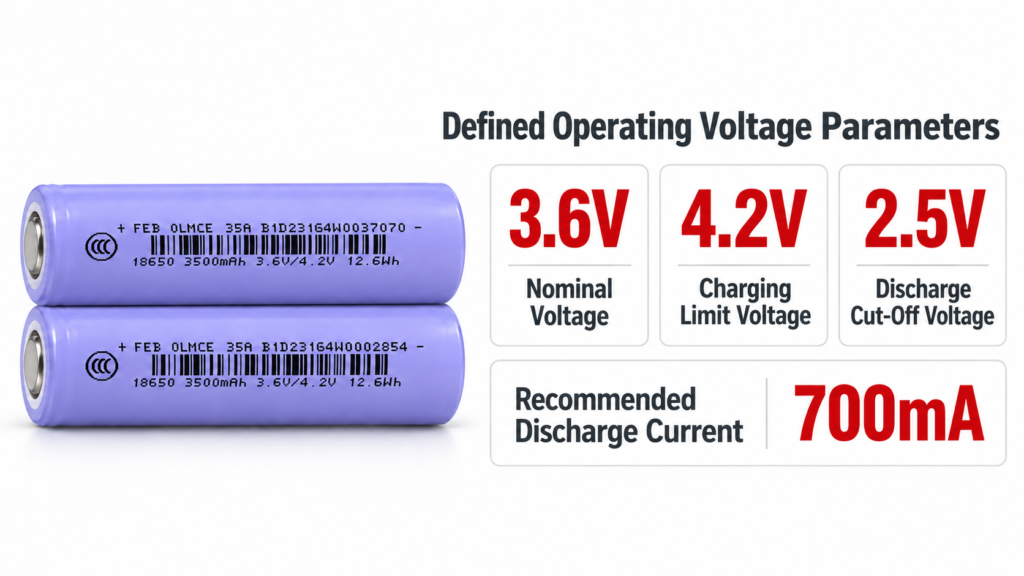
Its 18650 format provides a compact cylindrical structure that can be considered for integration into appropriately designed battery packs. The cell’s nominal capacity is 3500mAh, corresponding to approximately 12.6Wh of nominal energy at 3.6V.
As principais especificações incluem:
- Nominal capacity: 3500mAh
- Nominal voltage: 3.6V
- Nominal energy: 12.6O que
- Cell format: Cilíndrico 18650
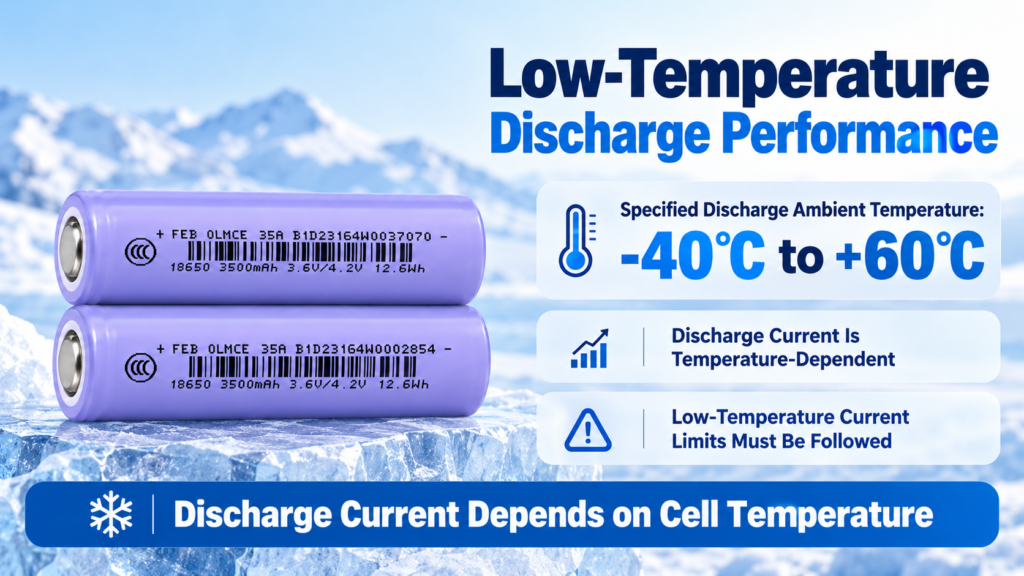
- Specified discharge temperature range: -40°C a +60°C
- Charging temperature range: -10°C to +45°C
- Corrente máxima de descarga contínua: Up to 7A under specified temperature conditions
These characteristics make the cell worth evaluating for equipment that must operate in cold climates or experience substantial temperature variation.
The actual performance of a finished battery pack will also depend on its electrical configuration, protection circuitry, projeto térmico, operating current and application conditions.
2. Why Low-Temperature Battery Performance Matters
Low temperatures can affect the electrochemical behavior of lithium-ion cells. Depending on the cell design and operating conditions, cold environments may reduce available capacity and power output, increase internal resistance and affect charging performance.
For equipment designers, these effects can influence operating time, startup behavior and overall system reliability.
A battery cell specified for low-temperature discharge provides an option for applications where ordinary operating conditions cannot be assumed.
The FEB 18650-35EA has a specified discharge temperature range beginning at -40°C. This makes it relevant for engineering evaluations involving cold-weather equipment, provided the required load profile and performance targets are validated.
It is important to distinguish between low-temperature discharge and low-temperature charging. The cell’s specified charging temperature range is -10°C to +45°C. Its ability to discharge at very low temperatures does not mean it can be charged at -40°C.
Battery pack designers should therefore consider charging controls, temperature monitoring and the operating conditions of the complete system.
3. Key Features of the FEB 18650-35EA
3500mAh Capacity in a Compact Cell Format
With a nominal capacity of 3500mAh and nominal energy of 12.6Wh, the FEB 18650-35EA provides a compact cell option for battery-powered devices.
Para projetos OEM, capacity is only one part of battery selection. Engineers should also evaluate the application’s continuous and peak current requirements, tempo de execução esperado, operating temperature and available installation space.
Low-Temperature Discharge Capability
The cell’s specified discharge temperature range extends from -40°C to +60°C.
This characteristic may be useful when designing power systems for outdoor installations, remote locations and equipment exposed to cold weather. The actual available capacity and output under low-temperature conditions should be validated against the detailed specification and the intended application.
Standard Cylindrical Design
O 18650 format is widely used as a cylindrical cell format in rechargeable battery applications. Its form factor can simplify mechanical planning for suitably designed multi-cell assemblies.
No entanto, the final battery pack must be engineered around the cell’s electrical and thermal characteristics. O 18650 format alone does not guarantee compatibility with a particular battery holder, enclosure or electronic device.
Defined Electrical Operating Limits
The cell has a nominal voltage of 3.6V, a charging cut-off voltage of 4.2V and a discharge cut-off voltage of 2.5V.
These values help battery pack designers establish the electrical limits of the system. The charger, battery management system and connected equipment must be designed to operate within the specified limits.
Suitable for OEM Battery Pack Evaluation
The FEB 18650-35EA can be evaluated for custom battery pack projects where low-temperature discharge is a priority.
Before production, manufacturers should verify cell compatibility, pack configuration, demanda atual, temperature exposure, protection strategy and the applicable safety and transport requirements.
4. Potential Applications of Low-Temperature 18650 Células
The FEB 18650-35EA may be considered for several types of battery-powered equipment, subject to application-specific testing and design validation.
Outdoor Monitoring Equipment
Outdoor monitoring devices may be installed in locations where temperatures drop significantly during winter. Battery selection is particularly important when equipment must operate without frequent maintenance visits.
Examples include environmental sensors, remote data loggers and monitoring devices used in exposed locations.
Industrial Instruments
Certain industrial instruments operate in unheated facilities, outdoor installations or environments with wide temperature fluctuations. A low-temperature cell may provide a useful component option when developing a suitable power system for such equipment.
Remote Sensing Devices
Remote sensing equipment may be deployed in locations where access to grid power is limited. Engineers must consider both the expected energy consumption and the environmental conditions the equipment will experience.
The FEB 18650-35EA can be assessed for these projects where its capacity, current rating and temperature characteristics match the system requirements.
Cold-Weather Electronic Equipment
Battery-powered electronic products designed for cold climates may require cells with specified low-temperature discharge capability. Potential suitability depends on the device’s power demand, runtime target, enclosure design and temperature profile.
Baterias personalizadas
Battery pack manufacturers may evaluate the cell for custom configurations serving specialized industrial or outdoor applications.
The final configuration should be selected only after confirming series and parallel arrangements, required output voltage, current capability, battery management, thermal behavior and system-level safety requirements.
5. Technical Specifications at a Glance
The following specifications provide an initial reference for product evaluation.
| Parâmetro | Especificação |
|---|---|
| Product model | FEB 18650-35EA |
| Cell type | Rechargeable lithium-ion |
| Cell format | Cilíndrico 18650 |
| Nominal capacity | 3500mAh |
| Nominal voltage | 3.6V |
| Nominal energy | 12.6O que |
| Charging cut-off voltage | 4.2V |
| Tensão de corte de descarga | 2.5V |
| Corrente máxima de descarga contínua | Up to 7A under specified temperature conditions |
| Charging temperature | -10°C to +45°C |
| Discharging temperature | -40°C a +60°C |
| Dimensões | Approximately 18.35mm diameter × 65.05mm height |
| Peso | ≤48g |
| Ciclo de vida | 800 ciclos sob condições de teste especificadas, with at least 70% capacity retention |
Actual results depend on the test conditions and the application profile. Buyers should refer to the official product specification for the complete test methods, operating limits and handling instructions.
6. What Should B2B Buyers Consider Before Purchasing?
Choosing a low-temperature battery cell requires more than comparing nominal capacity and voltage. Buyers should evaluate the complete application and confirm that the cell meets the project’s technical requirements.
Temperatura operacional
Identify the minimum and maximum temperatures the equipment will experience during operation, armazenar, charging and transportation.
The specified discharge temperature range should not be interpreted as an unrestricted charging or storage range.
Continuous and Peak Current
Confirm the device’s continuous load, startup current and peak current. A cell’s maximum continuous discharge rating must be assessed under its specified temperature conditions and within the limits of the final battery pack.
Required Runtime
Estimate the energy required by the application and account for system efficiency, low-temperature performance, aging and the reserve capacity needed for reliable operation.
Nominal cell energy alone does not determine the runtime of the complete device.
Battery Pack Configuration
Determine the required output voltage and energy capacity before selecting the number of cells and their series-parallel configuration. The pack must include suitable electrical connections, protection and thermal design.
Charging Strategy
Because the charging temperature range differs from the discharge temperature range, the finished system should include an appropriate charging strategy. Charging should remain within the cell’s specified limits.
Validation and Compliance
Before volume production, request the current technical documentation and verify the testing, certification and transport documentation applicable to the intended market and end product.
For critical equipment, application-level validation is particularly important. A cell’s stated operating range does not replace testing of the complete battery pack and powered device.
7. Why Work with a Battery Cell Supplier for OEM Projects?
For battery pack manufacturers and equipment developers, supplier evaluation is part of the engineering process.
A suitable supplier should be able to provide the technical documentation needed to assess the cell, clarify operating limits and support communication during battery pack development.
For projects involving the FEB 18650-35EA, B2B buyers should prepare the following information when requesting a quotation or technical evaluation:
- Intended application and installation environment
- Required operating temperature range
- Target capacity and output voltage of the finished battery pack
- Continuous and peak current requirements
- Estimated annual demand or initial order quantity
- Battery pack design status and project timeline
- Required documentation and target sales market
Providing these details helps both parties evaluate whether the cell is appropriate for the project and identify any additional validation requirements before production.
8. Perguntas frequentes
What is the nominal capacity of the FEB 18650-35EA?
The cell has a nominal capacity of 3500mAh, a nominal voltage of 3.6V and nominal energy of 12.6Wh.
Can the FEB 18650-35EA discharge at -40°C?
The specified discharge temperature range is -40°C to +60°C. Available capacity and output at a particular temperature depend on the load profile and test conditions, so application testing is recommended.
Can the cell be charged at -40°C?
Não. The specified charging temperature range is -10°C to +45°C. Low-temperature discharge capability should not be confused with low-temperature charging capability.
What is the maximum continuous discharge current?
The maximum continuous discharge current is up to 7A under the specified temperature conditions. Buyers should confirm the detailed conditions in the official specification before designing the battery pack.
Is the FEB 18650-35EA a complete battery pack?
Não. It is an individual cylindrical battery cell. A finished battery pack requires suitable electrical connections, protection circuitry and a design matched to the intended application.
What applications may use this cell?
Potential applications include outdoor monitoring equipment, industrial instruments, remote sensing devices, cold-weather electronics and custom battery packs. Final suitability depends on the system’s electrical, thermal and safety requirements.
What information should buyers provide for a quotation?
Buyers should provide the intended application, required quantity, temperature range, demanda atual, target battery pack configuration, project stage and documentation requirements.
Conclusão
The FEB 18650-35EA is a 3500mAh, 3.6V cylindrical lithium-ion battery cell designed for applications that require low-temperature discharge capability. Its specified discharge range down to -40°C makes it a candidate for evaluation in outdoor monitoring equipment, industrial instruments, remote sensing systems and custom OEM battery packs.
Para compradores B2B, the best approach is to assess the cell against the actual application rather than relying on nominal capacity alone. Temperature-dependent performance, demanda atual, charging limits, battery pack configuration and system-level validation should all be considered before production.
If you are developing a battery-powered product for cold-weather operation, review the FEB 18650-35EA technical specifications and discuss your project requirements with the supplier to determine whether it is suitable for your design.